



Written by Ambre Montespan on Aug 31, 2026 · Updated on Oct 15, 2026

Table of contents:
Have you heard that the handpan can fit into a yoga class or a relaxation session? Are you wondering whether you can play this percussion instrument to influence your chakras? Does this sound object have a place in the world of zen?
As someone who has played the handpan for more than 10 years, I’ve performed at the end of classes for yoga teachers and compared most of the meditation scales available on the market. I’ve also read, one by one, all the theories that connect each musical note to an energy center in the human body. That means I can answer the questions you may have on this topic.
The handpan absolutely has a place in a yoga class, especially during relaxation, when a 9- or 10-note model in D Kurd is enough. The connection between its notes and the seven major chakras of the human body is highlighted by its followers, but it has not been validated by science.
As you read this full article, you’ll discover:
- The exact role of the handpan during a yoga class
- The right way to play during guided relaxation
- The origin of the “zen” label on this instrument
- The relationship between notes and chakras
Once you’ve finished reading, you’ll be able to choose the scale and number of notes for your handpan that best suit your practice. You’ll also be able to play effectively during yoga and relaxation sessions to get the most benefit from them.
Let’s look right away at the role this sound object can play in a yoga studio, in chakra balancing, and in the world of zen!
What is the role of the handpan in a yoga session?
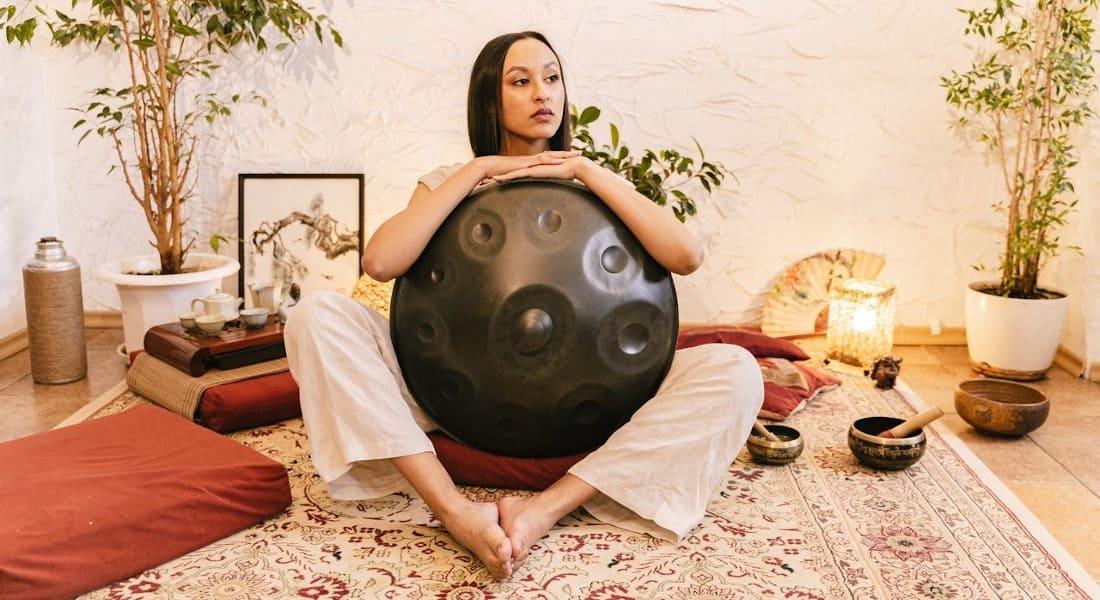
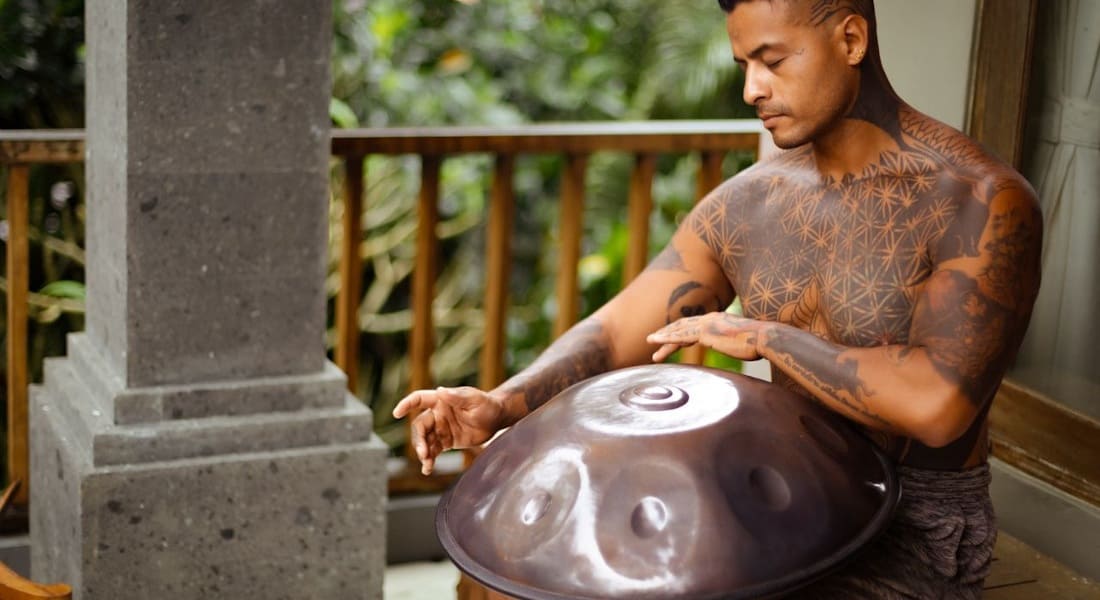
In a typical yoga class, the most delicate moment comes during the transition from movement to final relaxation. Usually, after about 45 minutes of postures, everyone has to lie down and do nothing, which isn’t always easy. The handpan fills this role perfectly, because a few sustained notes played more and more slowly help guide a gentle descent into calm. In this way, the instrument creates a smoother connection between a period of activity and a return to stillness.
In fact, what this musical instrument adds can be summed up in one word: volume. A recorded track has a tempo and volume set in advance, while a musician sitting in the room can follow what is happening. That musician can then adapt ideally to the situation. So a few discreet notes are enough during pranayama, meaning the breathing exercises, then the playing becomes more present during relaxation, and silence returns as soon as the teacher starts speaking again. As a result, the music never covers the teacher’s voice.
In the Indian tradition, there is a discipline devoted to sound, Nada Yoga, described in the Nada Bindu Upanishad, an ancient text connected to Hinduism. It separates the struck sound of a musical instrument from the inner sound, which remains the true goal of the practice. The handpan belongs to the first category, and it has no historical roots in this discipline, which takes nothing away from what it can bring to your sessions.
Therefore, the role of the handpan is to accompany a yoga session without any traditional link to that discipline, which is completely logical for an instrument invented in the early 2000s. To get an idea of what’s possible, watch the video below. It is a guided savasana in French, meaning the relaxation that closes a yoga class:
How do you play the hang drum during a relaxation or yoga session?
After trying many methods, I’m going to share the one I find simplest and most effective in a yoga or relaxation setting. The general idea is to play two note sequences, which makes learning easy and takes about ten minutes to master. You start with the first sequence, which consists of striking the ding, the central low note, then notes 1, 4, and 6, which you play 4 times in a row. Next, you move on to the second sequence, which starts with the ding again, then notes 2, 4, and 6, again 4 times in a row. Once you’ve played each sequence 4 times, you’ve completed one “round,” and you can start another. On a new round, you can either repeat the same notes, which is generally recommended, or change no more than one note per sequence. I still recommend keeping the ding note.
The idea is still to play several similar rounds and not change sequences on every round, which, in my experience, is not pleasant for practitioners. From the beginning, your hands play alternately, and you need to keep your execution steady so you don’t surprise anyone and everything stays fluid. Volume can also change from one round to the next. For example, you can lower the volume gradually as you approach the end by reducing the intensity of your strikes at the end of each round. I’ve noticed that this works particularly well.
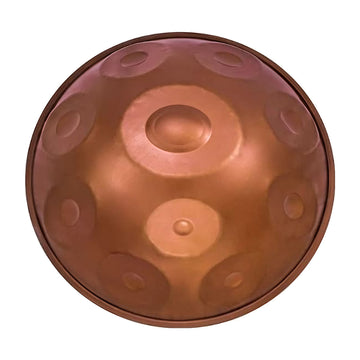
This technique works on just about every handpan, but I’ve noticed that it works especially well on a model tuned in D Kurd. Amara and Pygmy models are also interesting. In any case, it is better to stay with a minor scale for your handpan if you want to focus on wellness practices such as yoga or relaxation. I explain this in more detail in my article on handpan scales.
As for tempo, it is set according to the musical instrument’s sustain, meaning how long the note resonates after the strike, but also according to the acoustics of the place you are in. Long resonance requires slower playing. That is why the material used to make the handpan matters enormously, since a stainless steel instrument holds the note much longer than the same instrument made of nitrided steel. To compare the three steels on the market, read my guide to handpan materials.
Of course, the technique I’ve presented is a foundation. You can explore other directions with different note combinations, and you can also play two notes at the same time instead of just one. As you can see, these techniques use only a few notes at once, so a 9- or 10-note handpan is more than enough. I’m telling you this in case you were wondering what the ideal number of notes for your handpan is for yoga.
Where does the “zen” label on this musical instrument come from?
Originally, the term zen referred to a school of Japanese Buddhism. It is centered on seated meditation. In the West, the word has become a synonym for calm that no longer has much to do with that practice. The instrument linked to Japanese Zen is the shakuhachi, a bamboo flute, one of Japan’s traditional instruments, played by monks whose motto says it all: “become Buddha in a single sound.” There is indeed a handpan scale called Akebono that evokes Japan, but it is a name given by the community and not at all an origin that would suggest a link with Zen.
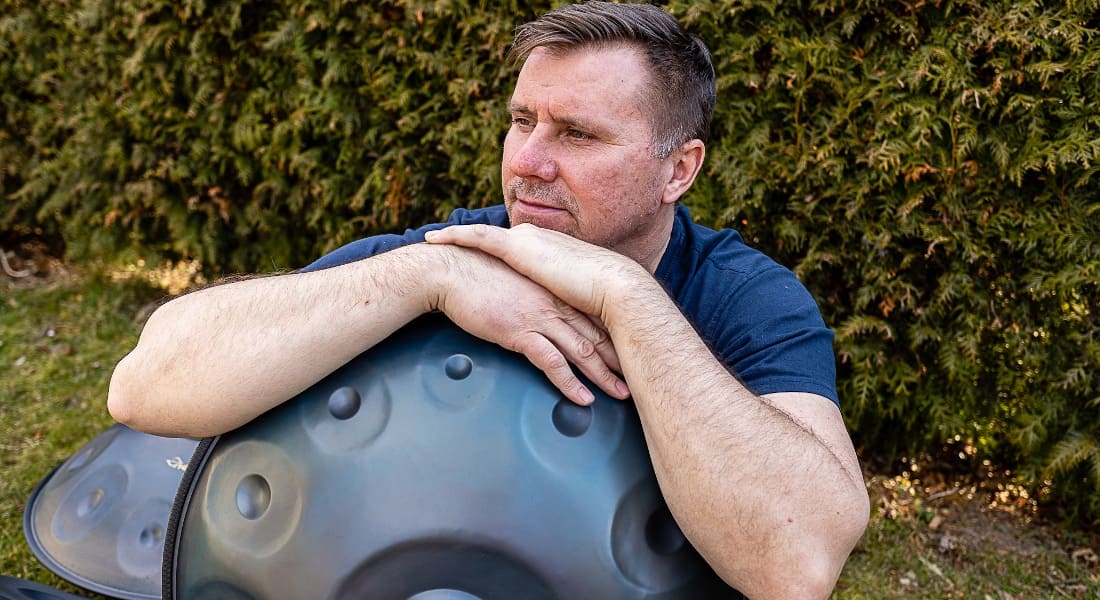
It is not unusual to read that the handpan has African, Middle Eastern, or Asian origins, even though it has a recent birth date. In November 1999, percussionist Reto Weber went to PANArt in Bern, Switzerland, to have his steelpan retuned and suggested making a steel musical instrument played with the hands. The first Hang came out in January 2000, created by Felix Rohner and Sabina Schärer. To trace the full lineage, read my article on the origins of the handpan. As a result, the handpan is far removed from original Zen, because it comes from Switzerland.
In reality, if the handpan is described as zen, it is simply because it is used in a relaxation context, in meditation, and more broadly in wellness thanks to its soft, airy sounds. It truly has no connection to the Japanese school of Buddhism. The word zen is better understood as a Western distortion used to describe something related to calm and fullness.
Is there a handpan tuned to the chakras?
This question is hard to answer, because depending on the sources you consult, you can find very contradictory information. You should know that several theories circulate to link sounds to chakras. The most widespread one in the West pairs the seven musical notes with the seven chakras according to the C scale, as follows: C for the root, D for the sacral, E for the solar plexus, F for the heart, G for the throat, A for the third eye, and B for the crown. But there is also the so-called sacred solfeggio, which gives a series of frequencies developed in the 1970s by Dr. Joseph Puleo using an old formula from the mathematician Pythagoras and the Book of Numbers, the fourth book of the Bible.
But that is not all. There are still other correspondences, such as the one from Hans Cousto, a Swiss mathematician and musicologist, who developed a system called the cosmic octave, based on the principle of transposing the periodic processes of nature and the cosmos into audible frequencies. Finally, there is also a color-based approach and another said to come from Himalayan traditions. You only have to compare all these theories to see that none of them agree with one another. Take a look at the frequencies I compiled in this table:
| Chakra | Root | Sacral | Plexus | Heart | Throat | 3rd eye | Crown |
| C scale | C | D | E | F | G | A | B |
| Sacred solfeggio | 396 Hz | 417 Hz | 528 Hz | 639 Hz | 741 Hz | 852 Hz | 963 Hz |
| Cosmic octave | 194.18 Hz | 210.42 Hz | 126.22 Hz | 136.10 Hz | 141.27 Hz | 221.23 Hz | 172.06 Hz |
| By color | 432 Hz | 480 Hz | 528 Hz | 594 Hz | 672 Hz | 720 Hz | 768 Hz |
| Himalayan approach | F | C | G | D | A | E | B |
For the C scale and the Himalayan approach, there are no frequencies, because you should know that the same note exists at several frequencies in music. For example, a C in the 3rd octave is 261.5 hertz, while a C in the 4th octave is double that, or 523 hertz. Which octave should be taken into account for the chakras? Do all octaves work? No one answers these questions.
So what do the ancient texts of the Hindu tradition say in this case? Strictly nothing. It is worth noting that the chakra system itself is younger than it seems. In a 2016 book, Kurt Leland places its birth between 1880 and 1970. It was Christopher Hills who introduced the relationship between rainbow colors and the chakras in 1977. In addition, according to Indian guru Ravi Shankar, sounds and music affect the chakras not according to the musical note played or a frequency, but according to the instrument. According to him, percussion instruments, such as the handpan, would promote root chakra balancing, while flutes would be linked to the crown chakra. You can find his full explanation in the video below:
Another clue can also come from brands that sell handpans dedicated to each chakra. Take the example of the maker Handpan Soul, which sells six different models, each supposedly specific to the heart, sacral, throat, third eye, crown, and solar plexus chakras. They are all made up of 9 notes and all sold at the same price with the same tuning. Only the color of the instrument changes. So the chakra becomes an aesthetic finish, not a sonic one. In addition, the absence of the root chakra is not explained, which is strange. This case is far from the only one, because another German seller of handpan stands recommends choosing the color of the accessory according to the chakras, which, once again, has no connection with sound or music.
So should you give up on the idea? Certainly not. The existence of chakras has not been confirmed or disproven by scientific advances to this day. Personally, I am convinced that a correspondence whose defenders do not agree with one another is not necessarily false. If a given note makes you feel good, that feeling belongs to you and is enough to guide your choice.
What does science say about the handpan during a yoga or meditation session?
To date, no scientific research has measured the effect of the handpan itself in this context. It turns out that a 2017 study looked at singing bowls. However, it was an observation without a control group, which means it measured what participants felt, not what the instrument did.
On the other hand, what is solid concerns music in general. A review published by Cochrane in 2013 covering 26 trials and 2,051 participants shows that recorded music reduces anxiety before surgery by 5.72 points more than standard care. Another review, updated in 2022 and covering 13 trials and 1,007 participants, cautiously concludes that music “might” improve subjective sleep quality. It is just a shame that none of this research put a handpan in anyone’s hands.
In fact, what is documented is not tied to a frequency but to slow breathing. At around six breaths per minute, heart rate variability is at its highest, and playing at 60 beats per minute or less gives you a natural metronome that promotes this slow breathing. If you want to learn much more and even learn how to combine handpan and wellness, read my guide to relaxation and meditation with the handpan.
Treat yourself to a handpan designed to accompany your sessions
The handpan has many strengths in a yoga session, and the word zen, like chakra correspondences, makes much more sense once you know its history. The links between notes and energy centers remain a matter of personal sensitivity, and nothing requires you to take a side in order to enjoy them. Thanks to the information you’ve just read in this article, you now know what to play, when to play it, and what type of instrument to choose.
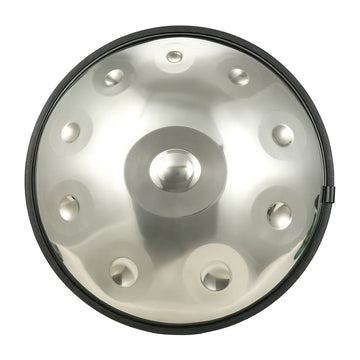
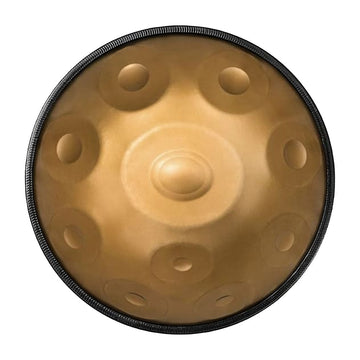
However, a stage handpan and a handpan intended for a yoga class do not require the same qualities, and it remains difficult to find a model designed for gentle practice, with long resonance and a scale that does not create tension. Where can you find such a model? I personally recommend the online store Instruments du Monde, which offers a wide selection of handpans, including several designed for this use. This 10-note model made for yoga, for example, has stainless steel construction and tuning that will give you wonderful moments of serenity.
Discover this magnificent handpan right now by clicking the image below:
As it happens, certain frequencies are sometimes said to promote calm and relaxation. But is that actually true, and does science back it up? Find out in my other article on the 369, 396, 417, 444, 528, 639, 777, 888, 999 and 1111 Hz frequencies and the handpan. You're bound to come across plenty of interesting facts.


