



Written by Ambre Montespan on May 29, 2023 · Updated on Oct 15, 2026

Table of contents:
Are you thinking about getting an ocarina in the coming days? Have you noticed that there are different types of this wind instrument, each with its own distinctive shape? Want to learn more about the world of the ocarina and satisfy your curiosity?
Having played beautiful melodies on this type of flute for over 10 years, I have had the opportunity to play many different types of ocarinas. As a result, I can provide you with a list of all the types of ocarinas available on the market.
While the most common type of ocarina is the 12-hole transverse ocarina, you’ll also encounter linear ocarinas, pendant-shaped ocarinas, globular flutes, finely carved ocarinas, and ocarinas with multiple chambers.
So, once you have read all the information in this article, you will have a clear overview of all the different types of ocarina, namely:
- Transverse ocarinas
- Linear ocarinas
- Pendant ocarinas
- Globular flutes
- Carved ocarinas
- Multi-chamber ocarinas
With that, you’ll have everything you need to choose your next musical instrument with confidence. And once you do, you’ll be able to truly enjoy your ocarina.
Let’s jump right in and explore all the different types of ocarinas out there.
The classic and popular transverse ocarina
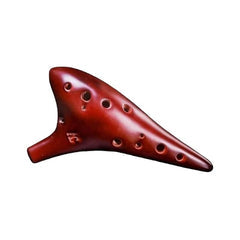
The first type of ocarina to discuss is the most commonly found, namely the transverse ocarina. This model, vaguely reminiscent of a goose’s head, is what inspired the instrument’s name in the 19th century. Indeed, ocarina literally means “little goose” in Italian. When the ocarina is mentioned, most people familiar with this instrument naturally picture this shape, where the mouthpiece sits at roughly a 90° angle on the underside of the chamber, about one-third of the instrument’s total length from the left side. The term “transverse,” as with a flute, comes from the fact that the player blows across the instrument at a perpendicular angle.
The first transverse ocarinas invented in Italy had 9 or 10 holes before being improved in 1928 by Japanese sculptor Takashi Aketagawa, who added 2 holes for a total of 12. Today, 12-hole transverse ocarinas are the most popular, and almost all models sold are of this type, although it is possible to find rare 11-hole models.
It’s worth noting that this type of ocarina can vary greatly in size. In fact, the transverse ocarina typically covers a range of just under an octave and a half. That’s why ocarinas are crafted in several pitch ranges—soprano, alto, tenor, and bass—so musicians can perform songs that require more notes. Soprano models are the smallest, while bass ocarinas are much larger. In all cases, it’s still a transverse ocarina, but it produces a higher or lower sound depending on its size.
The rare linear ocarinas
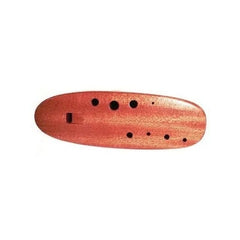
Linear ocarinas are identical to transverse ocarinas in every way, except that their mouthpiece is aligned with the airflow, just like a recorder or a simple whistle. The number of holes varies between 9 and 12, and this type of ocarina can be a good option for players with arthritis because the hands stay in a more natural position than with transverse ocarinas.
However, linear ocarinas have poorer acoustics than transverse ones. Furthermore, while the overall balance remains acceptable for small soprano instruments, this is not the case for bass or tenor models, where most of the weight is on the side opposite the mouthpiece, which can become uncomfortable over time. As a result, you’ll rarely find this type of ocarina on the market, as transverse ocarinas offer many advantages over linear ones.
Pendant-shaped instruments
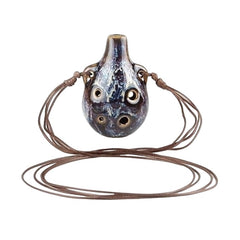
As the name suggests, pendant ocarinas are designed to be worn around the neck, much like a piece of jewelry. Invented by musician and instrument maker John Taylor in the 1960s, this type of ocarina is generally very small and has between 4 and 6 holes for playing about ten notes. The mouthpiece usually faces the same direction as your breath, just like a linear ocarina, though manufacturers love to get creative, so you’ll also spot them in fun, unique shapes.
While this type of ocarina might look like costume jewelry, it is anything but—this tiny instrument produces very high notes that are impossible on a classic transverse ocarina. Its compact size lets you take it anywhere and play a few simple melodies anytime. Finally, its small dimensions mean the sound accuracy and acoustics won’t be on the same level as a transverse ocarina.
Globular flutes
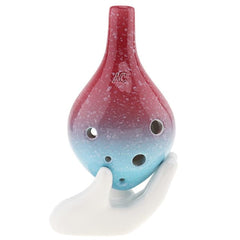
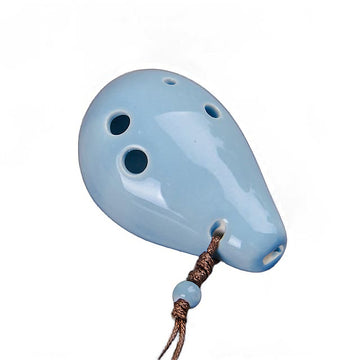
The globular flute is actually the ancient model that inspired Giuseppe Donati to create the transverse ocarina. This instrument was originally brought back from Mexico by the Spanish conquistador Hernán Cortés in the 16th century. It is not really an ocarina per se, although for practical reasons, the term ocarina is very often used to refer to this type of instrument.
The number of holes usually varies between 6 and 10. If you’re lucky enough to visit South America, particularly Peru, you’ll likely come across this type of ocarina, often sold to tourists. However, the sound quality is very poor, and I personally don’t recommend purchasing one—unless it’s simply as a souvenir (I explain where to buy a good ocarina in a dedicated guide). For a well-made instrument, you’ll want to buy from a specialist shop.
Charming carved ocarinas
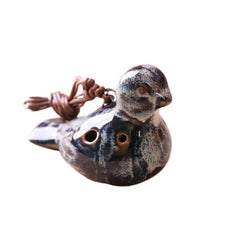
Carved ocarinas are simply instruments that the craftsman has chosen to give a particular shape, such as a bird in the photograph above. Although these ocarinas can play music and produce sounds perfectly well, it should be noted that in this case, form is often prioritized over ergonomics. The number of holes varies, and the mouthpiece can be positioned so that the carved ocarina is transverse or linear.
Because of the instrument’s shape, playing it can be more challenging, as the form often gets in the way of comfortable finger placement on the holes. In addition, the chamber will be more or less regular in shape, which doesn’t guarantee good acoustics. Furthermore, the price is usually higher than that of a classic transverse ocarina. Thus, the carved ocarina is better seen as a work of art than a true musical instrument, even if it can sometimes produce beautiful tones.
Complex multi-chamber ocarinas
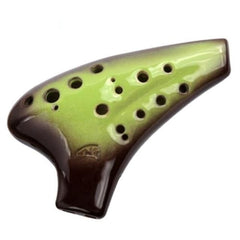
Multi-chamber ocarinas, as their name suggests, are composed of several chambers within the same instrument. When there are two chambers, it is called a double ocarina, a triple ocarina for three chambers, and so on. Theoretically, there’s no upper limit to the number of chambers an instrument can have, though size and weight increase progressively until the musician can no longer play it comfortably. As a result, triple-chamber ocarinas are scarce, and quadruple-chamber models are even rarer.
In a multi-chamber ocarina, each chamber is separate. To understand how it works, imagine that one or more small ocarinas are added to a classic transverse ocarina. This allows the musician to play additional notes that a transverse ocarina alone could not produce. Each chamber has its own mouthpiece. In the diagram below, which shows a double ocarina, the player can blow into the red mouthpiece to use the upper ocarina or into the blue mouthpiece to use the lower one.
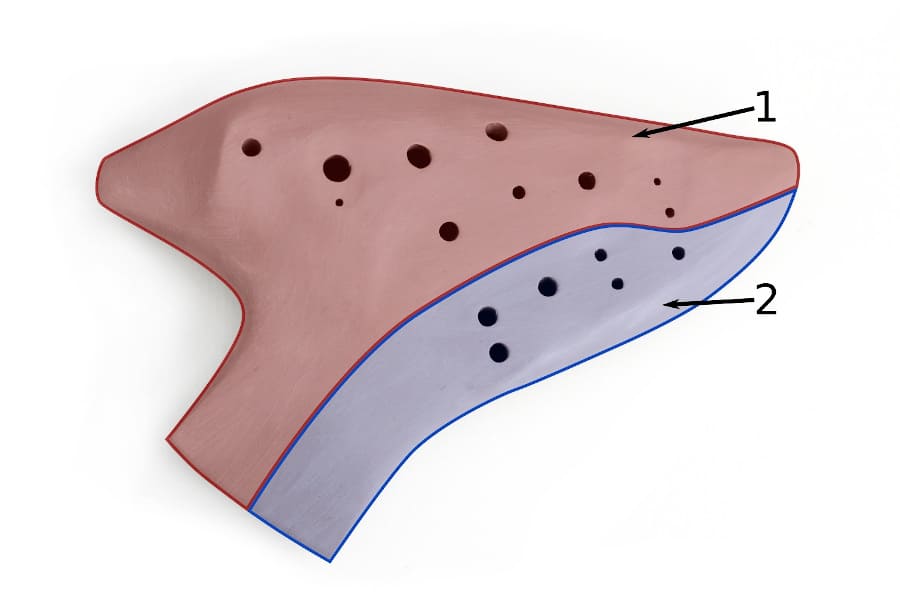
As you can see, this type of instrument is much more complex to master, because you actually have to play several ocarinas at the same time. That's why multi-chamber ocarinas are generally reserved for experienced players or seasoned musicians.
Choose the model you like
It’s not always easy to navigate the wide variety of ocarinas on the market, especially since some models are clearly intended for players who already have solid experience with the instrument. But thanks to the information you’ve learned in this article, you now know all the different types of ocarinas you might encounter. You also have a better sense of which model of this wind instrument might suit you best.
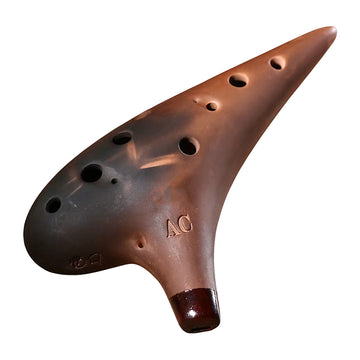
However, ocarinas are not easy to find in most guitar, violin, or piano shops. Most of the time, you’ll have no choice or only a very limited selection of this instrument. That’s why I recommend purchasing your future ocarina from the French store Instruments du Monde, which carries almost all of the types of ocarinas mentioned above. You’ll then be able to choose the one that suits you perfectly. As an example, here is a beautiful, high-quality transverse ocarina for beginners.
Begin your musical adventure with this ocarina by clicking on the image below:
Many musicians are considered experts in playing the ocarina. Discover a selection of the best artists who play this wind instrument and immerse yourself in the wonderful world of this type of flute.


