



Written by Ambre Montespan - Updated on Sep 25, 2026

Table of contents:
Would you like to give someone a sound massage using Tibetan singing bowls? Are you wondering where on the body you can place this Asian musical instrument? Are there any precautions to take when placing a singing bowl on the head, stomach, or back?
Having performed several hundred sound massages over the past 10 years, I’ve had the chance to build up a lot of hands-on experience. Here’s what I’ve learned so you, too, can safely place Tibetan singing bowls on other people’s bodies.
It’s absolutely possible to place a Tibetan bowl on someone’s stomach, head, or back to give a sound massage. However, you should be mindful of the bowl’s weight and how firmly you strike it.
Reading this short article in its entirety will help you understand:
- The benefits of placing a Tibetan bowl on someone’s body
- The best way to do it
- Whether there are any risks involved in placing singing bowls on different parts of a person’s body
As a result, you’ll be perfectly equipped to practice this relaxing technique on your loved ones or even clients if you’re a wellness professional.
Let’s now take a look at how to place Tibetan singing bowls on a person’s body.
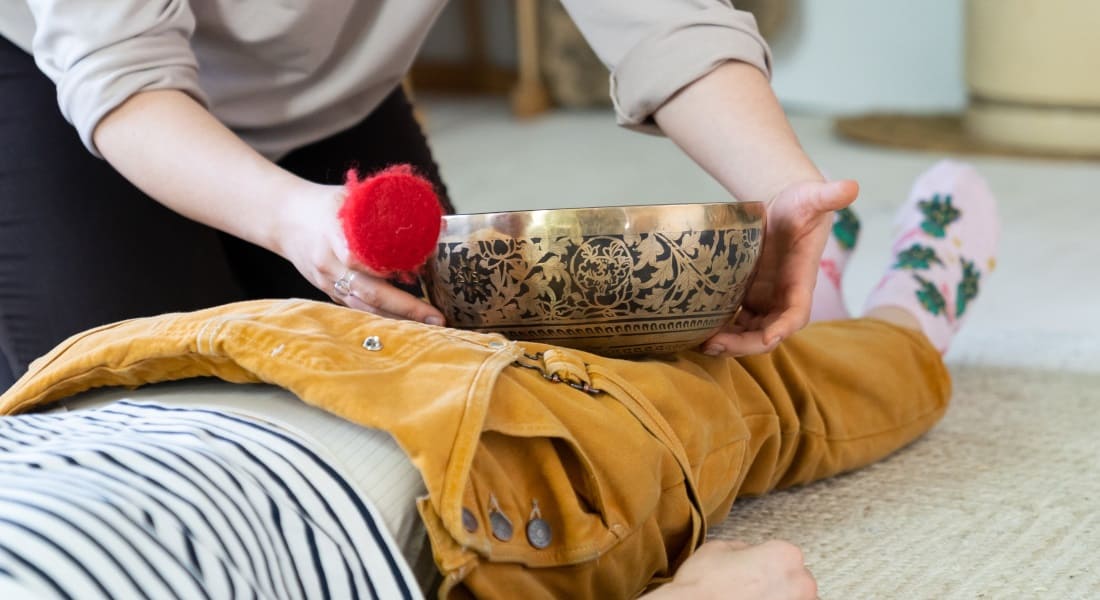
Why place a Tibetan bowl directly on a person’s body?
Placing Tibetan bowls on a person’s body—whether on the head, back, or stomach—is practiced as part of sound massage. Sound massage is a type of alternative therapy where the goal is to generate vibrations with musical instruments to promote well-being and relaxation for the person receiving the session. In this context, the instruments may or may not be placed directly on the body. We’ll focus on direct placement here, although it’s completely possible to combine both approaches during a sound massage.
The gentle vibrations from the singing bowls can genuinely “massage” the recipient, much like a professional therapist would, delivering benefits similar to a traditional spa treatment. Muscles tend to relax more deeply, which can help release tension after a stressful or intense period. To a lesser extent, the effects often associated with vibrotherapy may also apply to sound massage.
Beyond relaxation, some people believe these bowls can help balance the body’s energy centers, also called chakras. Although this has never been scientifically proven, Tibetan bowl sound massage is sometimes seen as a way to restore vibrational and energetic balance. To this end, Tibetan bowls tuned to specific musical notes may be used on areas of the body that correspond to different chakras. For example, the sacral chakra, located in the lower abdomen, is traditionally linked to the musical note D, so a singing bowl tuned to that note would be used to focus on that energy center. In that sense, placing a Tibetan bowl on the abdomen can be meaningful within this tradition.
How should a singing bowl be positioned on the stomach, back, or head?
When placing a Tibetan bowl on a person’s body, stability is key. The instrument mustn’t slip or tip when it’s rubbed or struck with a mallet or striker. Remember that the recipient may move slightly during the session, and it’s best to avoid a bowl falling during the treatment. For this reason, it can be placed on a cushion, a towel, or even directly on the clothing or bare skin of the person receiving the treatment. For the latter option, make sure the temperature of the singing bowls is close to body temperature, as cool metal can feel unpleasant. Alternatively, you can lightly hold the Tibetan bowl while vibrating it on a more unstable area such as the feet or hands. It is important that the contact between you and the instrument is as minimal as possible so that you do not disturb the vibrations produced.
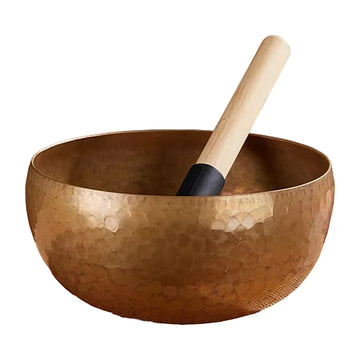
You can, of course, talk this through with the person so they can choose the method that feels best for them. However, keep in mind that the more layers you place between the Tibetan singing bowl and the body, the harder it will be to feel the vibrations. That said, some people prefer lighter, subtler vibrations to relax. It’s up to you to find the right balance so the session feels comfortable and effective.
Ideally, the person should lie on their back or stomach to ensure maximum stability during the sound massage. One or more instruments can be positioned at the same time in different places on the body. Traditionally, Tibetan bowls are placed on the parts of the body that you want to work on. This can be on the back, stomach, chest, neck, joints, legs, or even the location of the seven major chakras according to Hinduism. It’s always helpful to chat with the person beforehand so you can understand their expectations and focus on a specific area if needed. Watch the video below to see how a sound massage works.
There is also a special technique for the head, in which the Tibetan bowl is placed upside down on the person’s skull. Personally, I don’t use it very often because the weight of the instrument, and the fact that it can look a bit like a silly hat, makes it hard for people to truly relax. I also find this technique fairly difficult to incorporate into a full sound massage. You can see this method in action in the video below:
Is it dangerous to place this musical instrument on a person?
Placing a Tibetan bowl on a person’s body is not dangerous in itself, as long as you stay reasonable about a few key points.
First, you need to be mindful of the weight of the instruments. Some singing bowls can weigh over 22 lb (10 kg), which is a significant load if you place it on part of someone’s body. Even if a Tibetan bowl only weighs a few pounds (a few kilograms), be careful, because leaving it on someone’s back for many minutes can quickly become uncomfortable. That’s why I recommend using small to medium-sized bowls.
Next, it is also very important to pay attention to the volume generated by the instrument. Keep in mind that Tibetan bowls will sometimes be placed very close to the person’s ears. You should therefore strike them very lightly to avoid any risk of hearing damage.
Finally, always ask the person at the beginning of the session if they have any particular injuries or pain, just as you would in a traditional massage. For example, in the case of back pain or disc problems, placing singing bowls on the back should be avoided as a precaution. You can also ask the person if they have any contraindications to the use of Tibetan bowls. If you are not familiar with these, read my other article which details all the contraindications associated with this musical instrument.
Practice excellent sound massages with Tibetan singing bowl suction cups
To do it right, it’s natural to ask how to place singing bowls on a person’s body. While the risk is low, it’s still important to pay attention to a few details. With the insights you’ve gained from this article, you’ll be ready to deliver high-quality sound massages by positioning your instruments in a harmonious, safe way.
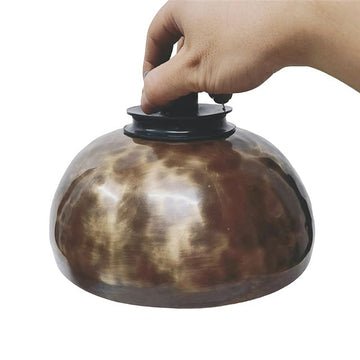
However, if you want to perform a sound massage on a specific area without the Tibetan bowl touching the person’s body, this can be tricky. In that case, use a suction cup: it lets you angle the singing bowl in any direction with one hand while rubbing or striking it with the other. You can find these in the Instruments du Monde online store. It’s an essential accessory for anyone who practices sound massage.
Discover suction cups for Tibetan bowls by clicking on the image below:
Although tradition dictates that singing bowls be made from an alloy of seven different metals, some artisans have shown originality by using other blends. In fact, there are Tibetan bowls made from five, nine, and even twelve metals. Sometimes zinc and nickel are added to the original composition. If you’re interested in this subject, it’s just one of many covered in our comprehensive guide to this Asian musical instrument. I invite you to consult it to learn more about this wonderful sound and therapeutic object.


