



Written by Ambre Montespan - Updated on Sep 25, 2026

Table of contents:
You’ve recently considered buying a Tibetan singing bowl for all the benefits it offers. Great! One question tends to come up, though: you’ve noticed that you can select the musical note (or tuning) of your Asian musical instrument. But which one should you choose? Will the note change the benefits you get from your singing bowl? And can you change the pitch once your decision is made?
Having practiced meditation with Tibetan bowls for over 10 years, I’ve had the opportunity to explore every possibility with this instrument, and I can answer all your questions.
Depending on the musical note you choose for your Tibetan bowl, the frequency of the sound waves will be different. Based on that frequency, one chakra may be targeted more precisely than the others. That’s why it’s best to choose your singing bowl’s tuning according to the chakra you want to balance.
So, after reading this article, you’ll know everything you need to know about:
- The different musical notes available for Tibetan bowls.
- The effects of the singing bowl’s tuning on the chakras
- The characteristics of each note so you can select the instrument that’s right for you.
As a result, you’ll be able to choose the Tibetan singing bowl that best matches the criteria you’ve set.
Let’s dive into this fascinating topic together!
Which musical notes can I choose for a Tibetan singing bowl?
Generally, when choosing the musical note for your Tibetan bowl, you can select any note from the diatonic scale, also known as the heptatonic scale. In other words, the classic 7-note scale: C, D, E, F, G, A, and B.
More rarely, some singing bowls may be offered with a semitone below or above the diatonic scale. That can mean, for example, instruments tuned to C sharp or D flat, written C# and D♭, respectively.
Next, let’s see how tuning influences the effects of your Asian musical instrument.

Why does the tonality of a singing bowl alter its effects?
First, we’ll review a few simple physics concepts before looking at the effects and wrapping up with instruments tuned to 432 Hz.
Different frequencies depending on the musical notes
The sound perceived by your body, and more specifically your eardrums, is actually a vibration in the air that propagates as a wave known as a sound (or acoustic) wave. Each wave has a specific frequency, which is the number of times per second that this vibration occurs. This number is expressed in hertz, and it affects the sound you hear. The higher the frequency in hertz, the higher the pitch of the sound. Conversely, the lower the frequency, the lower the pitch of the sound.
Based on this principle, a frequency has been assigned to each musical note. Since 1975, the note A has been standardized by the International Organization for Standardization (ISO) at a frequency of 440 Hz. A C corresponds to a frequency of 261.626 Hz, while a G is 391.995 Hz.
Let’s now look at the effects of these different frequencies.
The effects of tone on the chakras
According to Hindu tradition, there are seven major chakras in the human body through which a vital energy called "chi" flows. Chakras, which literally means "wheel" in Sanskrit, have been central to Indian medicine for over 5,000 years. According to this belief, we should activate our chakras according to our needs in order to balance them. Once this balance is achieved, we’re filled with a feeling of fulfillment and indescribable happiness.
The human body acts like a sponge for vibrations, absorbing sound waves that travel nearby. That’s why the Tibetan bowl is such a powerful tool for working with the chakras.
However, as we discussed earlier, it’s important to keep your chakras in balance. Start by identifying your needs so you can focus on the right chakra—or chakras—and select the ideal frequency. Each musical note corresponds to a major chakra, as shown in the chart below:

What are the differences between a Tibetan bowl tuned to 432 or 440 hertz?
When choosing your Tibetan singing bowl, you will sometimes have the option of selecting a frequency of 440 or 432 Hz. Earlier in this article, we discussed how A at 440 Hz, the reference pitch in music, has been the standard since 1975. However, some music therapy practitioners believe that instruments tuned to the reference A at 432 Hz are even more beneficial for the body and mind.
This is because 432 Hz is often described as a frequency connected to the earth and nature, as it is related to the golden ratio "phi". It’s said to be softer and brighter—in short, clearer and easier to listen to. Many meditation practitioners find it much more relaxing for the body and mind. You can find examples of relaxing singing bowl music in 432 Hz on YouTube.
Having practiced meditation with a singing bowl tuned to both frequencies, I recommend trying one, then the other. Because everyone is different, you may find that 432 Hz resonates with you more deeply than 440 Hz—or vice versa. Practically speaking, choosing A at 432 Hz instead of 440 Hz also shifts the frequency of every other note derived from it. So, as we’ve already discussed, if a C at 440 Hz has a frequency of 261.6 Hz, that same C will be 256.9 Hz at 432 Hz.
Now, let’s focus on the specific benefits of each musical note.
What are the benefits of Tibetan singing bowls depending on the note played?
Because each note has a specific influence on the chakras, below you’ll find the benefits of a Tibetan singing bowl depending on the note it’s tuned to.
C – root chakra
The musical note C is linked to the root chakra, the first of the seven major chakras, also known as Muladhara. The word Muladhara is composed of two Sanskrit words: mula, which means "root," and adhara, which means "support." Located at the base of the spine, the pelvic floor, and the first three vertebrae, the root chakra is responsible for your sense of security.
Because it’s the foundation of your system, balancing this chakra first helps create a solid base for working with the others. It’s associated with dynamism, survival, a sense of safety, self-confidence, and the need to stand up for your core values. If you feel the need to strengthen these areas, or if you’re new to chakra balancing, choose a singing bowl tuned to C.
D – sacral chakra
The second chakra, called Swadhisthana, is associated with the note D and is located in the lower abdomen. This is the sacral chakra, which governs creativity, relationships, and sexuality. Naturally creative, the sacral chakra’s main purpose is to help you discover what you love, pursue hobbies, build loving and exciting relationships, and express creativity in romantic partnerships and sexual intimacy.
Choose a Tibetan bowl tuned to D if you feel that your sacral chakra is out of balance.
E – solar plexus chakra
The note E is linked to your solar plexus chakra, which is located at the navel. Named Manipura, it is associated with personal power, organizational skills, emotions (especially blocked emotions), passion for life, and the ability to protect yourself from negative or aggressive emotions.
If you have incredibly high expectations of yourself or others, as well as a low tolerance for failure, your solar plexus chakra is probably out of balance. Somewhere deep down, you may fear making mistakes, and that fear can hold back your full potential. When you rebalance this chakra, you’ll realize that your vulnerabilities and imperfections are what attract people and opportunities—these are the parts of you others often love most.
If this description resonates with you, don’t hesitate—choose a Tibetan singing bowl in E.
F – heart chakra
The heart chakra is connected to the note F. This fourth chakra, called Anahata, is located in the center of the chest. It is associated with compassion, friendship, empathy, and the ability to give and receive love.
If you tend to isolate yourself, feel lonely, are excessively and frequently jealous, find it difficult to trust others, and are generally defensive during everyday conversations, there’s a good chance that your heart chakra is out of balance with the others.
In that case, focus your attention on a singing bowl tuned to F.
G – throat chakra
The throat chakra (Vishuddha) is, as its name suggests, located at the base of the throat. It is associated with communication, self-expression, and speaking your truth. It is balanced by the vibrations of the note G.
When this chakra is unbalanced, you may struggle to communicate with others. You might be afraid to say what you think (even when it’s the truth), have trouble expressing yourself clearly, and feel anxious about speaking, especially in public.
If you find it difficult to assert yourself in a group, consider a G-note Tibetan singing bowl—it can only help.
A – third eye chakra
Connected to the note A, the third eye chakra is located in the center of the forehead, between the eyebrows. This chakra is also called Ajna. It is associated with intuition, understanding, and self-acceptance.
The main issue with an imbalance in this chakra is refusing to look within ourselves and unearth our fears. Sometimes we’re afraid to acknowledge the truth, and our reasoning becomes clouded; we fear criticism and what others think of us.
A balanced sixth chakra means having a spiritual awareness of change—knowing there is an appropriate time for everything, for both beginnings and endings. It means being able to let go of old thought patterns and embrace the new. Those who can’t do this often remain afraid of the unknown and, as a result, afraid to truly live their lives.
If this chakra is blocked, it can lead to sleep disorders, headaches, nightmares, severe depression, and spiritual arrogance. Choose a Tibetan singing bowl tuned to A if you recognize yourself in these lines.
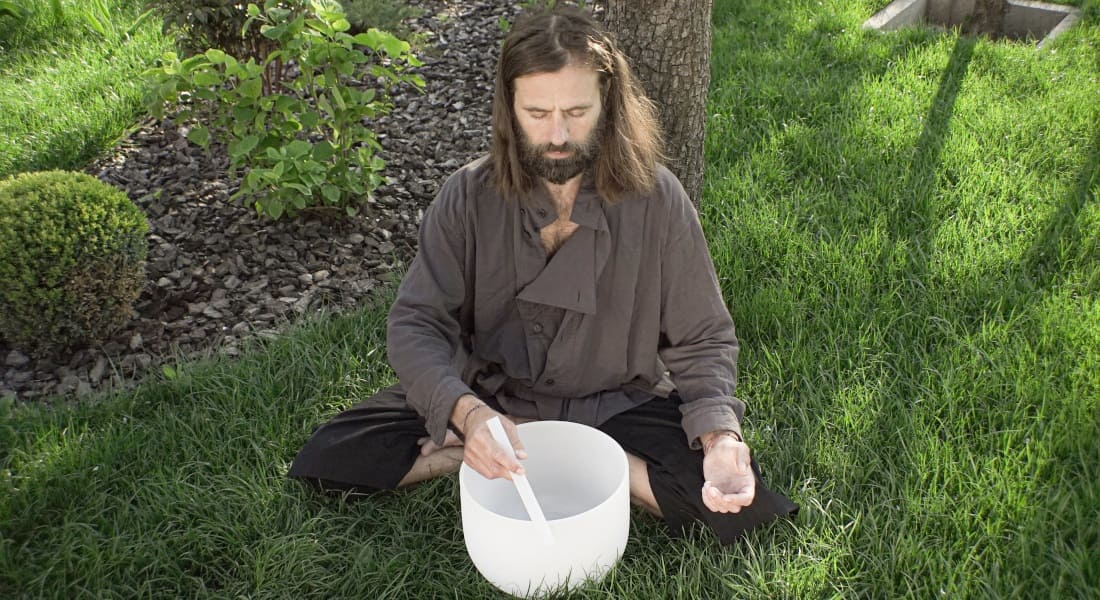
B – crown chakra
The crown chakra is called Sahasrara. It is located at the top of your head and is associated with the note B. This chakra represents your spiritual connection with yourself, others, and the universe. It also plays a role in your life purpose and wisdom.
Signs of an unbalanced crown chakra include lack of inspiration, greed, materialism, lack of empathy, feelings of superiority, disinterest in the divine, and recurring feelings of deep boredom.
Using a Tibetan singing bowl tuned to B will help you overcome these problems.
Can you change the tone of a singing bowl?
Unfortunately, no. Once you’ve chosen your Tibetan bowl, you can’t tune it like you would a guitar or piano. That’s because Tibetan bowls are percussion instruments in the idiophone family, meaning the material that makes up this Asian instrument produces the sound it emits.
So, once a Tibetan bowl is made, it produces a specific note, and you can’t change it later. That’s why it’s important to choose your meditation bowl carefully, based on your needs and expectations. Otherwise, you’ll need to purchase another bowl to get a different note. At most, you can partially fill it with liquid to shift the pitch slightly, but the range of change is quite limited.
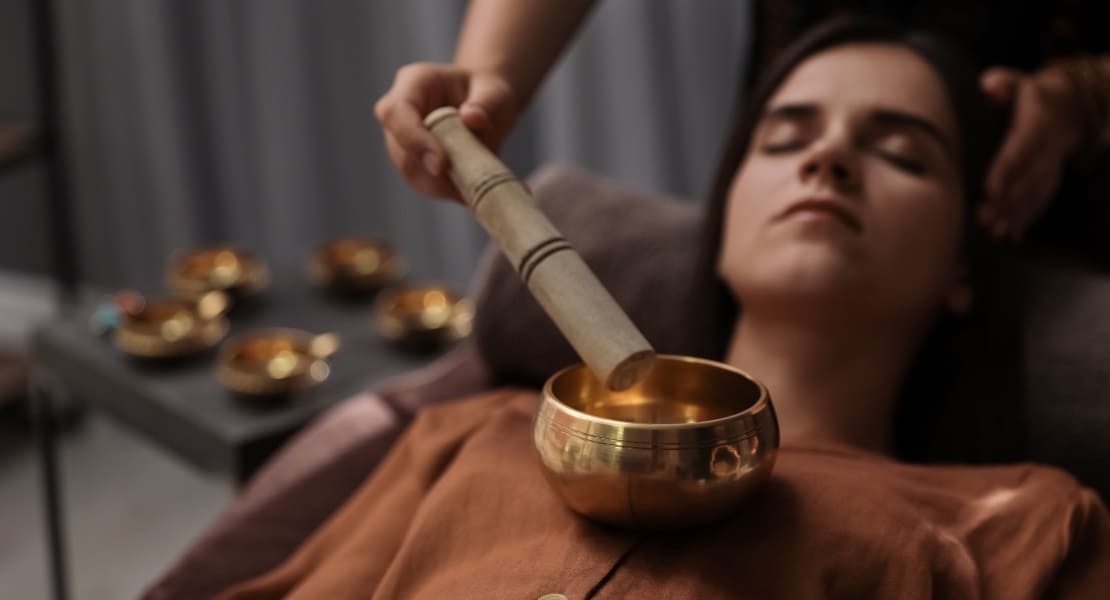
The Tibetan bowl I want does not have any information about the note it produces. Why is this?
Tibetan bowls made of seven metals sometimes don’t include information about the note they produce. That can be perfectly normal. What’s important to understand is that, as the name suggests, a seven-metal Tibetan bowl is made from several different metals. When the player makes the bowl sing, the metals vibrate at different frequencies because their molecular structures differ.
That’s why a metal singing bowl doesn’t produce one single note, but rather a dominant note plus a varying number of accompanying notes. So, with a metal bowl, you’re not working on one chakra exclusively, but on a whole group, with extra emphasis on the chakra linked to the dominant note. If the musical note isn’t listed in the bowl’s specifications, it usually means it has no clear dominant note and is therefore a “universal” Tibetan bowl that works across all the chakras.
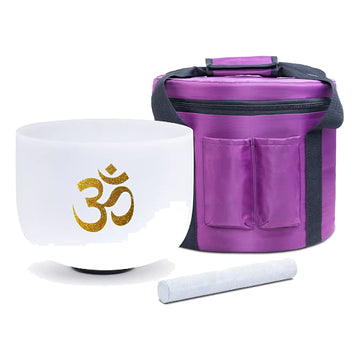
On the other hand, quartz crystal singing bowls are made from 99.9% pure crystal. As a result, they’re precise enough to produce one single note, focusing their effects on one chakra. If the musical note isn’t listed in the specifications of a crystal bowl, we strongly recommend steering clear—knowing the exact note is the main point of this type of instrument so you can target the right chakra.
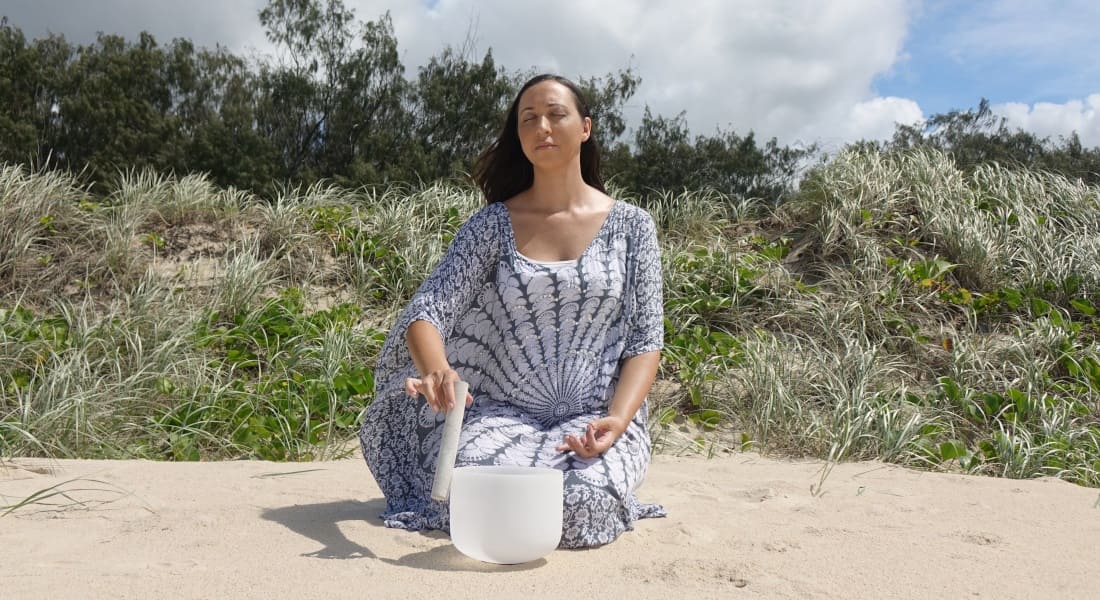
Enjoy all the benefits of Tibetan bowls with a set of 7 instruments!
As you can see, choosing the right note for your Tibetan singing bowl is crucial if you want to get the most out of its benefits. Now you can accurately determine which musical note corresponds to which benefits for your Asian instrument. That way, you’ll be able to confidently select the musical instrument that’s perfect for you or your loved ones.
However, it’s completely normal to hesitate when choosing a note for your Tibetan bowl, especially if you need to rebalance several chakras. Plus, if you plan to perform sound massages on people other than yourself, you may not yet know which chakras to focus on for it to be most beneficial.
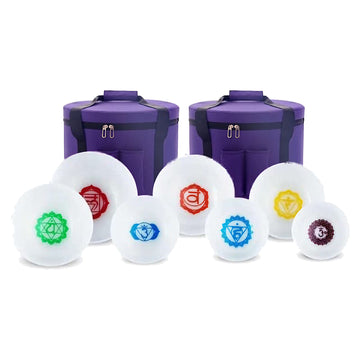
To meet this need for versatility, at Instruments du Monde, we offer a set of 7 quartz crystal singing bowls that correspond precisely to the 7 major chakras. That means no matter which chakra needs rebalancing, you’ll have the right instrument on hand.
Discover this set of 7 Tibetan singing bowls by clicking on the image below:
You may already own a singing bowl, but you don’t know the musical note it produces. If that’s the case, check out our tutorial to determine the note your Tibetan bowl produces. Once you know the note, you can connect it with this article to understand the benefits you can expect. Plus, deepen your knowledge of this instrument by exploring our comprehensive guide to singing bowls. It brings together all the information known about this instrument.


