



Written by Ambre Montespan - Updated on Sep 25, 2026

Table of contents:
Do you own a handpan and suspect that your instrument may be out of tune? Are you wondering if it’s possible to fix this? Is it possible to tune a handpan differently? How do you retune this percussion instrument? Who should you contact?
As a handpan enthusiast for over 10 years, I’ve unfortunately run into several instruments that no longer play true notes. Let me help you get oriented so your instrument can once again produce harmonious melodies.
Tuning a handpan isn’t something you can improvise. Once you notice your instrument is out of tune, you should consult an experienced professional and entrust your instrument to them for retuning.
By reading this article, you will find all the information you need about:
- The reasons why a handpan goes out of tune
- How to determine if your Hang drum is really out of tune
- The steps to follow to retune this musical instrument
This will help you find a professional who can handle this delicate operation on your handpan. You’ll also learn all my tips for keeping an instrument in tune longer.
Now let’s look at why such an instrument can go out of tune.
Why does a handpan go out of tune?
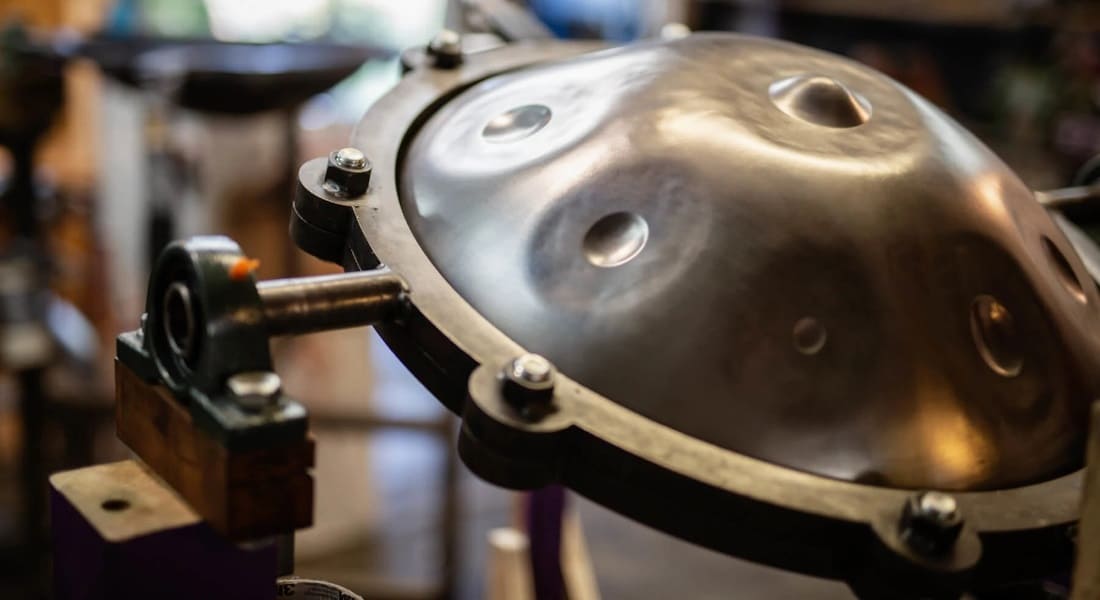
One of the many advantages of buying a handpan is that it doesn’t need to be tuned when you receive it, unlike a guitar or violin. That’s because the maker meticulously tunes every note during the build. So it’s easy to assume a handpan never needs tuning. In reality, that isn’t true. Of course, it’s nothing like a harp, which may need frequent touch-ups. With handpans, it’s more like every 2 to 5 years, depending on the model, how often it’s played, the type of steel used, and how it’s stored.
When a percussionist plays the handpan, they naturally rub or strike the metal. Even if it’s minimal and invisible to the naked eye, the metal tends to deform over time with the thousands of strikes it receives from the musician. That deformation changes the sound and can make a note drift out of pitch. It’s important to understand that a handpan’s steel is generally about 0.04–0.05 in (1–1.2 mm) thick. In other words, it’s a delicate instrument, and the most common cause of detuning is simply normal playing. Most players don’t notice because they get used to those tiny, gradual changes. And since nothing looks obviously “wrong,” the issue often comes up when you compare your instrument with other handpan players or check it with a tuner.
The second most likely cause is closely related to the first: the percussionist strikes the handpan too hard. Some players even use drumsticks or mallets, or specific techniques such as “ding-bending,” which put heavy stress on the instrument and can lead to deformation. Most players don’t even realize they’re detuning their handpan by playing this way.
A handpan can also play off-pitch notes after a strong impact, such as a drop. In this situation, which is often the most serious, the entire handpan becomes deformed, resulting in an instrument that no longer plays harmoniously. Finally, it’s worth noting that excessive heat—especially leaving your handpan in direct sunlight—can also cause it to go out of tune. As the temperature rises, the metal naturally expands and then contracts once it returns to normal. The problem is that the metal may not return to its exact original shape, which can create lasting deformation.
How can I tell if my handpan is out of tune?
To find out if your handpan is out of tune, you can, of course, rely on your ear. However, it’s safer to check with an electronic tuner, which can show you the exact pitch of each note. To do this, you need to know which notes your handpan is supposed to play. The easiest way is to use the note diagram for your instrument, which is usually provided by the seller. However, if your handpan is a common model, you can also find diagrams online. For example, here is one for a 9-note D Kurd handpan:
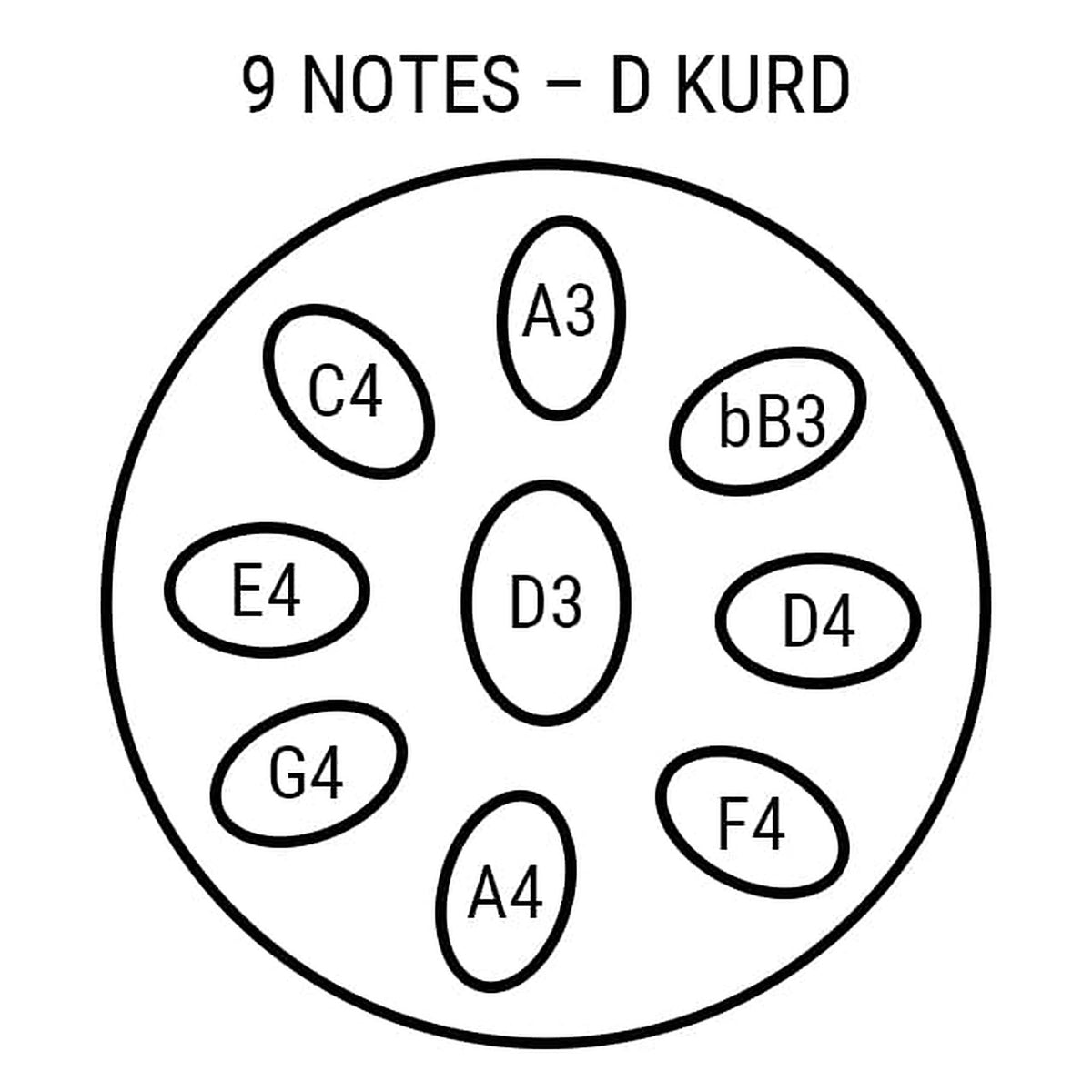
Once you’ve located and identified each note on your handpan, turn on your tuner or download a smartphone app that does roughly the same thing, but usually less accurately, since it relies on your phone’s built-in microphone. By playing each note, the tuner will display what it’s hearing. That way, you’ll know whether your percussion instrument is out of tune and, more importantly, you’ll pinpoint which note is wrong. Be careful, though: most tuners are set up for instruments tuned to 440 Hz. If you have a model tuned to 432 Hz, you’ll need to make sure your tuner supports that specific reference pitch.
For greater accuracy, some tuners and apps, such as Spectroid, can display the audio spectrum, including the fundamental frequency in hertz. You simply compare the frequency shown by the tuner with the one the instrument should produce. For example, here are some notes for a handpan at 440 Hz:
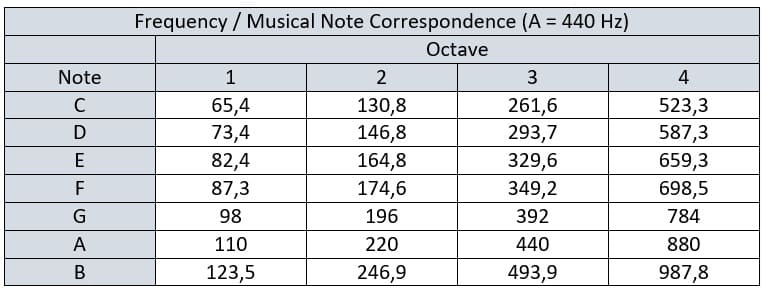
You can find all the notes based on 440 Hz right here. In practice, it’s best to allow some tolerance in the frequencies you see. Even though the ISO 16:1975 standard on tuning sets a maximum deviation of 0.5 Hz, most makers don’t reach that level of precision. A few hertz of difference, especially on higher notes, doesn’t automatically mean your handpan is out of tune, particularly since the tuner or app itself isn’t always perfectly accurate.
How can you retune the instrument?
Now that you’ve determined your handpan is out of tune, you’ll want to understand what to do first, then look into qualified professionals who can perform the retuning, and finally consider the cost of the service.
What should I do if I notice that my hang drum is playing wrong notes?
If you are certain that your handpan is playing one or more wrong notes, the first thing to do is simply stop playing it. Unfortunately, that means not touching it for a while. If you keep playing songs on an out-of-tune instrument, you risk making the problem worse. I therefore advise all musicians to store their handpan away until it has been retuned.
Who can retune my handpan?
Tuning a handpan is an art that takes months to learn, so a beginner can’t do a quality job, even with the best intentions. Tuning requires specific tools, real know-how, and, above all, experience, because the methods used will vary depending on the type of metal (nitrided or stainless), the thickness of the metal plate, and how the notes were shaped—for example, whether the edges are very visible or not. That’s why it’s best to seek out a professional who works on handpan tuning. Some have even specialized in it, such as Josh Rivera and his Riviera Steel Tuning workshop, which I personally recommend. You can also find other specialists by searching online. You can hear an example of Josh Rivera’s work before and after tuning in this video:
The process can take anywhere from a few days to several weeks if the professional has to separate the handpan’s two shells, which then have to be glued back together afterward. Typically, if the instrument has suffered a strong impact, separating the upper and lower shells is unavoidable.
How much does it cost to have your percussion instrument retuned?
In most cases, the professional you contact will ask you to send a video of you playing all the notes on the instrument so they can estimate the scope of the work. They may also ask you a few additional questions. Based on that, they’ll provide a quote. Obviously, a handpan that’s only slightly out of tune will cost less than one where many notes have drifted. On average, you can expect to pay between €100 and €300 for a new tuning.
Is it possible to tune your handpan differently?
No, it is not possible to tune your handpan to a different scale than its original scale. That would require so many modifications from the maker that it would be cheaper to order a new instrument. Therefore, this type of service is not offered.
Change the tuning by purchasing a new handpan.
Although handpans can naturally go out of tune, attempting to retune one yourself is complex and risky for the vast majority of musicians. So, as you’ve seen in this article, it’s best to rely on a qualified craftsman who can properly take care of your instrument.
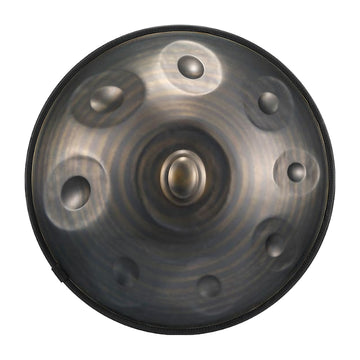
However, it will still be impossible to completely change the tuning or scale of your handpan if you want to explore a whole new sound world. In that case, you’ll need to purchase a new handpan. I recommend the Instruments du Monde store, which offers dozens of high-quality handpans to take you toward new musical horizons. In particular, this 9- or 10-note handpan is designed for relaxation and is precisely tuned to D Kurd.
Invest in a high-quality handpan and discover this model by clicking on the image below:
Discover other unexpected aspects of the handpan by reading my other article on the origins and history of this percussion instrument. You will learn about the context in which it was invented and how it evolved from a small country like Switzerland.


