



Written by Ambre Montespan on Mar 14, 2023 · Updated on Sep 25, 2026

Table of contents:
If you’re shopping for a kalimba, you’ve probably noticed there are two main versions: models with 17 keys and models with 21 keys. The problem is, you don’t know which one to choose. What really changes between an instrument with 17 or 21 keys? Which model will help you explore new soundscapes?
I’ve been playing the thumb piano for over 10 years, and I’ve already helped hundreds of people choose their kalimba. I can absolutely guide you toward the right choice when it comes to the number of keys on your African instrument.
17-key kalimbas are the most common and the easiest to get started with—perfect for beginners. 21-key models are rarer, offer a broader note range, and are better suited for players with some musical experience.
By the end of this article, you’ll know:
- The differences between these two types of kalimba
- The pros and cons of a 17-key model compared to a 21-key model
- Whether thumb pianos with far fewer or far more than 17 or 21 tines are worth considering
Kalimbas with 17 or 21 keys, also known as mbira, sanza, or thumb pianos, will have no more secrets for you! You’ll be able to make a smart, informed choice before buying your instrument, so you can start learning on the right footing.
Now, let’s answer this interesting question together.
What are the differences between a 17-key and a 21-key kalimba?
So, 17- or 21-note kalimba? To answer that properly, we need to look at every key difference between these two models. Let’s dive in.

A 21-key instrument has a higher number of playable notes than a 17-key instrument
First, let’s cover the general rule for kalimba notes, then see how it affects the melodies you can play.
1 – The general rule: 1 key = 1 note
The first difference—which becomes obvious once you understand how the kalimba works—is that a 21-key instrument will inevitably give you more playable notes than a 17-key one. If you’re completely new to the kalimba, here’s the key idea: each key corresponds to one single musical note, meaning one distinct sound—much like on a traditional piano keyboard. So, a 17-key kalimba gives you 17 notes. A 21-key thumb piano simply gives you more.
Now that that’s clear, it’s also important to note that the four extra musical notes on a 21-key kalimba aren’t added randomly. In the vast majority of cases, those four extra tines are inserted down the center of the instrument. Since the middle tines are always longer than the ones on the outside, the added tines end up longer than the existing ones on a 17-tine kalimba. As a result, the four extra notes on a 21-key kalimba are lower in pitch—because the longer the tine, the lower the note.

2 – A wider range of notes with a 21-tine instrument?
So what does that actually change? Will you be limited with a 17-key kalimba? Not really—you can still play plenty of well-known songs, though there will always be a few exceptions, whichever model you choose. However, the music will sound less nuanced and less full than it does on a 21-key instrument. For comparison, below you’ll find the same piece, "Ballade pour Adeline," played on a 17-key and a 21-key kalimba by a musician.
17-key kalimba:
21-key kalimba:
Although both musicians are talented, the kalimba and its range—meaning the full set of notes it can produce—has a big impact on the final result. A careful listener will notice it right away: the sound is richer and deeper. That’s the real advantage of a 21-note kalimba over a 17-note one.
3 – Why are the notes added to the 21-key kalimba necessarily lower?
You might wonder why the added tines have to be longer. Couldn’t the instrument be expanded with shorter tines to add higher notes instead? Or by mixing two higher-pitched tines with two lower-pitched ones? The answer is pretty simple.
If you’ve ever played a 17-key kalimba, you may have noticed that the tines on the far left and far right barely vibrate, if at all. That means the instrument is already at its physical limit. If even smaller tines were added, they simply wouldn’t be audible because they wouldn’t vibrate enough. That’s why the only workable solution is to add larger—and therefore lower-pitched—tines.
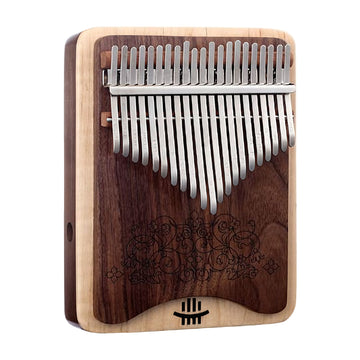
A different arrangement of notes and stickers on the thumb piano
As we’ve just seen, the extra notes on a 21-key thumb piano are placed in the middle of the tine set. This changes the placement of the notes and, therefore, the stickers.
Below is an image comparing the note layout on the two types of kalimba. The four blue tines are the ones added compared to the 17-key kalimba.
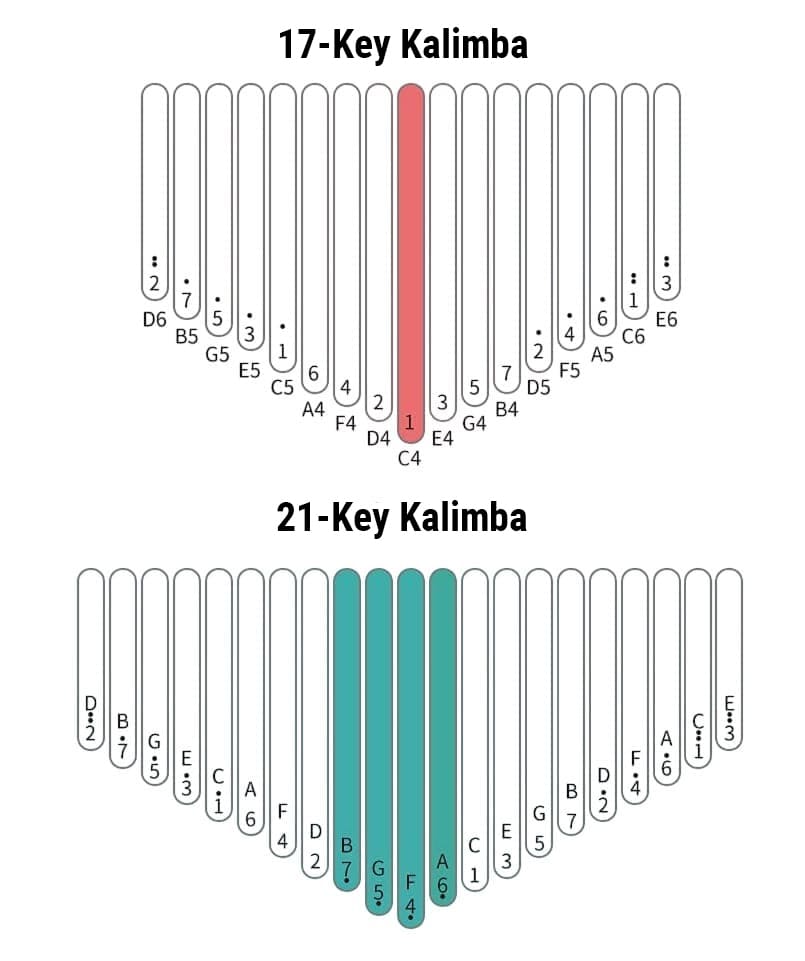
If you don’t understand what the letters, numbers, and dots mean, they refer to Arabic numeral notation (NMCA) alongside letter-name musical notation, which is widely used in the kalimba community. Each letter or number corresponds to a note in the diatonic scale. The dots indicate which octaves the notes belong to. A dot below the number means the same note one octave lower, and a dot above means one octave higher. To help you, here’s a solfège conversion table:
| solfège | do | ré | mi | fa | sol | la | si |
| letter names | C | D | E | F | G | A | B |
| NMCA | 1 | 2 | 3 | 4 | 5 | 6 | 7 |
So you’ll want to pay close attention to this difference and locate your notes clearly so you can stay oriented during practice. You’ll also need to place your stickers according to the number of keys on your kalimba. If you’re not sure how to apply them, we recommend this article: How to properly place stickers on your kalimba. You’ll learn, in particular, how to apply them on a 17- or 21-key thumb piano.

You’ll find more tablature available for 17-key sanzas than for 21-key sanzas
17-key kalimbas have been on the market much longer than 21-key kalimbas. On top of that, they’re far more widely purchased. This means musicians have had more time to learn the 17-key models, create their own arrangements, adapt existing melodies for kalimba, and share them online.
As a result, you’ll find a much larger number of sheet music, tablature, and musical works for 17-key sanzas than for 21-key ones. For example, at Instruments du Monde, we provide free kalimba sheet music and tablature. Most of it is written for 17-key models.
However, you may have noticed from the note-layout image above that every note on a 17-key kalimba is also present on a 21-key model. So, with a bit of adjustment from the player, it’s always possible to play tablature written for a 17-key mbira on a 21-key model.
Is the 17-key kalimba easier to learn than the 21-key?
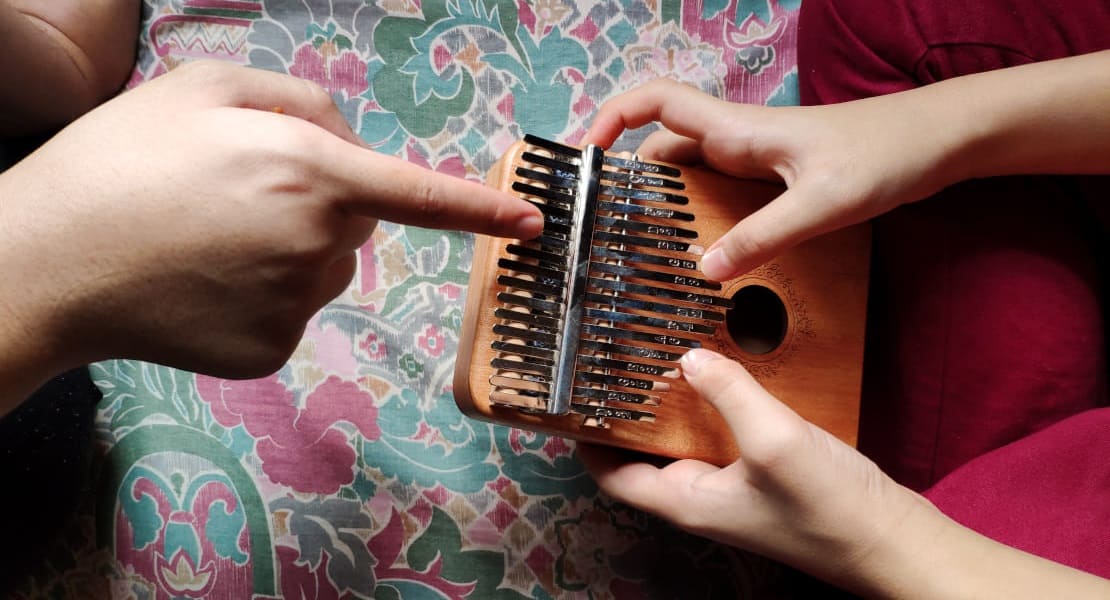
In general, the kalimba is an easy instrument to learn. But overall, a 17-tine kalimba is even easier to get the hang of than a 21-tine model. And that makes sense: you’re less likely to lose your bearings on 17 tines than on 21.
Most importantly, as we’ve already seen, the 17-note thumb piano has become far more popular than other versions. As a result, it has a large player community. You’ll find more tutorial videos, more tips, and more sheet music for this specific model, which is great for beginners and for anyone looking to level up. In short, the 17-tine kalimba is more approachable than the 21-tine version.

Differences in weight and size between a 17-note and 21-note mbira
Another point of comparison between the two models is weight and overall bulk. Adding four keys to the kalimba’s tine set means increasing the surface area of the soundboard that holds them. As a result, the weight of a 21-key instrument will increase slightly—by about 3.5 oz (100 g), depending on the soundboard material—compared to a 17-key instrument. If you play for long periods, those extra ounces can start to be felt in your wrists and forearms and may turn into discomfort.
The same goes for size. While the height of the kalimba generally stays the same, its width increases by about 2 in (5 cm). That’s worth considering if you travel often and want to stay as mobile as possible with your thumb piano.

How does the price of a 17-note kalimba compare to a 21-note model?
Adding more tines—and increasing the surface area of the soundboard—also affects the price. It depends on the overall build quality, but typically you’ll pay about €10 to €20 more if you want a 21-tine instrument compared to the same model with 17.
Even though playing the kalimba, or sanza, is an affordable hobby, it’s still worth identifying what you truly need so you don’t spend money unnecessarily.
Kalimba: 17 or 21 tines? Pros and cons
To help you see things more clearly, here’s a comparison table:
| 17-key kalimba |
21-key kalimba |
|
| Range of notes | Classic | Slightly wider |
| Learning difficulty | Very easy | Easy |
| Number of scores and tutorials available | Very high | Low |
| Dimensions | Standard size | Slightly larger than average |
| Price | Low | Average |
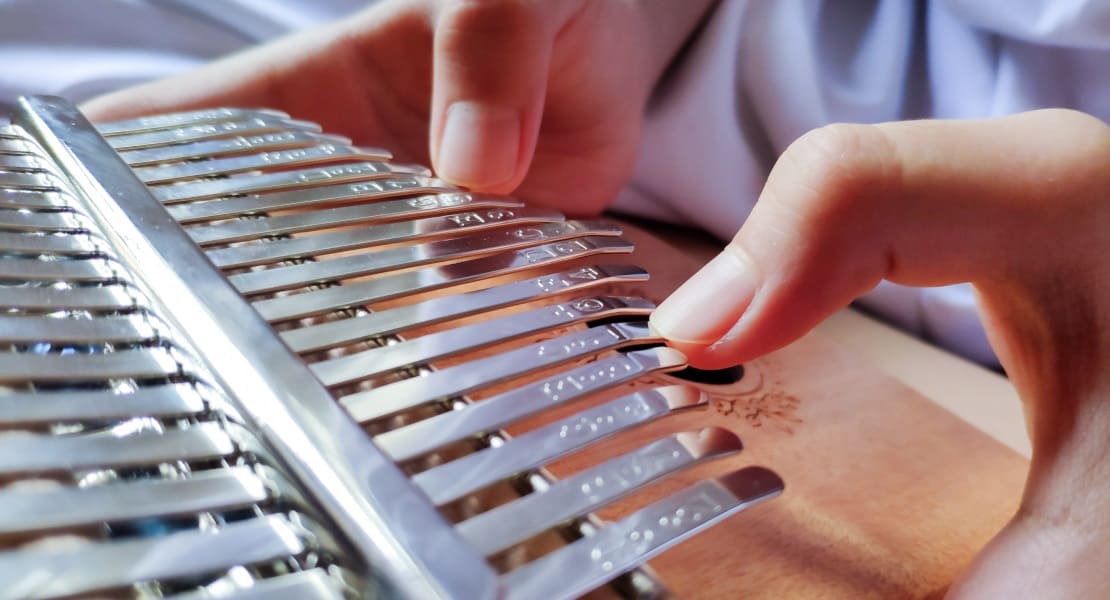
Considering all these factors, we recommend a 17-tine kalimba for beginners and anyone who’s new to music. It’s easier to get started with, offers the same soothing tone as a 21-note model, and you’ll find far more help if you get stuck.
On the other hand, if you already have some experience with the thumb piano—or you’re generally comfortable with musical instruments—you’ll likely be happier with a 21-note kalimba. It’s an excellent choice for creative players who like making their own arrangements and may feel limited with only 17 tines.
Are kalimbas with more or fewer than 17 or 21 notes worth considering?
We’ve just covered 17- and 21-key kalimbas. But you’ll also find models with many more—or many fewer—tines. Are they worth buying? Let’s take a look.
Kalimbas with fewer than 17 tines
There are kalimbas with 5, 9, or even 10 keys. These percussion instruments really only make sense in two situations.
The first is if you want to gift a kalimba to a child—which is a fantastic idea. Honestly, I don’t know a better instrument than the thumb piano to introduce kids to music. A kalimba is small, light, portable, already tuned, and there’s very little risk of a child getting hurt. Plus, it’s relatively quiet and gentle on the ears, unlike the famous metal xylophone, which can feel like a “poisoned gift” for some parents.

The second scenario is if you want an ultra-portable mbira—often called a “pocket mbira”—so you can truly play anywhere. If you don’t fit either of these situations, you’ll likely be disappointed by what the instrument can do. That’s why a 17- or 21-note model is strongly recommended.
Thumb pianos with more than 21 keys
Some thumb pianos have 24, 34, or even 42 keys. Most of the time, these are chromatic kalimbas intended for experienced musicians.
With thumb pianos, more is not always better. Wanting more and more keys isn’t a great idea if you don’t already have a solid musical foundation. You might get overwhelmed by the kalimba’s possibilities and lose motivation quickly. That’s why it’s best to start with a mbira that has a reasonable number of keys for your current level, then level up once you’ve gained experience.

Choose quality for your African instrument
As we’ve seen, choosing between a 17- or 21-key mbira is not a trivial decision. You need to weigh what you expect from the instrument to determine the number of keys that fits you best. Beginners tend to do better with a 17-note thumb piano, while more experienced players often feel more at home on a 21-tine version. Either way, you now have everything you need to choose the right number of keys with confidence.
That said, even if you know how many notes you want, your kalimba still needs to be well made to deliver a relaxing, pleasant sound. To avoid disappointment when you start playing, Instruments du Monde invites you to discover a top-tier kalimba without a resonator box, crafted with outstanding finesse and high-end materials.
Click on the image below to see this exceptional kalimba:

Whether you choose a 17- or 21-tine instrument, you’ll inevitably want to play beautiful melodies. And to do that, you’ll need to know how to read sheet music and tablature for the kalimba. That way, you can easily play all your favorite popular songs on your instrument! If you want to learn everything there is to know about the thumb piano, check out this tutorial.


