



Written by Ambre Montespan - Updated on Sep 25, 2026

Table of contents:
Would you like to be able to read kalimba sheet music or tablature so you can play your favorite melodies? Have you noticed these scores are made up of letters, numbers, or several lines of music notes, but you don’t really know what you’re looking at? Want to learn all of this without having to study music theory first?
I discovered the wonderful world of the kalimba more than 10 years ago. Also known as the mbira, sanza, or thumb piano, this instrument quickly became a passion of mine—and I can help you decipher these scores so you can play any song you want.
To read a kalimba score or tablature, you first need to identify what type it is. If it’s a sequence of numbers or letters, those symbols represent notes you play in that order. If the score includes several parallel vertical lines, you’ll need a few basics of music theory to read it from bottom to top.
By carefully reading this entire article, you will ultimately learn:
- Why it is important to understand how to read kalimba sheet music
- How to read sheet music with letters, numbers, or tablature with parallel vertical lines
- How to write your own sheet music for thumb piano
Interpreting sheet music and tablature will quickly become second nature, and before long you’ll read them as easily as a regular book. Most importantly, you’ll be able to fully enjoy your kalimba by playing all your favorite songs.
Let’s walk through the content of this article point by point.
Why is it essential to learn how to read thumb piano sheet music?
Learning to read kalimba sheet music comes with plenty of benefits—let’s list them right away.

Play an infinite number of melodies with your musical instrument
This is the first—and most obvious—reason you’re here. Once you understand the different methods for reading kalimba tablature, a whole new world opens up. You’ll have everything you need to keep improving your playing without limits.
On the one hand, you won’t need to memorize every song you love—because sooner or later, everyone hits a limit with pure memorization. On the other hand, you’ll be able to play music you’ve never even heard before. With nothing more than a sheet of paper covered in a few symbols, you’ll unlock a brand-new melody.
Sheet music: a universal notation system for thumb piano
Another advantage is that musical notation is universal. It doesn't matter if the person who wrote the score speaks English, Mandarin, German, or Portuguese—you'll be able to understand the series of musical notes to play on your thumb piano. And if you later want to share your own compositions with other musicians, it’s an essential tool for connecting with the musical world.
Improve your visual memory with mbira tablature
Reading tablature helps create connections in your brain between what you see and what you hear. With experience, you’ll be able to “hear” the notes just by reading a score. Over time, this makes it easier to memorize new melodies you want to learn and gives your brain a great workout.
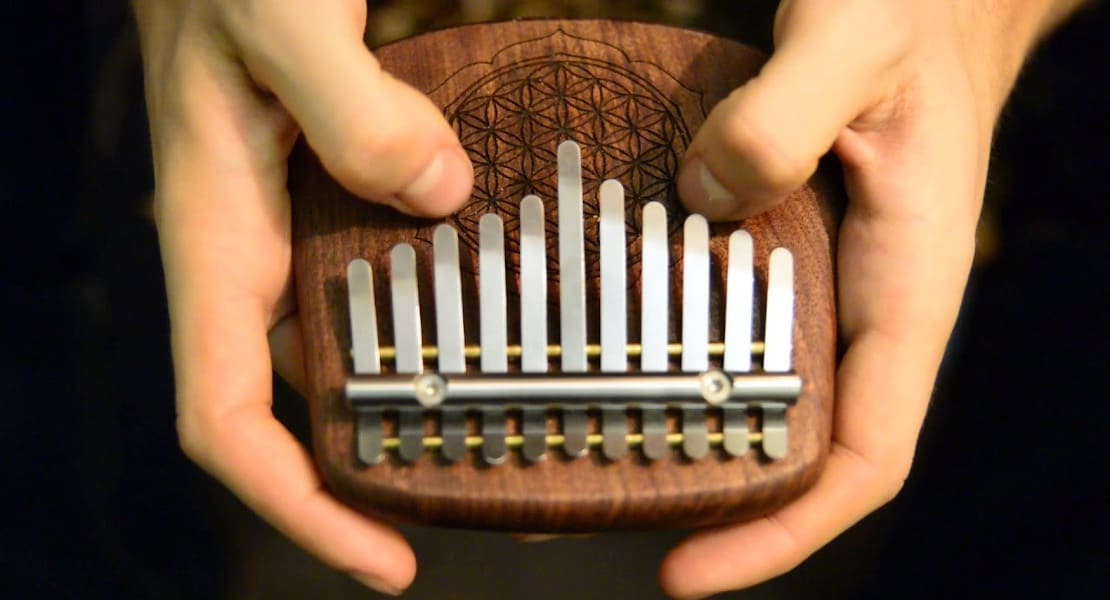
The links between music and its beneficial effects on the brain are well established. As highlighted by numerous researchers, including Emmanuel Bigand, director of the CNRS research laboratory, in his recent book "Les bienfaits de la musique sur le cerveau". Making the effort to learn to read kalimba sheet music fits perfectly into this context. You can also find all the benefits of the kalimba in this article.
A way to gain credibility for any musician
For a sanza player, reading sheet music shows real mastery of the instrument. Whether you want to join a band or share your skills (for example, by giving volunteer lessons in schools), being able to read kalimba sheet music will instantly boost your credibility.
How to read kalimba notes: the complete guide!
First of all, it’s important to differentiate between the four types of tablature or sheet music specifically designed for the kalimba. There are scores that use either letters or numbers, which are more suitable for beginners. There are also advanced scores with numbers and a few touches of music theory. The last type, called tablature, is a little more complex but more precise, and also uses music theory, albeit in a slightly more advanced way. Let’s take a look at them together right now.
How to interpret thumb piano sheet music with numbers?
Here is an example of kalimba sheet music with numbers:
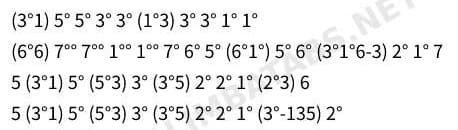
The score is read from left to right and top to bottom, just like regular text. Each number corresponds to a musical note, following the Arabic numeral notation system (NMCA). Below is a conversion table:
| solfege | do | re | mi | fa | sol | la | si |
| NMCA | 1 | 2 | 3 | 4 | 5 | 6 | 7 |
Some numbers are followed by the ° symbol. This means it’s the same note, but one octave higher. If there are two of these symbols, it means two octaves higher. Note that the ° symbol may sometimes appear as * or ', but this does not change the interpretation. On the kalimba stickers you placed on the metal tines of your instrument, or if they are engraved, octaves are marked by dots above or below the number in question.
If you’re unsure which note corresponds to each tine, here are some examples of kalimbas tuned to C major, the most common tuning.
17-key kalimba:
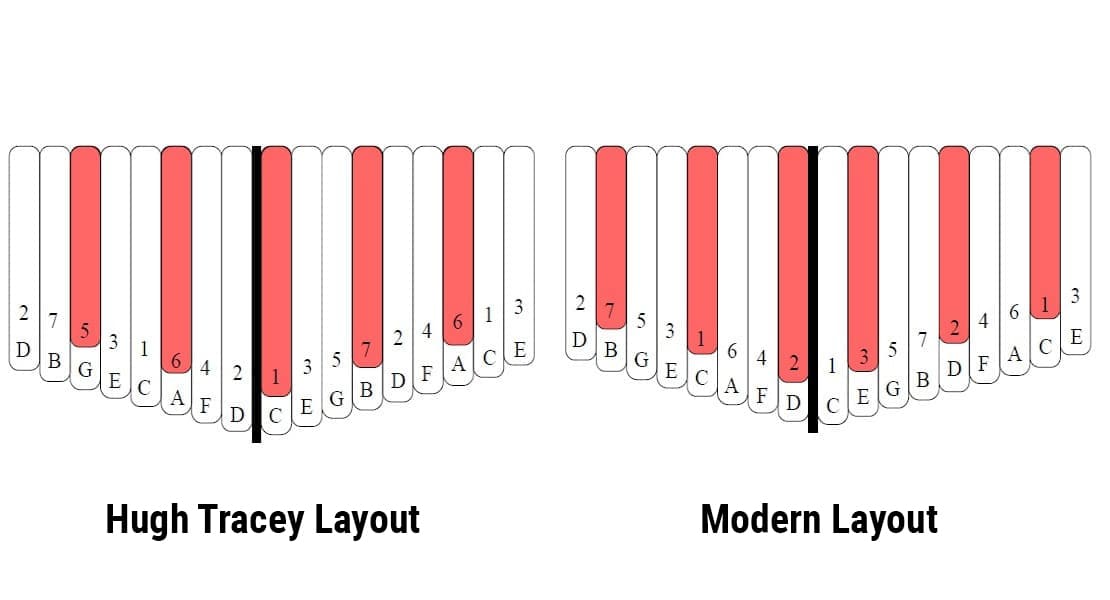
21-key kalimba:
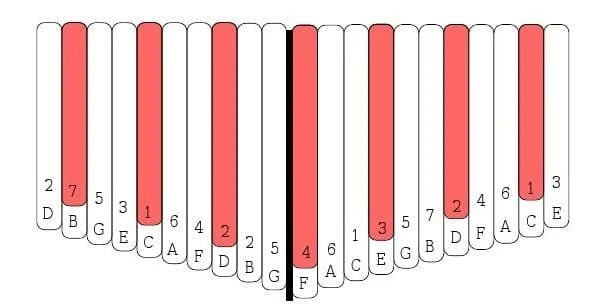
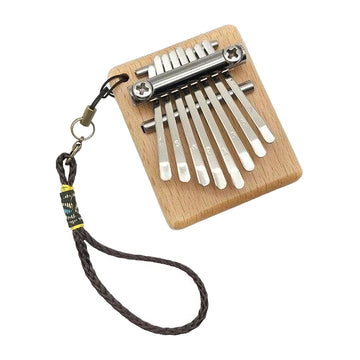
8-key kalimba:
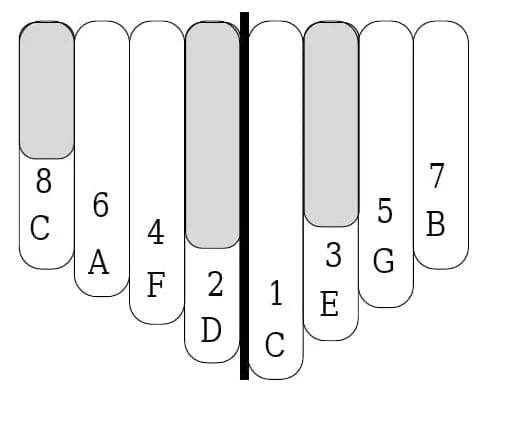
This means that each note must be present on your kalimba in order for you to play the score. Therefore, you will not be able to play a score for a 17-key kalimba with an instrument that only has 8 keys. However, it will always be possible to play a score that requires fewer keys on a kalimba with a higher number of keys.
It will also be necessary to check that the kalimba has been correctly tuned and that it has all the notes required for the entire score. Most standard kalimbas currently have 17 keys and are tuned to C major. If no specific information is provided at the beginning of the score, there is a good chance that it corresponds to this standard. However, this is not certain, as some scores require a specific tuning (in F major, for example). It is up to you to check this.
Finally, you may have noticed that several numbers may be written in parentheses. This means that you must play these notes at the same time. To do this, if the tines are located side by side, you can use the "glissando" technique, which consists of sliding your thumb across to pluck several tines almost simultaneously. Otherwise, you will need to use both thumbs at the same time (or combine both thumbs with one or more glissandos). Instead of parentheses, the numbers can be written with a dash, such as 6°-1°°. This is a different notation, but it means the same thing as (6°1°°).
Long fingernails make the glissando easier, and here’s a video demonstrating the technique with ideal nail length:
How can you perfectly understand a simple mbira score with letters?
Scores with letters look like this:
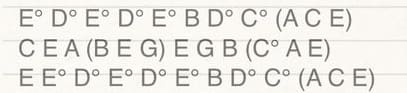
This type of mbira score works exactly like the ones with numbers mentioned above. It also includes notation for octaves and simultaneous notes. The only difference is that here, each letter represents a musical note instead of a number—using the standard letter-name system. Here is a conversion table:
| solfege | do | re | mi | fa | sol | la | si |
| letter names | C | D | E | F | G | A | B |
With this notation system, whether using numbers or letters, it’s easy for any beginner to transpose musical notes onto their instrument or, conversely, to write their own kalimba scores and share them with the world. Here’s an example of the result you can achieve with practice on Ed Sheeran’s song “Perfect”:
However, the simplicity of this notation is also its weakness. How can you know the rhythm of the melody? How fast should you press the kalimba keys? How do you know if a note should last longer or shorter? In practice, with a simple score in numbers or letters, you’ll need to know the song’s tempo ahead of time or watch someone else play it first.
To remedy this, some instrumentalists have had the idea of adding a few touches of music theory to scores written with numbers and letters. This is known as an advanced score.
How do you play advanced sheet music for the sanza?
Below is an example of an advanced score with numbers. It is also possible, but less common, to find them with letters:
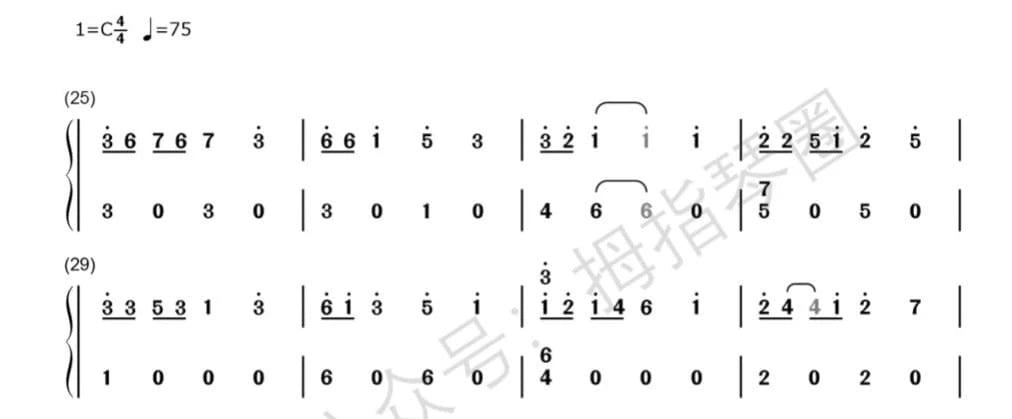
In the top-left corner, the fraction 4/4 indicates the time signature, showing the number of beats in each measure. Here, it means there will be 4 beats. If you’re unsure what a measure is, you can safely ignore the time signature for now—it’s not essential for reading advanced sheet music—or brush up on time signatures on a dedicated music-theory website.
The number 75 next to the musical note indicates the tempo of the melody—75 beats per minute (BPM). Tempo helps you calibrate the various rhythmic values in the tablature, and the higher it is, the faster the music will feel.
The number 25 in parentheses is a reference point and indicates that this is the 25th measure of the song.
Now, let’s go into a little more detail about the numbers. To help you understand, I have circled certain blocks of numbers:
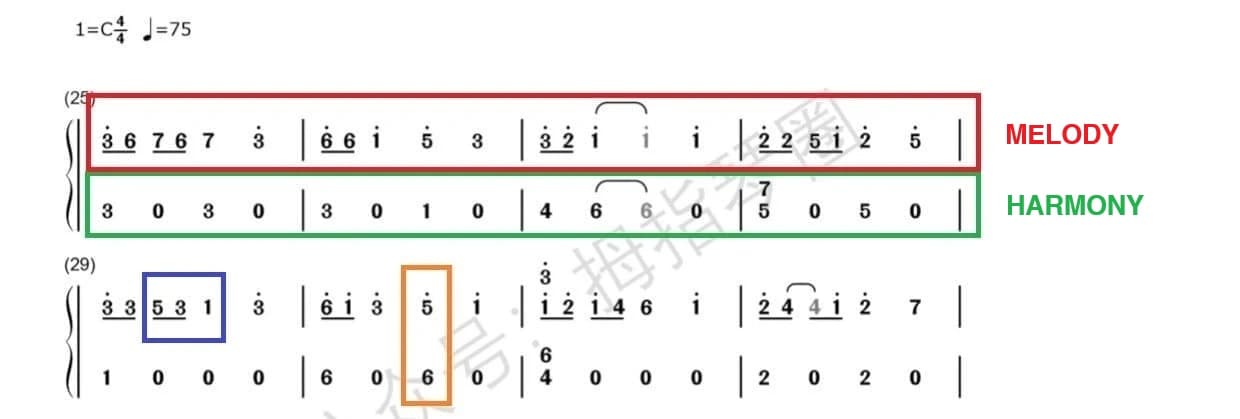
Just like with basic scores that use numbers or letters, advanced scores are read from left to right and top to bottom. The numbers—whether they have dots above them or not—always indicate the Arabic numeral notation (NMCA) of the musical notes, as we covered earlier. One key difference from simple scores is that both lines of numbers within the braces must be played simultaneously.
These two lines are, on the one hand, the melody notes (in the red box) and, on the other hand, the harmony notes (in the green box). This means, for example, that when the instrumentalist reaches the orange box, they must play 5° and 6 at the same time.
The vertical lines represent the beginning and/or end of a measure.
The horizontal lines below or next to the numbers show each note’s or rest’s duration, following this equivalence:
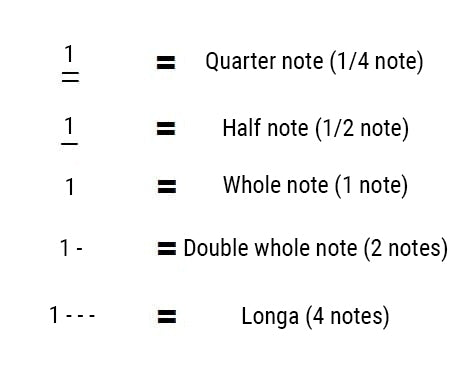
So in the blue box, notes 5 and 3 are played one after the other and each lasts the same amount of time as the single note that follows: note 1.
Finally, some notes are shaded and connected to each other by a kind of arc, like this:
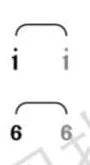
This is a tie. In this case, only the non-grayed note should be played, and it should be held for the full length of the tie.
What does the 0 mean in kalimba sheet music?
In some scores, you may find 0s that do not correspond to any musical note according to NMCA notation. The 0s simply mean that you should leave a moment of silence. Therefore, you should do nothing when you encounter this number.
However, I don’t recommend spending too much time learning to read this type of sheet music. It can get quite cluttered for complex melodies, and this notation system has largely been replaced by something clearer and more visual: kalimba tablature.
It’s now time to explore this specialized method for thumb pianos.
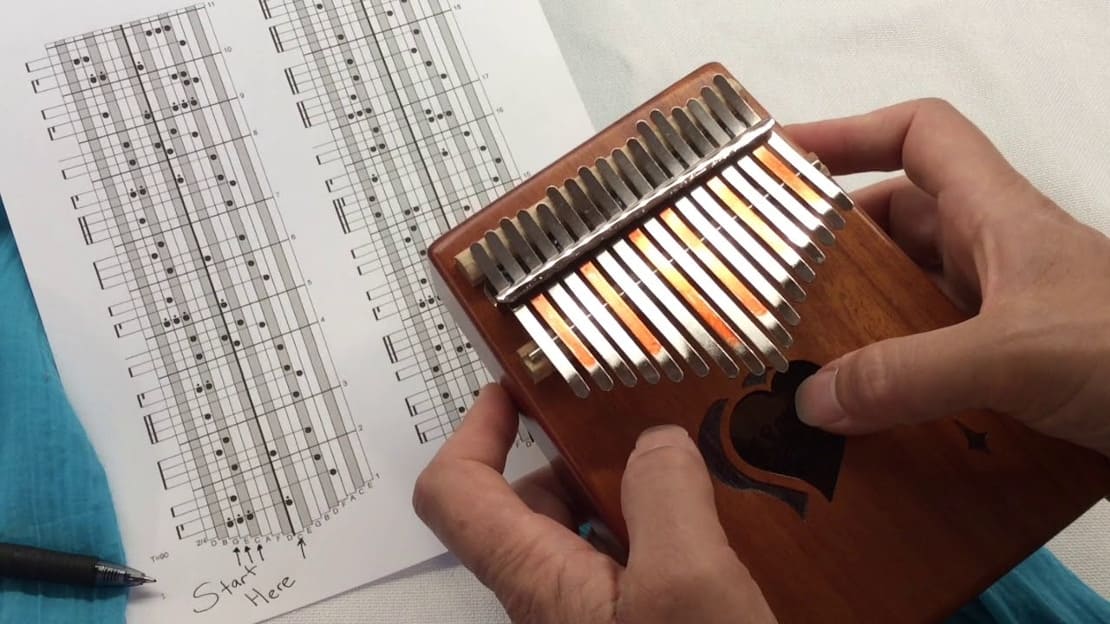
Kalimba tablature: the ideal compromise!
In order to play a melody with kalimba tablature, you need to learn how to read it, understand note durations, and pick up a few basics of music theory.
1 – How to read kalimba tablature?
Kalimba tablature was invented in 2003 by Mark Holdaway, a talented musician specializing in various instruments, including the kalimba. He was dissatisfied with scores written with letters or numbers for the reasons we discussed in the previous paragraph.
As a result, he developed a hybrid between a classical music score and a score with letters or numbers. Here is an example below that was created just for this guide. It is deliberately more complex than traditional tablature so that we can see all the symbols you might encounter on real tablature.
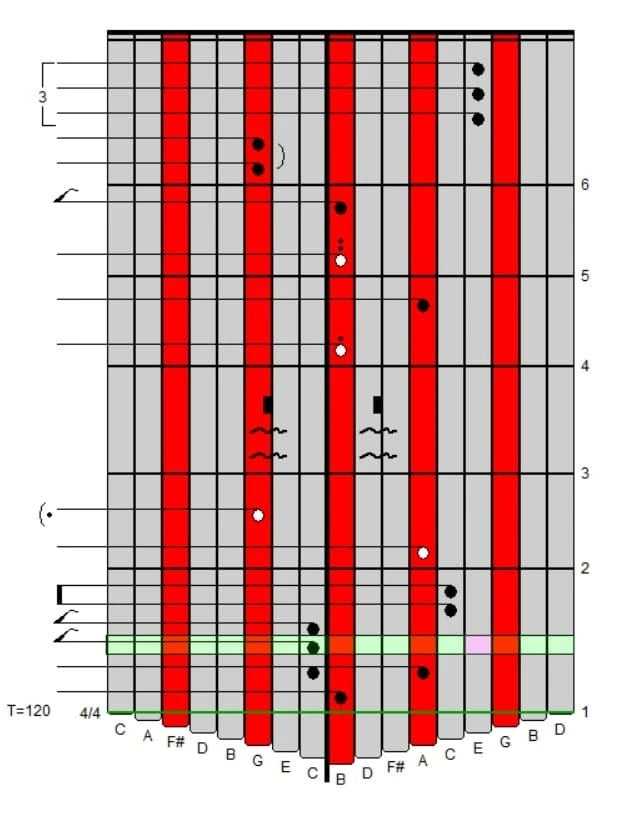
Each vertical column represents a tine on the kalimba, and you can find the corresponding note name at the bottom of the score. The numbers on the right side of the tablature show the measure you are on. The red tines simply indicate where the colored stickers are supposed to be placed—this is just to help you find your way around on your kalimba stickers. Consult our guide to learn how to place kalimba stickers correctly.
The tempo is normally noted at the bottom left of the tablature. It is 120 beats per minute, or BPM, on this one. The higher the tempo, the faster the melody will be.
Here, the tablature is read from bottom to top and, when there are several columns, from left to right. The principle is simple: whenever you encounter a musical note (black or white circle) on a tine, you play it. If there are several notes on the same horizontal line, they must be played at the same time (using the two-thumb technique or glissando as seen previously).
2 – Some basic music theory to understand note duration
Next, you need to determine how long to play the note. To do this, look at the color of the note and the markings on the far left, on the horizontal line where the note you are playing starts. Here is a table to help you find your way around:
| name | whole note | half note | quarter note | eighth note | sixteenth note | thirty-second note | sixty-fourth note |
| note value |  |
 |
 |
 |
 |
 |
 |
| duration | four beats | two beats | one beat | half a beat | one quarter of a beat | 1/8 of a beat | 1/16 of a beat |
Notes may be tied together on the left side of the tablature. Only eighth notes, sixteenth notes, thirty-second notes, and sixty-fourth notes can be grouped together in this way. In music theory, this notation is called beaming, and it’s simply designed to make reading easier. Some tablature composers prefer to beam their notes, while others do not. The duration of the notes remains exactly the same whether they are beamed or not. You’ll find an example of equivalence below:
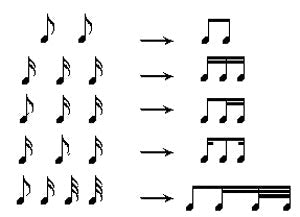
You may also encounter moments of silence, meaning that no notes should be played during this period of time. Below is a table of the rest values corresponding to each symbol:
| name | whole rest | half rest | quarter rest | eighth rest | sixteenth rest | thirty-second rest | sixty-fourth rest |
| silence figure |  |
 |
 |
 |
 |
 |
 |
| duration | four beats | two beats | one beat | half a beat | one quarter of a beat | 1/8 of a beat | 1/16 of a beat |
In reality, these tables are only accurate for a 4/4 time signature. But this brings us into slightly more complex music theory concepts that are not really useful for the kalimba at a non-professional level. Keep in mind that depending on the note on the tablature, it will last for a longer or shorter amount of time and that, for example, a quarter note will always last twice as long as an eighth note and half as long as a half note.
However, if you’re eager to explore music theory, you’ll find plenty of excellent free tutorials on YouTube.

3 – A few symbols you need to know to read tablature correctly
There are still a few small symbols to cover to ensure that you can read all kalimba tablature. These are the fermata, the tie, the triplet, and the dot.
A – The fermata
The fermata, also known as a hold, is represented by this symbol:

It will always be found on the left side of the kalimba tablature. When you encounter this musical notation, the tempo is suspended for the duration of the note(s) (or rests) to be played. It is up to you to determine when the note should end. Think of it as a brief moment of freedom where the player decides how long to hold the note, and only that note; then the tablature resumes as normal.
B – The tie
The tie takes the form of an arc between two notes:
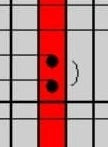
Only notes of the same pitch can be connected with a tie. Here, the second note is not played and the first is extended for the duration of the second. Therefore, placing a tie on two quarter notes does not make sense, as it would be equivalent to placing a half note. However, it is possible to combine a quarter note with a sixteenth note to obtain durations that do not exist with standard note values.
C – The triplet
The triplet looks like a hook with the number 3 on the left side of the tablature:
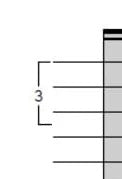
The triplet is a special way to divide time. It lets you play three notes in the space of two. For example, if three quarter notes are in a triplet, all three must be played in the duration of two quarter notes.
D – The augmentation dot
The augmentation dot is a simple notation that looks like a dot placed after a note. You can use one or more:
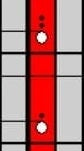
It works like a tie, except that the duration added to the note is fixed. The first dot always adds half the initial duration of the note, the second dot a quarter, and the third an eighth. For instance, a half note followed by two dots lasts for the duration of the half note + half the duration of the half note (1st dot) + a quarter of the duration of the half note (2nd dot), or 3.5 beats. Like ties, the augmentation dot is used to obtain note durations that do not exist with basic note values.
E – Repeat bars
Repeat bars are represented by two horizontal green lines of different thicknesses, with two dots added above or below them.
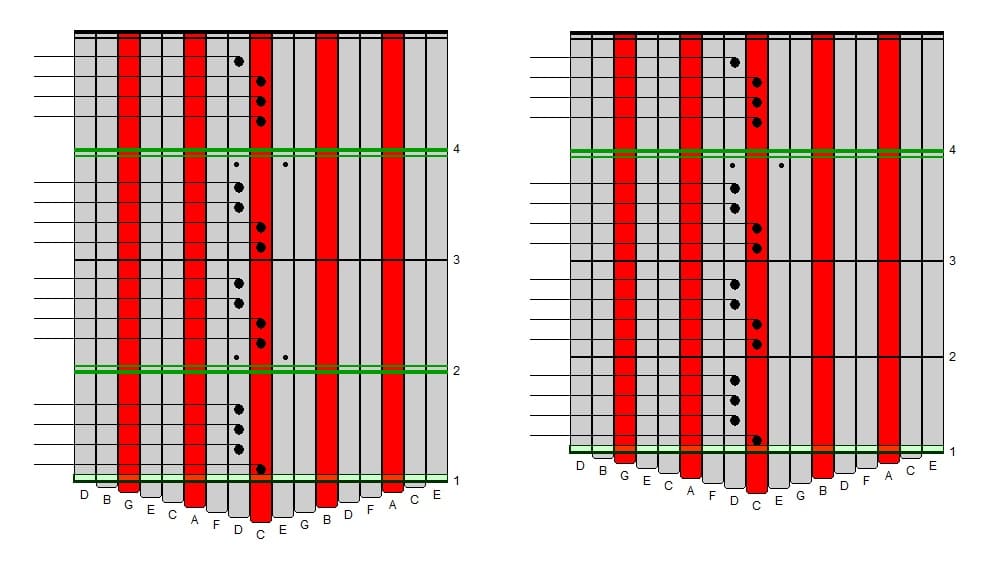
These repeat signs indicate that a passage in the tablature must be repeated. The principle is simple: when you encounter a repeat bar with dots below it, you must return to the repeat bar with two dots above it. If there is no bar with dots above it in the tablature, you must start again from the very beginning.
For example, in the tablature on the left, you play measures 1, 2, and 3, then repeat measures 2, 3, and finally 4. In the tablature on the right, you play measures 1, 2, and 3, then repeat measures 1, 2, and 3, and finally play measure 4. Repeat bars are used to shorten tablature when several passages of the melody are repeated.
4 – The final result with your percussion instrument once you have deciphered the tablature
Once you’ve digested all this information, here’s an example of what you can achieve with kalimba tablature:
The tablature method for sanza is more complex than scores written with numbers or letters, and it does require some knowledge of music theory. Once you’ve overcome these hurdles, though, you’ll gain access to a higher level of playing because you’ll clearly understand the rhythm and duration of every note.
In addition, musicians with solid theory skills can also play the kalimba from classical scores, just as with any instrument. However, this is a general approach not unique to the kalimba, so we’ll leave it aside for now.
Where can you find tablature for playing your African instrument?
Now that you know how to read sheet music and tablature for your African percussion instrument, you need to find some good-quality ones.
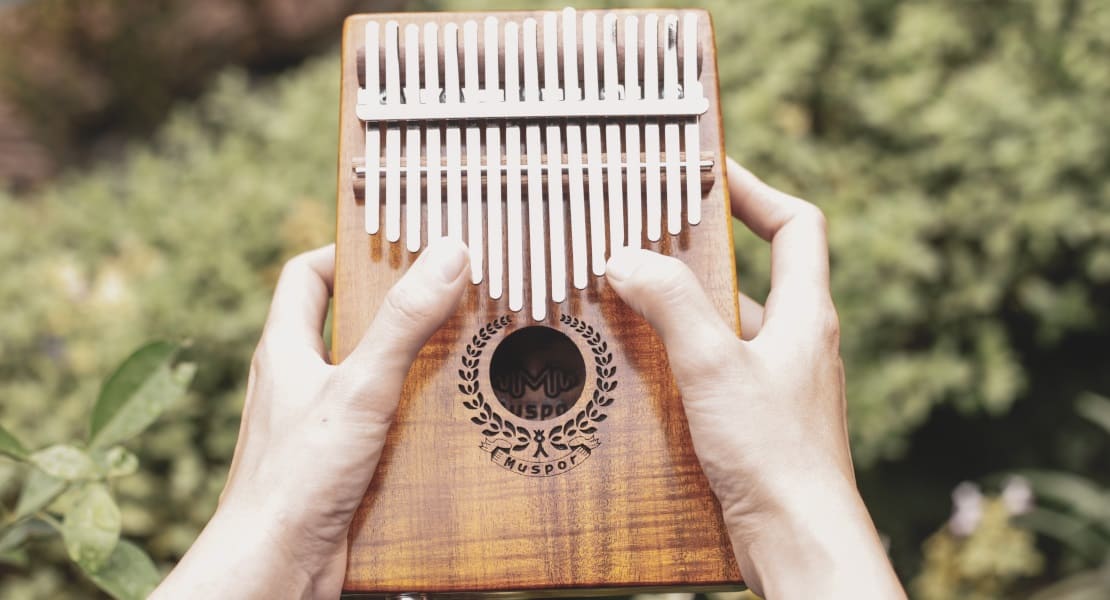
At Instruments du Monde, we offer a wide selection of sheet music and tablature for the kalimba. In addition, if you want a particular song, you can contact us to request it.
How do you write your own tablature for finger piano?
For sheet music, a simple sheet of paper or a Word document will suffice for writing down the sequence of numbers or letters. If you’re interested in converting a song specifically for the kalimba, this process is called transposition. The full method is outlined in this article.
For tablature, you can also write it by hand after printing blank kalimba tablature sheets. Alternatively, you can use specialized software. There are few options available, as the kalimba remains an exotic instrument, and fewer developers have taken an interest in creating tools for it.
One solution is KTabS for Kalimba Tablature Software. The software is quite comprehensive and runs on Windows 10. You can create any finger piano melodies you want with it. However, it should be noted that KTabs is over 10 years old, updates have been discontinued for several years, and it costs around €30 to purchase.
Some musicians don’t really want to spend €30 on software that has been abandoned but is still functional, so an enthusiast has created free, open-source software called Kalimba Tabs. It is currently less comprehensive than KTabS but may be an interesting alternative for those who don’t want to invest in tablature software.
Note that some mobile apps such as Kalimba Real (free) and Kalimba Royal (paid) have an editor mode that lets you create your own tablature and share it with the app community.

Record all your favorite kalimba compositions!
Reading kalimba sheet music and tablature is essential for any musician who wants to progress quickly with this African musical instrument. It requires real commitment from the player who wants to learn, but there are several levels of difficulty to help you master the kalimba at your own pace. You now have all the information you need to read all types of sheet music and tablature perfectly. With practice, you’ll soon be playing all your favorite melodies.
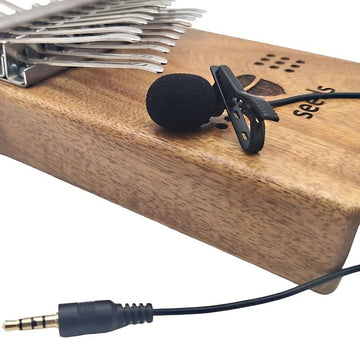
However, even if you know how to interpret tablature, very few kalimbas come with a microphone that allows you to record your performances. Saving your compositions lets you share them with the world and, more importantly, track your progress over time. There’s real satisfaction in seeing how far you’ve come. To solve this problem, Instruments du Monde offers a high-quality, low-cost kalimba microphone so that all musicians can record their musical performances.
Discover it now by clicking on the image below:
Reading sheet music is valuable, but that knowledge can be useless if your kalimba is out of tune. That’s why learning to tune your kalimba is essential for getting the most out of your finger piano. You may also be interested in our ultimate guide to the mbira.


