



Written by Ambre Montespan on Mar 14, 2023 · Updated on Sep 25, 2026

Table of contents:
Have you heard names like mbira, sanza, kalimba, or sansula used to refer to thumb pianos? Are you wondering whether they’re actually the same instrument? Are there real differences behind these names? Are they just different words for the same thing, or do they refer to truly distinct instruments?
As a thumb piano enthusiast for over 10 years, I’ve studied their history and origins in depth—enough to spot the subtle (and not-so-subtle) differences between the models. Read on, and I’ll answer all your questions!
While the mbira and sanza are traditional African instruments dating back more than 3,000 years, the kalimba dates to 1954 and is considered a modernized take on the mbira. The sansula, meanwhile, was invented in 2001 by adding a stretched membrane and a frame to a kalimba.
After reading this article, you’ll finally understand the differences between a kalimba, a mbira, a sanza, and a sansula.
You’ll be able to quickly identify each instrument and choose the one that will help you flourish musically.
Let’s dive right into this fascinating topic!
The similarities between all thumb pianos
Before we list each instrument’s unique traits, let’s note their shared features so you have a solid foundation to work from.
Whether it’s a kalimba, mbira, sanza, or sansula, all these musical instruments belong to the idiophone family, and more specifically to the lamellophone family. Idiophones—literally “self-sounding”—are percussion instruments whose sound (and therefore vibrations) is produced by the instrument’s own body. Lamellophones are idiophones made of one or more tines (lamellae), with one end fixed and the other free. The player plucks the free end to set the tine vibrating and produce sound.
These instruments also all have a soundboard. This means that part of the instrument is designed to receive the vibrations from the tines in order to amplify them. In the case of all these thumb pianos, this is a block of wood or acrylic that the player holds in their hands. Finally, it’s worth noting that all these highly melodic instruments are played with the thumbs or fingers.
To sum up, kalimbas, mbiras, sanzas, and sansulas are lamellophones played with the thumbs, and they all have a soundboard that boosts resonance.
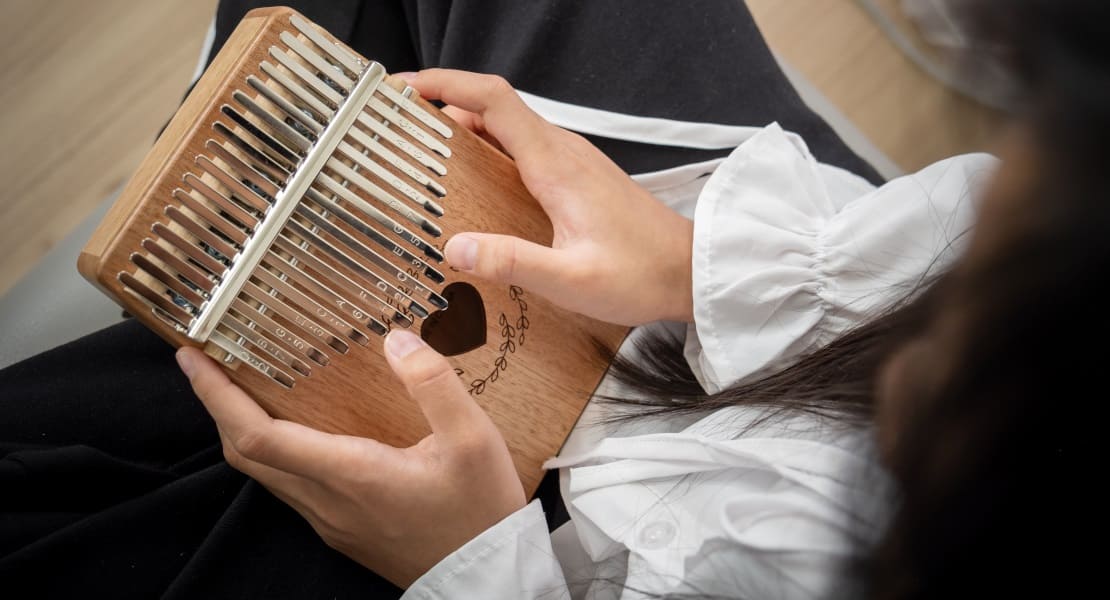
Is the mbira really different from the kalimba?
The mbira differs from the kalimba in terms of its origins and design.
The origins of the mbira
It’s quite difficult to pin down the exact date of its invention, but the earliest traces of this instrument appear more than 3,000 years ago on the west coast of Africa. At that time, the mbira was crafted from wood and bamboo blades. It then disappeared, only to reappear around 1,300 years ago in Central and Southern Africa in the Zambezi Valley, which encompasses the following modern-day countries: Zambia, Angola, Namibia, Botswana, Zimbabwe, and Mozambique. The instrument has evolved considerably, with the bamboo blades being replaced by metal keys.
The instrument gained popularity, especially among the Shona people, an African group primarily living in Zimbabwe, who gave it the name mbira. For several centuries, the mbira was used for religious purposes to communicate with spirits. It was played by griots to contact the dead and by the tribe’s mystical guardians. It was also used to ask the spirits for specific weather conditions and for festive celebrations such as weddings. Today, the mbira is growing in popularity thanks to the many concerts that feature this musical instrument.
The design of the mbira
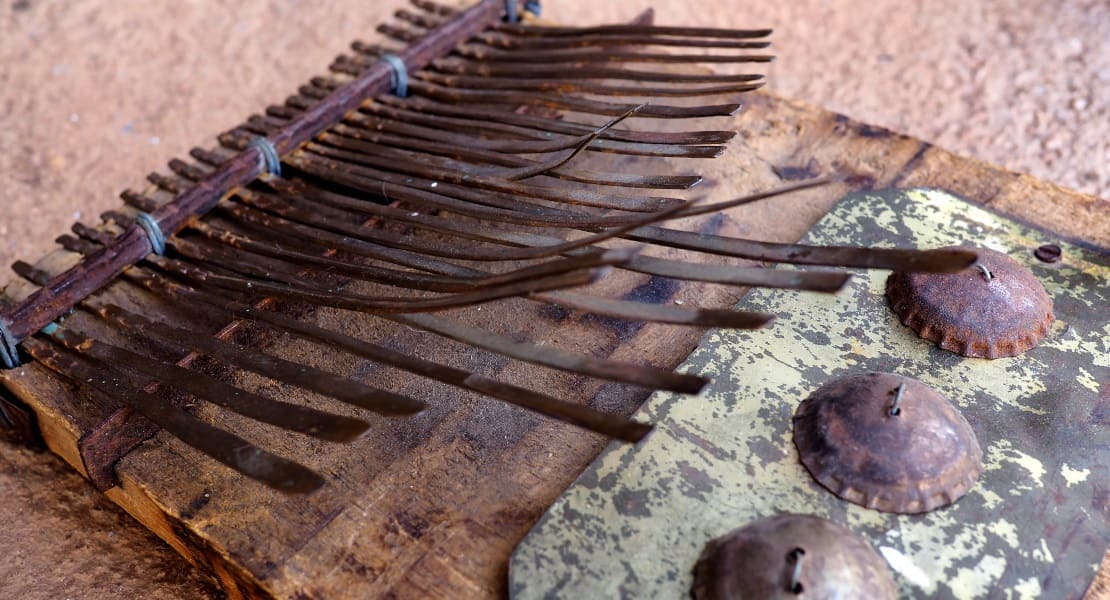
The mbira also differs from the kalimba in its design. The mbira generally has two rows of tines. The tines increase in width toward the end where the player plucks them with their thumbs. In addition, the notes played by the tines are not laid out according to a diatonic scale as they would be on the kalimba, but are tuned differently. The sound is therefore very distinctive, typically African, and some notes may even be missing from a scale, which can feel surprising if you’re used to Western musical standards.
Some models also feature metal resonators—usually bottle caps mounted on the soundboard—that create a buzzing, vibrato-like effect. You’ll also find mbiras with sound boxes crafted from calabashes.
Below is a video of a traditional mbira player:
What are the differences between a sanza and a kalimba?
The sanza, also known as senza, is synonymous with the mbira. There is absolutely no difference between a sanza and a mbira except for the individual who chooses one or the other term. Some African tribes use mbira to refer to a thumb piano, while a few dozen miles away, another tribe will call the same instrument a sanza.
And that’s not all. In fact, African thumb pianos have more than a hundred different names, such as "likembe," "mbila," "huru," "nhare," "matepe and njari," "okeme," "ubo," and "gyilgo." Depending on the geographical region and ethnic group, the same object can go by multiple names.
How the kalimba differs from other thumb pianos
As we’ve just discussed with the sanza, it turns out that kalimba was also another name given to the thumb piano by various African peoples. However, this word now has a different meaning thanks to ethnomusicologist Hugh Tracey.
While traveling across Africa—especially in what was then Rhodesia—in the 1930s, Hugh Tracey became deeply interested in thumb pianos. In 1954, he drew heavily on them to create a Westernized version of this instrument, which he called the kalimba, using one of the many names already found among Africa’s indigenous peoples. In this version, the kalimba has only one row of 15 thin, evenly spaced tines. This kalimba is tuned to the diatonic scale in G major. It features a hollow sound box with one front hole for vibrato effects and two rear holes for wah-wah effects. These design choices are the main differences from the traditional mbira or sanza.
See Hugh Tracey’s model below:
Hugh Tracey’s kalimba was a huge commercial success, and several other musical-instrument manufacturers adopted his design. Today, all the major companies offer thumb pianos they call kalimbas.
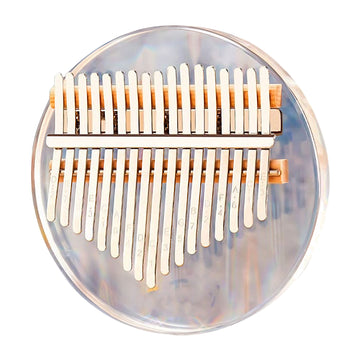
Since then, the kalimba has continued to evolve. Most modern models have 17 tines, though 21-tine versions have also been developed to expand tonal possibilities. The soundboard or body can be made from mahogany wood, and you can also find transparent acrylic glass versions that are far more durable and resistant to the elements. Electronic kalimbas with built-in microphones and even two or three rows of tines to create a chromatic scale have also appeared, further blurring the line between mbira and kalimba.
In conclusion, it’s not really a mistake to call a traditional instrument from Africa a kalimba and the version revisited by Hugh Tracey a mbira. However, thumb piano players often prefer to call the traditional, handcrafted instruments from Africa mbira or sanza, and reserve “kalimba” for Western-style models inspired by them—typically tuned to a diatonic (or sometimes pentatonic or chromatic) scale and clearly not made directly in Africa.

Kalimba or sansula—are they the same thing?
The sansula is indeed a different musical instrument from the kalimba, mbira, or sanza. It was invented almost by accident in 2001 by Peter Hokema, creator of the brand of the same name.
While playing the kalimba with the instrument resting on a simple frame drum, Peter Hokema saw the potential of combining the two instruments. He then crafted a hybrid by attaching the kalimba to the drumhead, surrounded by wood. This created a stronger resonance and generated unique sound effects when the instrument was moved.
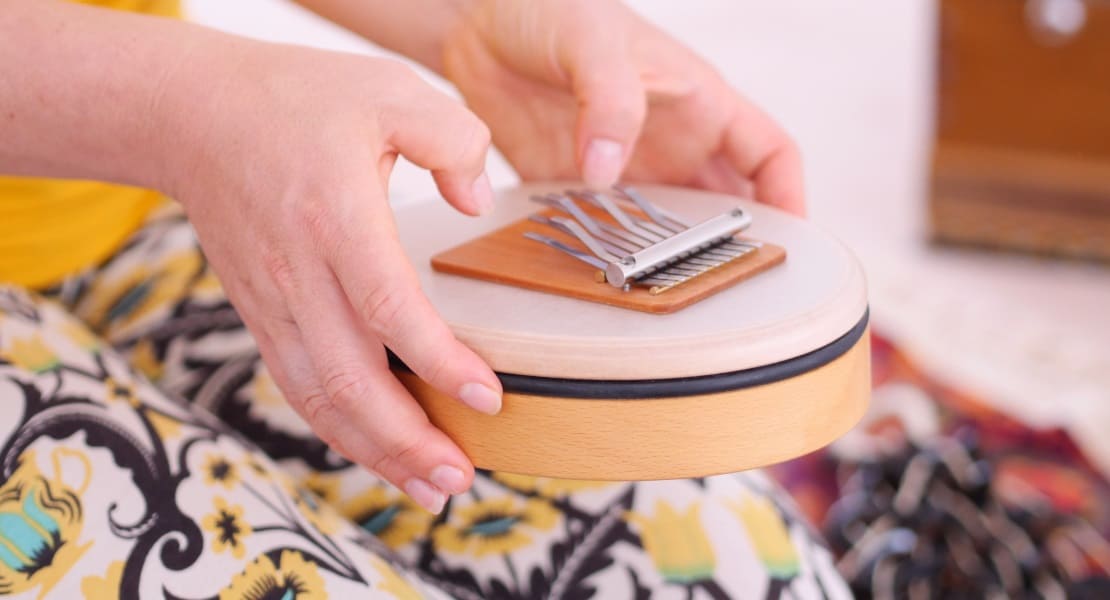
He named this new instrument the sansula. The name comes from a combination of sanza, which we discussed earlier, and "ula," which means small—so sansula essentially means “little sanza.”
You can find a video presentation of the sansula by Peter Hokema himself just below:
Travel to Africa with a high-quality kalimba!
It’s natural for any new musician exploring the world of thumb pianos to feel a bit confused by the terms kalimba, sanza, mbira, and sansula. The line between these names can be surprisingly thin. Now you can confidently distinguish among them, avoid misnaming them, and even help friends and family understand the difference.
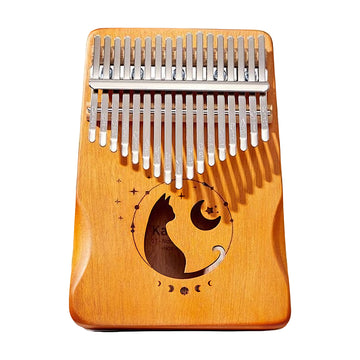
However, thumb pianos are still considered exotic musical instruments in the West. Unfortunately, they are not as widespread as the guitar, piano, or trumpet. As a result, finding high-quality kalimbas is no easy task. That’s why Instruments du Monde, a French company, makes it easy for you by offering a 17-tine kalimba with a cute little cat in the center, guaranteeing you an exceptional musical journey.
Treat yourself to this superb kalimba now by clicking on the image below:
Are you a weekend DIYer who’s always dreamed of building your own thumb piano? Perfect—thanks to our tutorial on how to make your own kalimba, you’ll get a clear, step-by-step guide to successfully crafting your own African musical instrument. Or, check out our detailed article on the sanza.


Joe
Jun 9, 2026Thank you, Ambre. I never heard of thumb pianos. I found your article fascinating. Will be looking for more of your articles.
Joe
Ambre Montespan
Jun 9, 2026Hi Joe,
Thanks for the kind comment. You'll see that it's a fascinating instrument.
Best regards