



Written by Ambre Montespan on Sep 25, 2023 · Updated on Oct 15, 2026

Table of contents:
Have you just bought yourself an ocarina? Do you want to learn how to play several melodies with your brand new wind instrument? Have you seen that there are sheet music or tablature for this type of flute, but you don’t really know how to read them?
Having played songs on my various ocarinas for over 5 years, I’ve mastered reading sheet music and tablature. In this guide, I’ll show you how it all works and explain what each symbol means.
There are several types of sheet music and tablature for ocarina. Some require no music-theory background at all, while others do require a basic understanding of standard music notation.
By reading this article in its entirety, you will learn:
- Why it is essential to know how to read sheet music
- How to read tablature for the ocarina
With that knowledge, you’ll be able to play hundreds—even thousands—of songs, because you’ll understand exactly what to do with your fingers on the ocarina to play a specific tune.
Now, let’s start looking at sheet music for this instrument together.
Why is it useful to know how to read sheet music for the ocarina?
Learning to read sheet music is an essential skill for any musician, whether amateur or professional, because it opens the door to a wide range of musical possibilities and helps you understand music more deeply overall. Here are a few reasons why reading sheet music matters:
1 – Access to a vast musical repertoire
Sheet music is an archive of hundreds of years of music. From the classics of Beethoven and Mozart to contemporary compositions, jazz standards, and popular songs, the ability to read sheet music gives you access to a rich world of musical creations. Without this skill, a musician will inevitably be limited in their repertoire, because it’s impossible to memorize everything.
2 – Universal communication and sharing of music
Musical notation is a universal language. No matter where a musician comes from or what language they speak, the notes on the page will always be the same. So if you can read sheet music, you can collaborate with other musicians from around the world, transcending linguistic and cultural barriers. This also means you can read tablature from other countries and share your own arrangements globally. Musicians who can write their music down can easily share their work, whether for teaching, selling, or simply preserving it for the future.
3 – Musical professionalism
If you want to be taken seriously as a musician, learning to read sheet music is a must. Whether it’s to join an orchestra, collaborate in a recording studio, teach music, or accompany soloists, this skill can open many professional doors. That may not be your goal today, but a great opportunity can always come along sooner (or later) than you expect.
4 – Independent learning and improved cognitive function
Rather than relying entirely on a teacher or online tutorials, a musician who can read sheet music can choose to learn any piece on their own. This independence is freeing and lets you progress at your own pace. It’s also rewarding and great for confidence. In addition, numerous studies have shown that reading music stimulates the brain in a unique way, supporting memory, focus, and coordination—which can have positive effects in everyday life.

How do you read the specific tablature for this wind instrument?
When you’re searching for pieces to play on the ocarina, you’ll typically come across three types of musical documents: simple tablature, classical sheet music, and more complex tablature that blends the first two. It’s best to go through them in that order.
How to read simple tablature for the ocarina
In music, tablature is a notation system that lets you play melodies using diagrams that represent all or part of the instrument. So there are as many types of tablature as there are instruments, since the diagrams change from one instrument to another.
Here is an example of a simple tablature for ocarina:
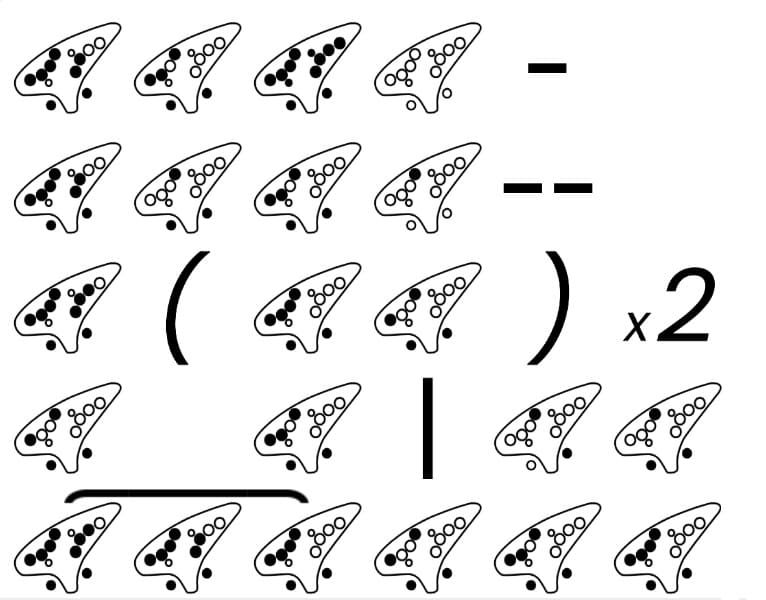
Read a tablature just like a book—from top to bottom and left to right. Each time you see an ocarina diagram, it means you should play one note for one beat. The hand position shown is called a fingering. To play that note, cover the holes on your instrument that are filled in black on the diagram, and leave the white holes open so air can flow. The two holes on either side of the mouthpiece represent the holes at the back of the instrument.
When you see a horizontal line, hold the previous note for two beats instead of one, so it lasts twice as long as a note without a line. If there are two horizontal lines side by side, the note lasts for four beats.
Multipliers work exactly as they do in math. If parentheses are present, you must repeat everything between the parentheses the number of times indicated by the multiplier. If there are no parentheses, simply repeat the last note.
Vertical bars or spaces can mean different things depending on the author of the tablature. Sometimes they indicate a moment of silence. Other times, they’re simply used to format the tablature to make it easier to read. Some players also use them to mark a spot where you can take a breath. If the author doesn’t provide specific instructions about what these bars or spaces mean, you’ll need to infer it from context.
Finally, horizontal braces above several patterns indicate that you should play those notes in a single breath. These are called phrasing slurs. Normally, you would articulate each note by giving your breath a new impulse. You can learn more about this by reading our article on how to blow properly into an ocarina. The brace tells you to do the opposite—keep blowing continuously as you change notes. This technique is more suited to advanced musicians, because it requires good lung control and very clean fingerwork.
Is the fingering in the tablature always the same regardless of the ocarina?
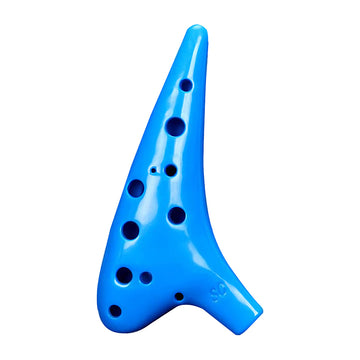
Unfortunately not. As you may have noticed, the tablature shown above is for a 12-hole ocarina. There are therefore different tablatures for 10-hole ocarinas, 6-hole ocarinas, and even double and triple ocarinas. This means that very often, if you do not have the ocarina that is visually shown in the tablature, you won’t be able to play it as-is, and you’ll need to transpose it—which can be long and tedious.
In addition, it’s important to know that all ocarinas have a key and a range. The range is the span of notes the instrument can play. For ocarinas, there are mainly four ranges: soprano, alto, tenor, and bass. Be aware that some manufacturers call "tenor" the model that most others call "alto". Range isn’t an issue for reading music, because an alto and soprano ocarina in the same key use the same fingerings. The melody will simply sound lower or higher depending on the instrument’s range.
On the other hand, the key completely changes the ocarina’s fingering. There are essentially three keys: C, F, and G, although you can find more unusual ones. Since the fingering changes with each key, it’s crucial to know which key the author used when writing the tablature. So don’t expect to play tablature written for a C ocarina on your G ocarina. To help you understand, here is a diagram of the fingering for a C ocarina:
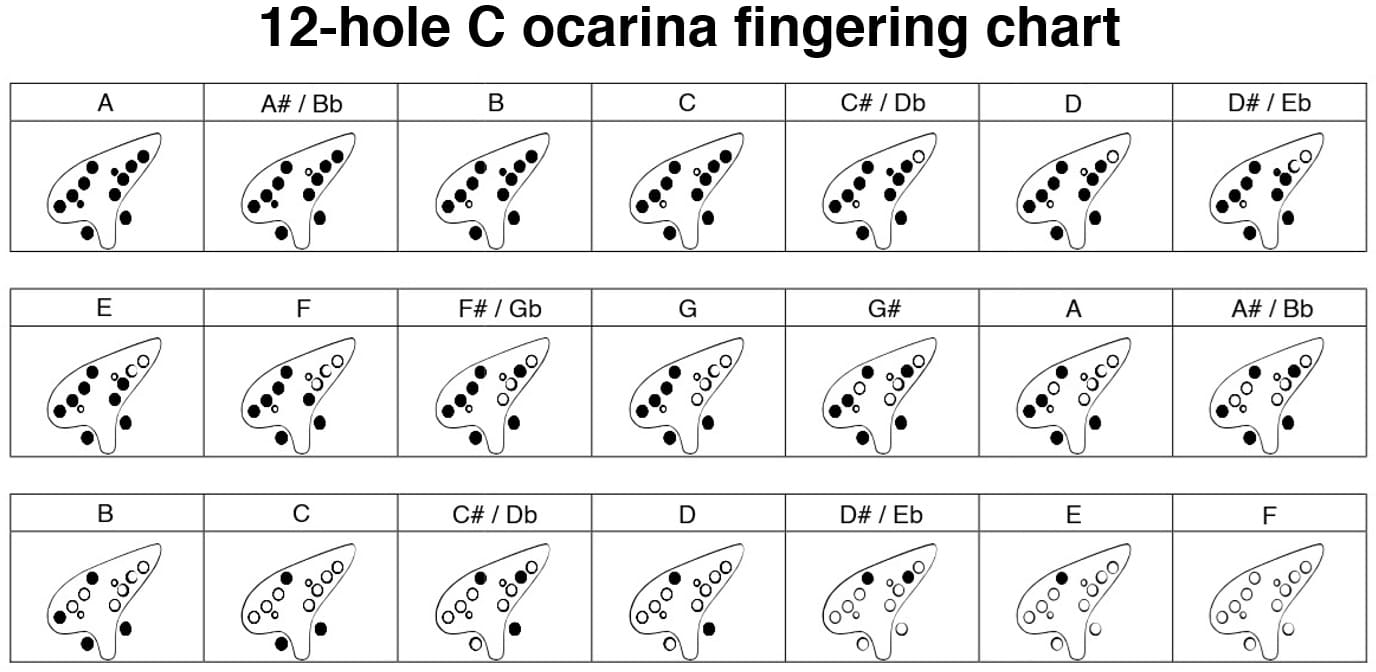
Then, for comparison, here is the diagram for a G ocarina:
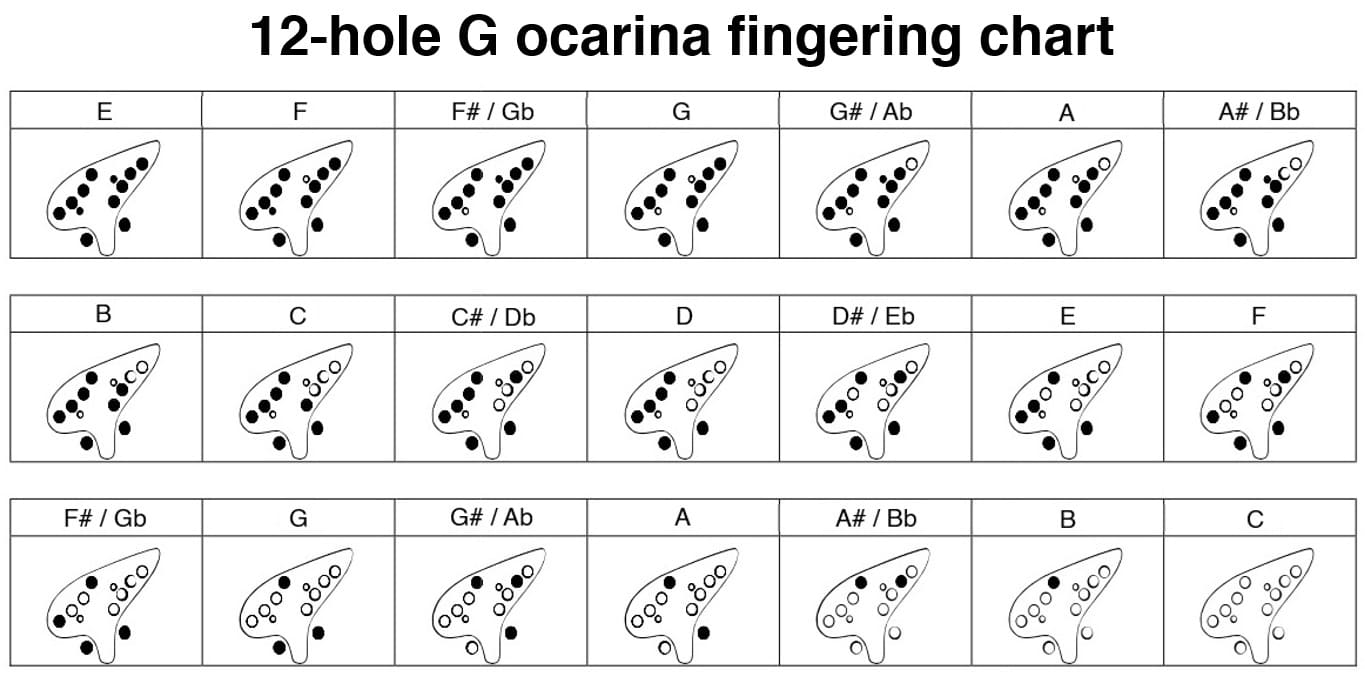
You’ll notice the fingerings are different, so it’s essential to know the intended key when following a tablature. If no information is given, the tablature is most likely for a C ocarina, since it’s currently the most common and best-selling model.
In conclusion, tablature has the advantage of being simple and providing a visual reference, which is perfect for beginners. However, it also comes with drawbacks. For example, how do you show that a note should last for half a beat or a quarter of a beat? And what exactly counts as one beat? That level of timing detail is hard to express in simple tablature. That’s why some musicians prefer using standard sheet music, which works for any instrument. Let’s look at that next.
Classical sheet music, but specific to this type of flute
Ocarina sheet music is essentially standard notation that has been simplified so it can be played on an ocarina. It’s important to understand that, unlike a piano, you can’t play multiple notes at once on an ocarina. So you generally can’t play a piano score directly on ocarina, except for very simple melodies. That’s why some musicians have created sheet music specifically arranged for ocarina. It looks like this:
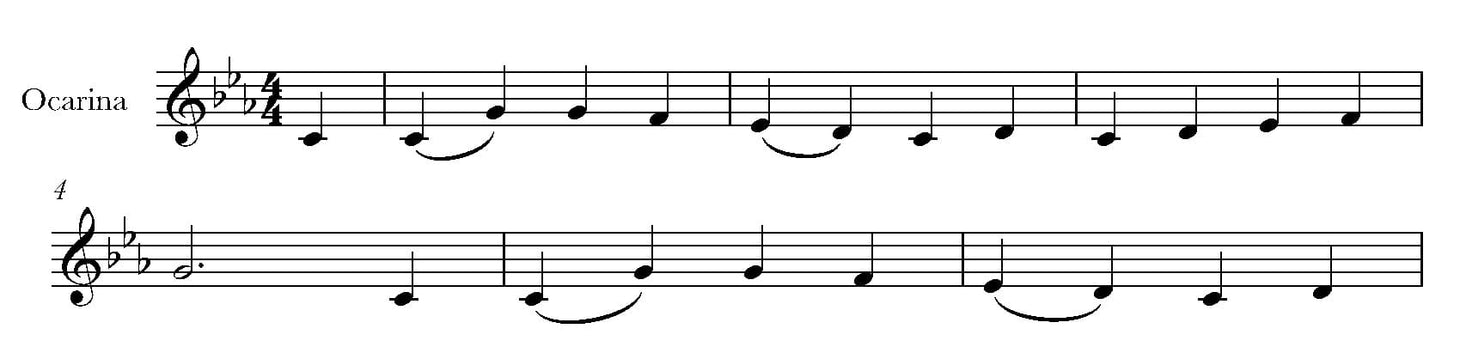
As you can see, if you have no background in music notation, these scores can become confusing quickly. The goal of this article isn’t to teach music theory, but to give you the basics you’ll need if you still want to try playing this kind of sheet music.
On the far left, next to the word "ocarina," you’ll find the treble clef along with the key signature and time signature. These concepts can be a bit much for beginners, so we invite you to visit this website to learn more about them. Next come the musical notes on the staff. Depending on the shape of the symbol, each note lasts for a different length of time, as shown in the table below:
| name | whole note | half note | quarter note | eighth note | sixteenth note | thirty-second note | sixty-fourth note |
| note value |  |
 |
 |
 |
 |
 |
 |
| duration | four beats | two beats | one beat | half a beat | quarter of a beat | 1/8 of a beat | 1/16 of a beat |
Notes may be grouped together. Only eighth notes, sixteenth notes, thirty-second notes, and sixty-fourth notes can be grouped like this. In standard notation, this is called beaming. It’s simply a way to make rhythms easier to read. The note durations stay exactly the same whether they’re beamed or not. You’ll find an equivalent example below:
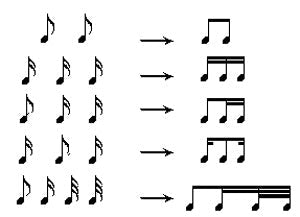
You may also encounter moments of silence, meaning you should play no notes for that amount of time. Below is a table showing the different rests and their durations:
| name | whole rest | half rest | quarter rest | eighth rest | sixteenth rest | thirty-second rest | sixty-fourth rest |
| silence figure |  |
 |
 |
 |
 |
 |
 |
| duration | four beats | two beats | one beat | half a beat | quarter of a beat | 1/8 of a beat | 1/16 of a beat |
In reality, these tables are only accurate for a 4/4 time signature, like in the example shown above. But that gets into music theory concepts that aren’t especially useful for non-professional ocarina playing. Just remember that different note values last for different lengths of time and, for example, a quarter note always lasts twice as long as an eighth note and half as long as a half note.
The position of the note on the staff then indicates which pitch to play. You’ll find the correspondence in the diagram below:

A curved line between two notes indicates a slur, as explained above, or a tie, which is used to extend the same note. There are four in the example above. You may also find one or more dots immediately after a note, as on the only half note in the example above. This is an augmentation dot, which also extends a note’s duration. It works like a tie, except the added value is fixed. The first dot always adds half the original duration, the second adds a quarter, and the third (which is rare) adds an eighth. So a half note followed by two dots lasts for the half note + half of that value (1st dot) + a quarter of that value (2nd dot), for a total of 3.5 beats. Like ties, dots help you create rhythmic durations that aren’t available as basic note values.
More rarely, you may encounter a triplet, which looks like this:
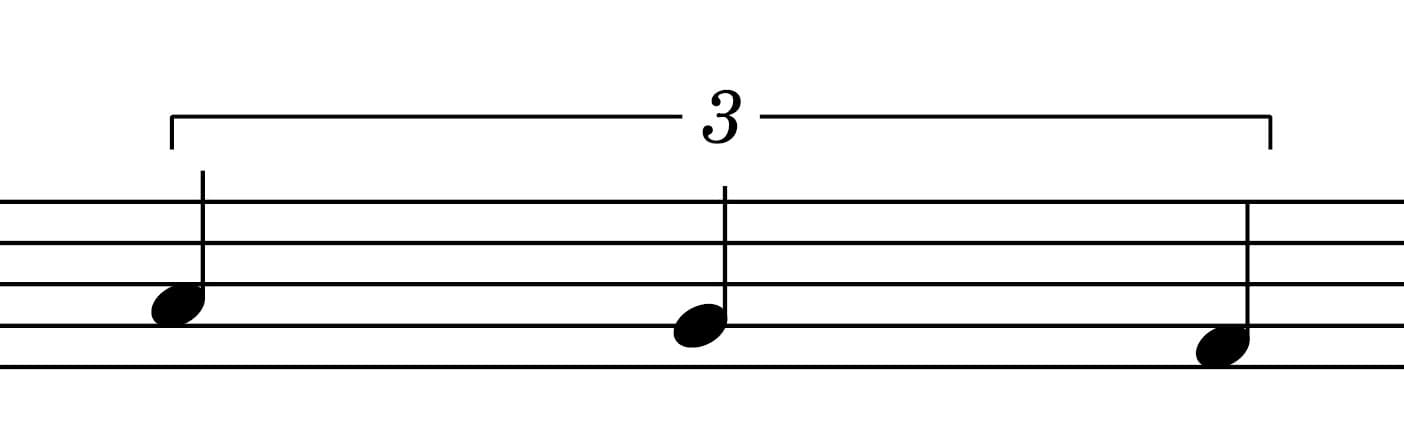
A triplet is a special rhythmic division: you play three notes in the time normally taken by two. So if, for example, three quarter notes are in a triplet (like here), all three must be played in the time of two quarter notes.
Finally, certain passages in the score may be repeated. These passages are enclosed between what are called repeat bars. They’re represented by two vertical lines with two dots either before or after. Look at the example below, where they’re placed at the beginning and end of the staff:

These repeat signs tell you to repeat a passage. The principle is simple: when you reach a repeat sign with dots on the left, you go back to the repeat sign with dots on the right. If there’s no repeat sign with dots on the right, you go back to the very beginning. So in this example, you play the entire staff twice. Repeat bars save space and make the music easier to read for both the composer and the musician.
So, to play a song from standard notation, you need to identify the notes you’re meant to play on your ocarina, memorize the fingering for each note, and then perform it on the instrument. This is clearly not the easiest way to learn ocarina. That’s why some musicians have created a hybrid between sheet music and tablature.
Understanding complex tablature for this wind instrument
Complex tablature is a smart mix of tablature and sheet music, both of which we covered earlier in this article. The idea is to show the correspondence between the notes written on the staff and the fingering you need to use on the ocarina. Here is an example:
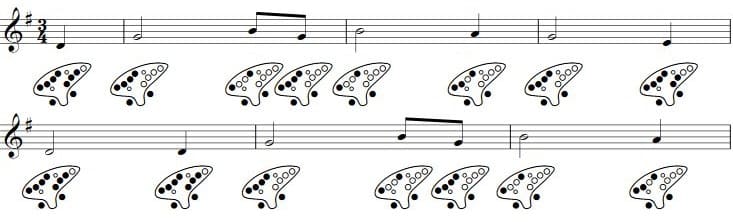
This is the method I recommend for beginners, because it helps you gradually learn the logic of standard notation until, one day, you no longer need fingering diagrams. You’ll then be able to play just about any piece of music written for ocarina, and you’ll also build a strong foundation if you decide to learn another instrument later. That said, the same note about key still applies: the ocarina you’re playing must be in the same key as the score or chart. Otherwise, the fingerings won’t match.
The challenge is finding this kind of hybrid tablature, since it’s still fairly rare.
Play the vast majority of songs with a C ocarina
Reading ocarina sheet music and tablature is far from easy, especially for beginners who have never played an instrument before. But thanks to what you’ve learned in this article, you now know how to decipher these musical documents and play an unlimited number of melodies.
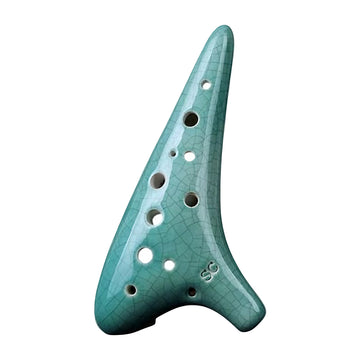
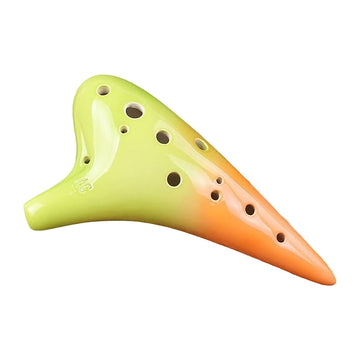
That said, you’ve also seen how central the key and the number of holes are when it comes to following sheet music. Since the vast majority of charts you’ll find online are written for a 12-hole ocarina in C, it’s a great choice if you want the best chance of enjoying well-known songs without headaches. That’s why the Instruments du Monde store recommends this beautiful ocarina, which perfectly matches what most sheet music and tablature are written for.
Click the image below to check out this ocarina:
Do you know where the ocarina comes from? It’s often assumed that it was created in Italy, but in reality, it has roots in several cultures. Discover the origins of the ocarina by clicking here.


