



Written by Ambre Montespan - Updated on Sep 28, 2026

Table of contents:
Would you like to know about all the professionals who make handpans in the United States? Is one of their workshops located near you? What are the prices and production times for the instruments you might want to buy?
As a handpan player for over 10 years, I’ve long been interested in the various artisans who produce handpans across the American continent. So I’m well placed to give you a broad list of the makers crafting this truly unique sound object within the U.S.
The best-known handpan maker in the United States is Pantheon Steel, Kyle Cox’s brand, simply because it was the very first workshop in the Americas to produce this instrument, starting in 2004. Since then, dozens of other companies have emerged across the United States.
As you read this article, you’ll discover:
- Whether there are handpan makers near you
- A list of most of the professionals working in the U.S.
That way, you’ll get all the useful information about these makers so you can potentially meet them and see whether their instruments are right for you.
Now, let’s take a look at all these American professionals together.
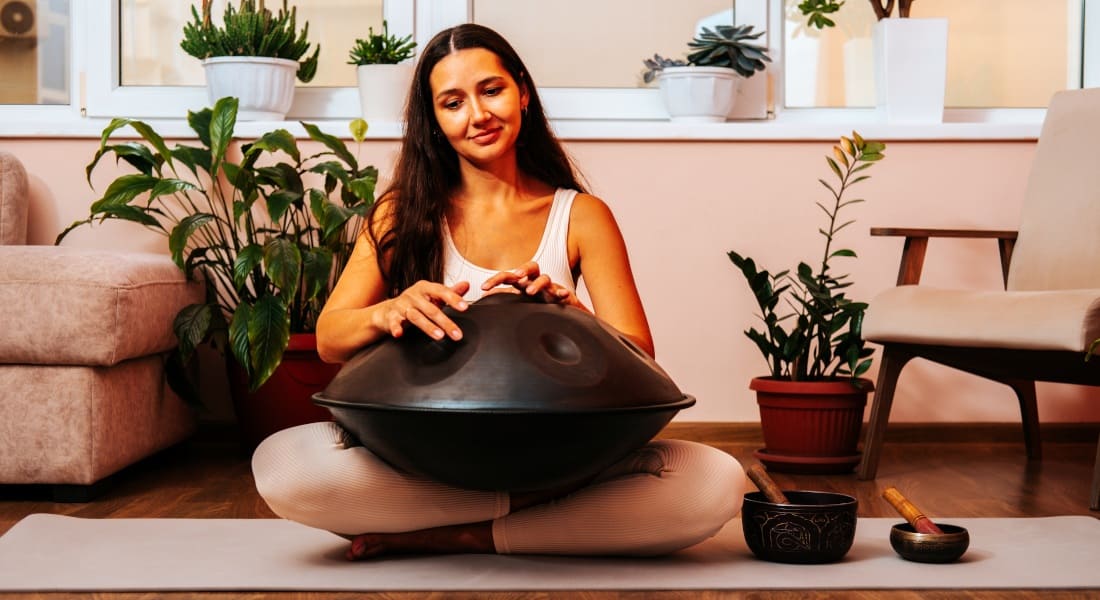
Who are the artisans making handpans in the United States?
While the handpan is derived from the Hang, which was created in Switzerland in 2000, the term “handpan” was actually coined in the United States by Kyle Cox when he began crafting sound objects similar to those made by PANArt, simply because demand was exploding and PANArt was limiting production. Today, the United States has a good dozen workshops that truly manufacture their instruments on American soil. Here is a detailed list.
Pantheon Steel, the Missouri elder
It all started here, or almost. Based in Farmington, Missouri, Pantheon Steel is not only the first handpan maker in the United States but arguably the second in the world after PANArt. Behind the brand is Kyle Cox, a former steel drum maker who founded his workshop in 2004 and released his first instruments, called “Halo,” around 2007. Once supported by his business partner Jim Dusin, who passed away in 2016, he now leads a team of about ten people. The Halo is crafted from nitrided steel and comes in several diameters, from 53 to 58 cm (21 to 23 in). It is distinctive for featuring up to 12 different notes on a single shell, with the high notes placed in the centre, a deliberate nod to the Trinidadian steel pan. Price-wise, expect to pay between US$3,000 and US$3,500 depending on the model and number of notes, with a hard case included. For many years, the brand distributed its instruments through a nearly legendary waiting list system with tens of thousands of registrants.
Makai Instruments, the breath of the Pacific
To find the most far-flung workshop on this list, you have to cross the entire country to Pahoa, on Hawaii’s Big Island. It’s there, inside a 6 m (20 ft) shipping container set a few hundred metres from the ocean, that David Galleher crafts his Makai Instruments. The brand name comes from the Hawaiian word “makai,” meaning “toward the ocean.” It’s also worth noting that David Galleher created the very first podcast dedicated to the handpan, simply titled “The Handpan Podcast,” which was later taken over by Sylvain Paslier. Established in 2016, David Galleher has developed a recognizable sound signature, with deep resonance, brightness, and great clarity, as if the salty Pacific air had slipped into the steel. His instruments sell in a range of about US$1,800 to US$3,000, with a production lead time of around two months. It’s a small-scale island operation, but one with real affection in the community, driven as much by the warm personality of its creator as by the quality of his pans. Here is one of his creations:
Arcana Musical Instruments, canyon steel
Arcana Musical Instruments was founded in 2012 by Josh Keegan and Jerred Houseman. Two years earlier, they discovered the handpan and went on to handcraft their first instruments two years later in the spectacular canyons of Manitou Springs, at the foot of the Rocky Mountains. Arcana specializes in stainless steel, with its signature model, the Dōm Illuminous. The handpans range from 50 to 53 cm (20 to 21 in) in diameter, and you’ll need to budget between US$1,800 and US$3,000 to own one. Jerred Houseman is also associated with another brand, Vimana Handpans, also based in Manitou Springs, proof of a deeply rooted creative energy in this small Colorado town, which, against all odds, has become a hub for handpan making in the United States.
Iskra Handpans, Colorado’s secret
This workshop may have changed its name, but the craftsmanship has not. Sean Beever formerly crafted his instruments under the Symphonic Steel brand in Southern California. That company has closed for good, but the maker has relaunched his business from Colorado under the name Iskra Handpans, named after his flagship model. A seasoned tuner, Beever began playing steel pan at age twelve and has been tuning steel for more than twenty years, with a level of precision that commands respect. The secret of the Iskra lies in its steel: a highly nitrided alloy whose exact composition remains closely guarded, similar to alloys used in aerospace for their rust resistance and strength. The shells measure about 53 cm (21 in) and come in a wide range of scales, from Celtic Pygmy to Hijaz Kar, with an entry-level line called Motif. Prices range from about US$1,200 to US$2,400 depending on the number of notes.
Veritas Sound Sculpture, the truth of steel
Josh Rivera’s journey reads like a coming-of-age novel. A player since 2006, the year a PANArt Hang turned his life upside down while he was living in North Dakota, he attended his first handpan gathering in North Carolina in 2012. Two renowned makers, Mark Garner and Colin Foulke, told him he had “the personality to learn how to tune.” Back home, he closed his recording studio to devote himself entirely to the art of tuned steel. Four and a half years with the Saraz team followed before he founded Rivera Steel Tuning and then launched his own brand, Veritas Sound Sculpture, in 2018. Based near Asheville, Josh Rivera crafts 53 cm (21 in) handpans from 430 and 439 stainless steel. Prices range from about US$1,800 to US$4,500 depending on the line and number of notes.
Elysian Instruments, the soul of the Pacific Northwest
Head northwest to the misty forests of Washington State, where Patrick Verschoor has set up his workshop. The name “Elysian” evokes all things celestial, paradisiacal, and divinely inspired, and Verschoor grew up roaming the snow-covered mountains and lush forests of his native region. Wild nature and music have always fed his imagination, but hearing a handpan for the first time sparked his calling. He then spent two full years searching, experimenting, and weathering setbacks until he mastered his own approach to making them. Available for immediate purchase or as a custom pre-order, Elysian handpans can be ordered directly from his website, which also includes an educational section for beginners.
Pansnap, the Texas bet
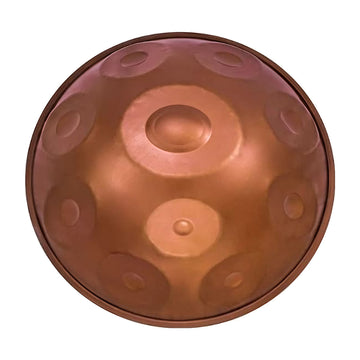
Bryant Evangelista, a percussion student at the Bob Cole Conservatory at California State University, Long Beach, launched his brand Solaris, which later became Pansnap, in 2016. He is one of the few handpan makers in the state of Texas. Pansnap works with heat-treated stainless steel, which takes on a distinctive coppery hue, with a reference tuning of 440 Hz. The shells measure about 50 cm (20 in) in inner diameter and roughly 20 cm (8 in) high, weigh around 4 kg (8 lb 13 oz), and come in eight or nine notes. You can hear one of his creations in the video below:
Spirit Handpans, the next generation from North Carolina
In Swannanoa, just outside Asheville, Rebecca Dancyger has written one of the most beautiful recent chapters in American handpan making. Presented as the second woman in the world to have made a handpan, and as the youngest owner of a production workshop at the time of its creation, she founded Spirit Handpans in June 2016 after training with Jon Antzoulis of Aura Handpan. Her workshop? The basement of her own home, transformed into a sound laboratory. Spirit works mainly with stainless steel, using several processes depending on the format: deep-drawn Ember stainless for standard sizes, hydroformed 430 stainless steel for medium and mini models, “Titan Steel,” and even nitrided steel on request. The shells measure about 53 cm (21 in) in inner diameter. Prices remain gentle for handcrafted work: expect US$1,200 to US$1,800 for an eight- to ten-note model, and US$1,800 to US$2,400 for models with more than eleven notes.
Axiom Instruments, Nevada’s obvious truth
The name says it all: an axiom is a truth so obvious that it needs no proof. That is the philosophy Jacob Lee placed at the heart of his workshop, founded in 2013 in Pahrump, in the Nevada desert, after he nearly gave up on music. A life-changing encounter with the power of the handpan put him back on track and pushed him to build a business entirely grounded in the truths of that experience. Since then, thousands of hours have gone into developing his craft through patient, persistent iteration. The workshop notably works with deep-drawn 430 stainless steel on 53 cm (21 in) shells, as shown by its recent fifteen- and sixteen-note models. Featured in the catalogues of several retailers and active in the community, Axiom Instruments embodies this new generation of rigorous American makers who place sound quality above all else.
Hamsa Handpans, the heir who became a master
Among the students of David Beery, a highly respected master handpan maker, Stevan Morris has done especially well. After two years of apprenticeship with the master, he founded Hamsa Handpans in 2015 and set up on his own in California. More than ten years later, he has an international clientele and expertise that goes far beyond simple manufacturing. Hamsa is also a complete ecosystem around the instrument: tuning services, a studio, lessons, and educational support. Stevan Morris is also the founder of the Pantasia Handpan Gathering, an event held in Joshua Tree, California, that has become one of the community’s key West Coast gatherings.
Xenith Handpans, the inventor from Sonoma
In Sonoma County, California, Colin Foulke is not an ordinary maker. A player since 2009 and a maker since 2013, he made his mark on the scene by developing a method for hydroforming shells, meaning shaping steel under the pressure of a fluid. After making his discovery public, many makers now use this method to create their own models. His current model, the Xenith Classic, is built from nitrided steel with a stainless steel rim on 50 cm (20 in) shells, usually with seven notes tuned in D. Originally launched at an introductory price of around US$1,000, it now sits around US$1,600, plus shipping.
Dave’s Island Instruments, the mentor figure
David Beery is no newcomer: he has been making steel drums since 1991 and handpans since 2010, making him one of the veterans of the California scene. Based in the Los Angeles area, his workshop, Dave’s Island Instruments, abbreviated as “Dii,” has mainly served as a training ground. He trained Stevan Morris, the future founder of Hamsa, as well as Bryant Evangelista, the man behind Pansnap. A true family tree of American handpan making has its roots in his expertise. On the manufacturing side, David Beery uses nitrided steel, stainless steel, and even ember steel to create handpans about 50 cm (20 in) in diameter, priced from US$1,800 to US$2,400.
Saraz Handpans, the soul of the Appalachians
Head to the mountains of North Carolina, around Asheville and Black Mountain, where Mark Garner has set up his workshop. The story of Saraz is first and foremost a family story: Mark founded the brand in 2011 with his father, “Papa Steve,” after discovering the Hang and then buying a Halo from Pantheon Steel. Curious and generous, he studied the major names in American handpan making and was one of the first to publicly share his techniques on forums, helping to train an entire generation of makers. Fifteen years later, Saraz Handpans is one of the oldest workshops still fully active, and one of the most respected. Mark Garner and his team work with both nitrided low-carbon steel and stainless steel. Prices start around US$2,000 and climb past US$4,000 for larger models. Give one of their handpans a listen:
Oasis Sound Sculpture, the meditative gateway of Los Angeles
Originally from Honolulu, Adrian Ensor discovered the handpan in 2014 while watching a video that left him speechless. He began collecting pieces in 2016, then trained by making shells in the garage of Terence Jay, the maker behind Nirvana Handpans, and alongside Stevan Morris of Hamsa Handpan. One thing led to another: he founded Oasis Sound Sculpture in 2017 and began building his own sound sculptures. He works with nitrided steel and stainless steel shells, available in 50 and 53 cm (20 and 21 in), with custom scales and lower notes available. Expect to pay about US$1,200 to US$2,400 depending on the number of notes, with a six- to eight-week production lead time.
Acolyte and Nirvana, California’s two faces
In Glendale, a suburb of Los Angeles, Terence Jay runs a dual operation under two complementary brands. On one hand is Acolyte Instruments, which offers financially accessible models. On the other is Nirvana Handpans, which allows for almost total customization of the instrument in exchange for a much higher budget and a far longer production lead time. Diameters range from the mini 43 cm (17 in) to the classic 53 cm (21 in). Budget-wise, an eight-note Acolyte starts around US$1,199, the AcoLana model runs around US$1,799, and customizable Nirvana models start around US$2,500.
Aura Handpan, from a pizza pan to New Jersey
Not every calling begins gloriously. Jon Antzoulis’s started in 2012, when he began hammering a simple pizza pan to understand how steel could sing. A Rutgers University graduate, he has been tuning what he calls his “singing steel” since 2014 and set up his Aura Handpan workshop in Denville, New Jersey, one of the few serious East Coast makers outside North Carolina. Take the time to hear one of his handpans:
Isthmus Instruments, the Wisconsin pioneer
In Madison, Wisconsin, a city built on an isthmus that gave the workshop its name, Jenny Robinson made history in another way. By founding Isthmus Instruments in 2013, she became the first woman in the world to lead and operate a handpan company. It’s a point of pride she claims openly. Surrounded by her tuner, April Moncrief, and several apprentices, Jenny Robinson also co-authored one of the first handpan method books published in the United States. Her workshop works with nitrided low-carbon steel and stainless steel, and it stands out for making its own shells entirely on U.S. soil from steel melted in the U.S. The instruments, offered in a 53 cm (21 in) diameter, fall within a range of about US$1,800 to US$2,800.
Treat yourself to an excellent handpan with sublime tones
From the first Halo handpans hammered in Missouri to the hydroformed shells of Sonoma, through Hawaiian shipping containers and North Carolina basements, American handpan making tells a beautiful story of self-taught artisans, transmission, and contagious passion. Thanks to the list of professionals in this field that you’ve discovered in this article, it’s now certain that you have a better overview of these artisans.
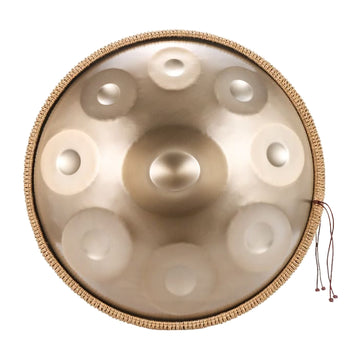
However, placing an order with these companies can take time and cost a great deal. That’s why I instead recommend the affordable, immediately available models sold by Instruments du Monde. You’ll have a choice of more than 100 references with perfect acoustics and unbeatable prices, such as this 9-note handpan tuned to D minor.
Buy this handpan right now by clicking on the image below:

Now, why not cross the northern border of the United States to take a look at the handpan makers based in Canada? As it happens, there are several interesting workshops there too.


