



Written by Ambre Montespan - Updated on Sep 26, 2026

Table of contents:
Have you just discovered a rather unusual musical instrument called a Tibetan singing bowl? Are you wondering where this mysterious object comes from and what its path of creation might have been? What are the origins of the Tibetan singing bowl?
As someone who’s always been curious about this instrument, I’ve taken a deep dive into the roots of the Tibetan singing bowl. I can now share what I’ve learned over more than 10 years to help you uncover the secrets behind the singing bowl.
The origins of the Tibetan singing bowl are far from certain. The few written records concerning this instrument date back to the 1970s, and while some claim that the singing bowl was born more than 5,000 years ago in Mongolia, nothing actually confirms it.
After reading this article, you will finally know:
- The origins of Tibetan metal-alloy bowls
- Where quartz crystal singing bowls come from
That way, you’ll have everything you need to form your own opinion about the lineage of this enigmatic musical instrument.
Let’s explore the origins of the Tibetan singing bowl together.
What are the mysterious origins of the Tibetan bowl?
It turns out that before the 20th century, there are no written records mentioning Tibetan singing bowls, either in the literature of that country or in the various exploration reports produced by Westerners. Consequently, the origins of this instrument are unclear, and the first mention of it dates back to the 1970s.
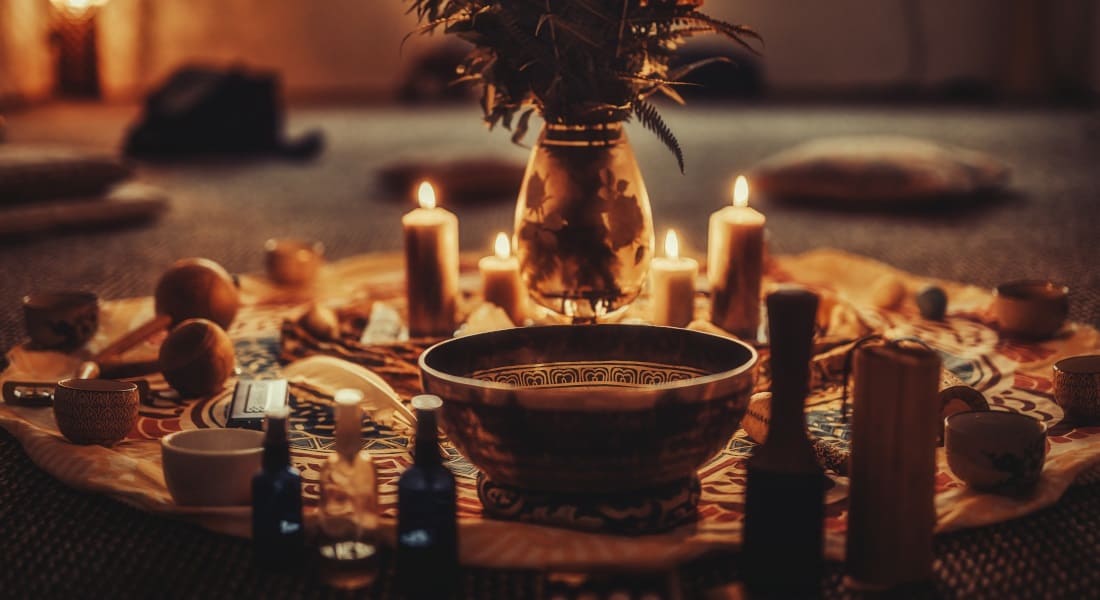
The near-absence of sources leaves doubt surrounding this musical instrument
Looking at the legends that have grown up around the Tibetan singing bowl, it seems that this instrument was born around 5,000 years ago in the steppes of Mongolia, where nomadic blacksmiths hammered copper bowls for cooking. As the craftsmen’s techniques improved over time, the bowls were later made from metal alloys rather than just copper, producing richer tones and stronger vibrations. Mongolian shamans then supposedly took an interest in these objects, using them in their rituals as mystical musical instruments.
From there, the singing bowl was incorporated into the Bön religion, a Tibetan tradition that predated Buddhism, before Buddhism became the majority faith starting in the 8th century. The use of bowls would then have been passed on to Buddhist monks and spread to India, Nepal, China, and, of course, Tibet. The legend goes on to say that when Tibetan miners met Nepalese blacksmiths, the quality of the bowls improved significantly through the incorporation of the famous seven metals before the bowls were “discovered” by Westerners in the 1960s. However, metallurgical analyses of the composition of more than 100 ancient Tibetan bowls show that these objects were made of a bronze alloy—namely copper and tin, sometimes with a little iron—and not seven metals.

The problem with this legend is that there’s no solid evidence to confirm it. It’s true that metal-alloy bowls were used by Tibetan families for cooking and by Buddhist monks to receive alms. Still, many other cultures, peoples, and religions have clearly done the same. As a result, these elements can’t serve as proof that Tibetan singing bowls existed in the ancient world.
Furthermore, written records seem to contradict this story about the origin of Tibetan bowls. In 1988, ethnomusicologist Daniel Scheidegger published a book titled "Tibetan ritual music. A general survey with special reference to the Mindroling tradition" focusing on traditional Tibetan music and instruments. He lists dozens of instruments, and there is no mention of anything resembling a singing bowl. Almost 100 years earlier, Perceval London, an English journalist and explorer, spent nearly two years between 1903 and 1904 studying Tibetan music. Again, there is no mention of Tibetan singing bowls in his writings.
Furthermore, some accounts, such as that of Tenzin Dheden, a Tibetan student who immigrated to Canada, indicate that, according to her, Tibetan bowls never existed before the arrival of Westerners in her country of origin. Her family and various acquaintances born before the 1960s had never heard of them. Some suggest the bowls were hidden during the Chinese military invasion of 1950. But how could Tibetan bowls have been hidden so effectively—and why? There’s no clear answer.
So what is the origin of singing bowls? Let’s now turn to the earliest existing written records.
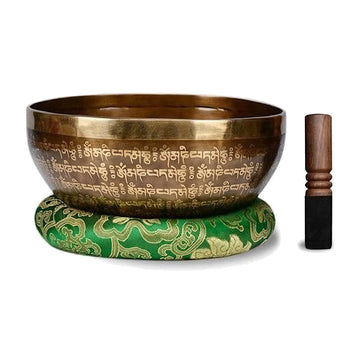
The birth of the term "Tibetan bowl" in the 1970s
The first known appearance of the term “Tibetan bowl” or “singing bowl” in writing was on the cover of the album “Tibetan Bells,” released in 1972 by musicians Nancy Hennings and Henry Wolff. The aim of this album was to offer the listener a very special sound journey using percussion instruments. You can listen to an excerpt from this album by watching the video below:
Although the term "Tibetan bowl" is used, nothing proves that the instrument heard actually came from Tibet, as the two musicians provided no details. Still, to the ear, there’s a characteristic sound that evokes a singing bowl.
Looking at the musical instruments of Tibet’s neighboring countries, you’ll notice a strong resemblance between the Japanese "rin" or "dobachi" (itself inspired by the Chinese "nao") and today’s Tibetan singing bowl. Like the latter, the rin or dobachi has the shape of an inverted bell, rests on a fabric cushion, and is played with a felt-covered mallet. The resemblance is striking. They were used in Buddhist religious rituals and could measure more than 3 ft 3 in (1 m) in diameter. You can see a musician playing a rin in the video below:
So did Nancy Hennings and Henry Wolff make a mistake by calling something a "Tibetan bowl" when it was actually a dobachi? Was that choice intentional, using the word “Tibetan” to give the instrument a more mystical, esoteric aura? Or did they actually discover a singing bowl in Tibet? Most likely, no one will ever know.
What is certain is that today it’s no longer possible to walk around the tourist areas of Kathmandu without coming across a singing bowl seller or an energy healer offering treatments to open, unblock, or harmonize your chakras using a Tibetan bowl. Skeptics tend to think that this musical instrument is simply the result of strong Western interest in the object and that Tibetans have capitalized on it. Others assume that all or part of the legend surrounding Tibetan bowls is true.
It’s up to you to form your own opinion on the subject based on the various objective facts presented in this article. But whatever you decide, know that this in no way detracts from the benefits and virtues associated with Tibetan bowls. Indeed, their soothing properties are well established.
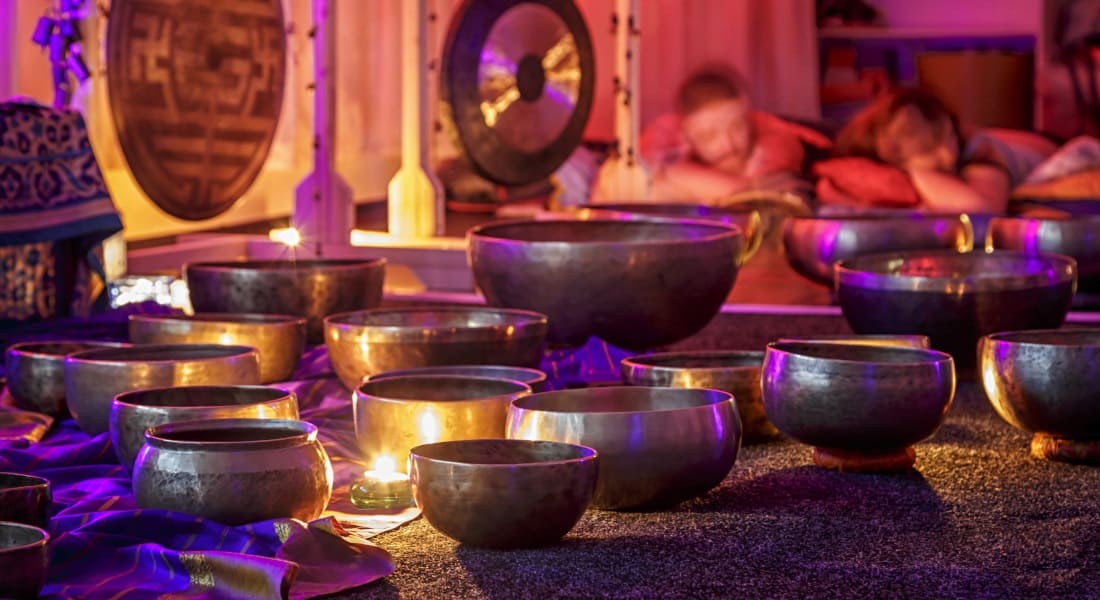
The more recent origin of quartz crystal singing bowls
Quartz crystal or rock singing bowls have a much more recent origin. During the 20th century, the French company Saint-Gobain, one of whose branches specializes in quartz, filed a patent for a special process for transforming quartz powder into a solid material.
Using the principle behind this patent, powdered quartz crystal is melted at several thousand degrees to give it the desired shape, in this case that of a singing bowl. The first crystal bowls for therapeutic purposes appeared in the 1980s. However, the name of the person who came up with the idea of combining quartz and Tibetan bowls has been forgotten. Today, crystal singing bowls are valued for the great precision of their note.
Experience deeper calm by purchasing a Tibetan singing bowl today
The origins of the Tibetan singing bowl remain a mystery to this day, and it’s quite likely they’ll remain that way for years to come. Now you have all the relevant information about the singing bowl so you can form your own opinion on the matter.
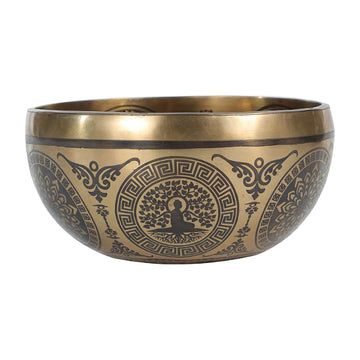
However, if there is one point on which there is no debate, it is the relaxing benefits of this musical instrument, particularly when used in meditation. The Instruments du Monde store recommends using this engraved singing bowl, whose deep vibrations are sure to bring you the peace you seek.
Treat yourself to this Tibetan bowl by clicking on the image below:
Now that the origins of the singing bowl have been laid out, it’s time to go into more detail about how this musical instrument is made. So, read our article explaining exactly what a Tibetan bowl is. If that doesn’t interest you, take a look at this other article that covers everything you need to know about the singing bowl. This crystal-clear sounding object will hold no more secrets for you.


