



Written by Ambre Montespan on Mar 14, 2023 · Updated on Sep 25, 2026

Table of contents:
You know what a kalimba is—that small percussion instrument that looks like a miniature piano—but where does this mysterious object actually come from? When did it first appear? What are the origins of the kalimba?
It’s been more than 10 years since I discovered the thumb piano, and I was immediately intrigued by its roots. So I did a deep dive into the subject, and I can share what I’ve learned about the creation and evolution of the kalimba.
The kalimba originated in sub-Saharan Africa over 3,000 years ago. It has evolved many times, especially in the 1950s, when Hugh Tracey introduced a Westernized version of the instrument that greatly increased its popularity.
As you read this article, you will learn all about the history of the kalimba, including:
- The birth of this instrument
- Its rediscovery several centuries after its disappearance
- The discovery of the kalimba by Western colonists
- The reinvention by Hugh Tracey
- The evolution of thumb pianos to the present day
You’ll then understand every step that turned the kalimba into the instrument we know today. And you’ll be able to easily explain to your friends where this curious instrument comes from when they see you holding one.
So let’s set off together to explore the origins of the kalimba and learn everything there is to know about it.
When was the kalimba invented?
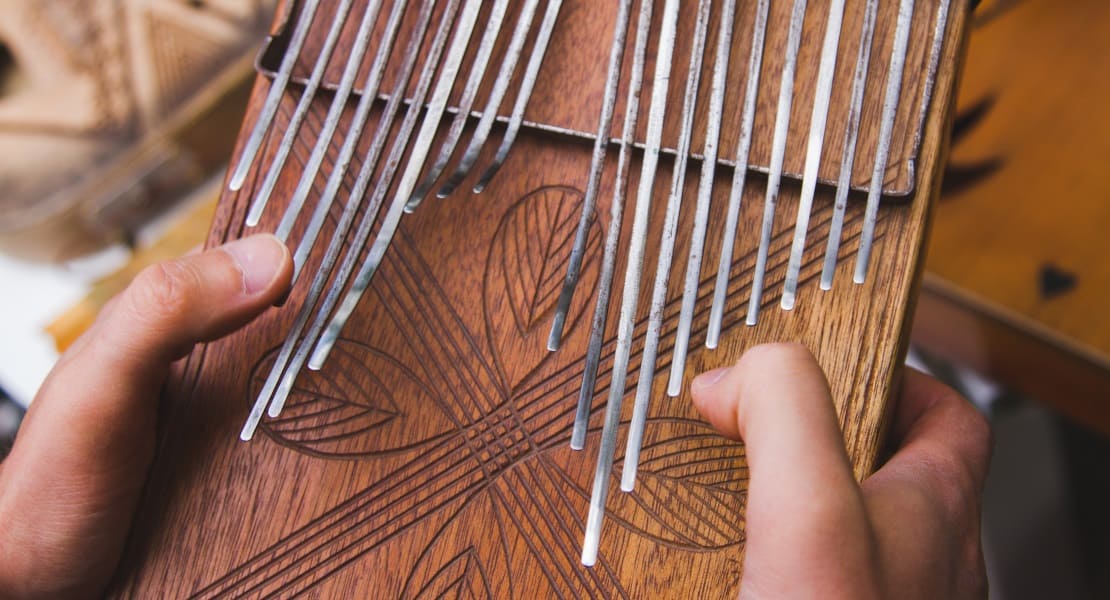
The first archaeological evidence of the kalimba dates back to around 3,000 years ago on the west coast of Africa, mainly in what is now Cameroon. At that time, local communities didn’t yet have advanced metalworking techniques, so the instrument was made with wooden tines, likely bamboo. As a result, those early kalimbas were more fragile than the ones we know today.
Ultimately, few traces have been found of these thumb pianos with bamboo keys. According to current archaeological findings, the kalimba then disappeared completely, only to resurface a millennium later on the other side of the continent in a new form.
The second invention of the thumb piano several centuries after its first appearance
Much later, after its first appearance with bamboo keys, the thumb piano reappeared approximately 1,300 years ago, still in Africa, but this time around the Zambezi, a river that flows through Zambia, Zimbabwe, and Mozambique.
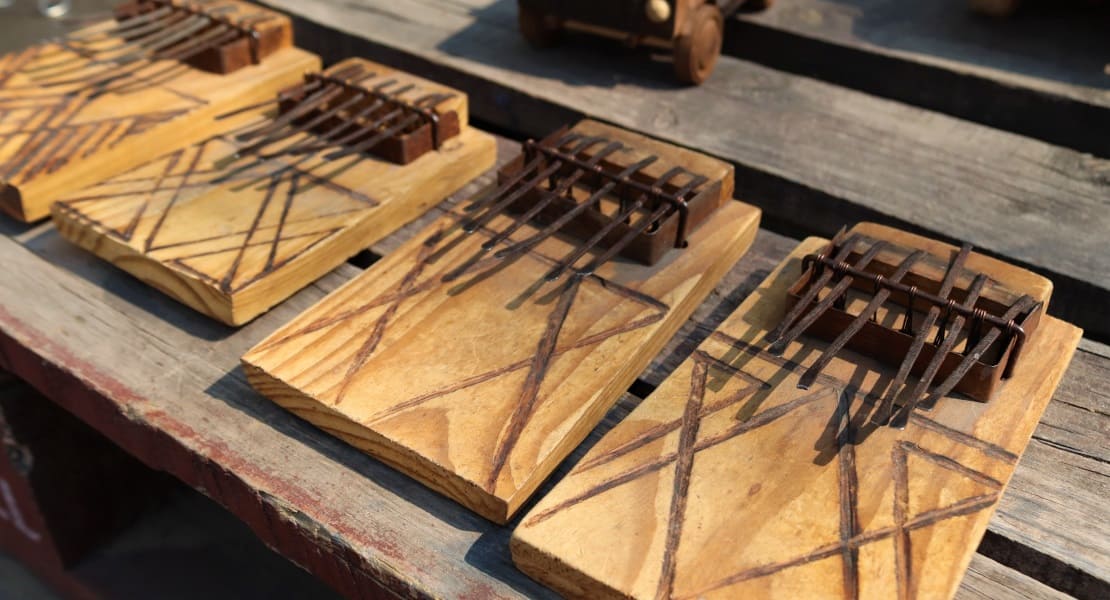
Archaeologists now see that the kalimba has evolved: the tines, once made of bamboo, are now crafted from metal, greatly improving durability. To date, no evidence links the 3,000-year-old bamboo-tined kalimba to the metal-keyed version. As a result, many experts now believe this African instrument was effectively invented twice—a surprising idea given how close those regions are to each other.
The thumb piano with metal tines spread throughout the African continent, particularly in Zimbabwe among the Shona people. Members of this community use the kalimba as a central part of social life. It’s played at celebrations such as weddings and also in more spiritual contexts to connect with spirits or the deceased.
The Shona people call this instrument the mbira. However, many other names exist across Africa to refer to the thumb piano. Among the most famous are: “likembe,” “mbila,” “huru,” “nhare,” “matepe, njari,” “okeme,” “ubo,” “gyilgo,” “sanza,” and the famous “kalimba.”
Today, these words have different meanings. To find out more, check out our article on the difference between a kalimba, a mbira, a sanza, and a sansula. It will help you sort through all these names, whose nuances can sometimes be very subtle.
The discovery of the thumb piano by Western colonists
The first written records of the thumb piano date back to the 16th century and are the work of João dos Santos, a Portuguese Dominican missionary. In 1586, he traveled to East Africa, to what are now Mozambique, Zimbabwe, and Malawi, which were Portuguese colonies at the time. João dos Santos stayed in Africa for a little over 11 years, leaving the continent in 1597. A few years later, in 1607, he published a description of the regions of Africa he had visited in a book he called “Ethiopia Oriental.” It was in this work that thumb pianos were first mentioned in writing.
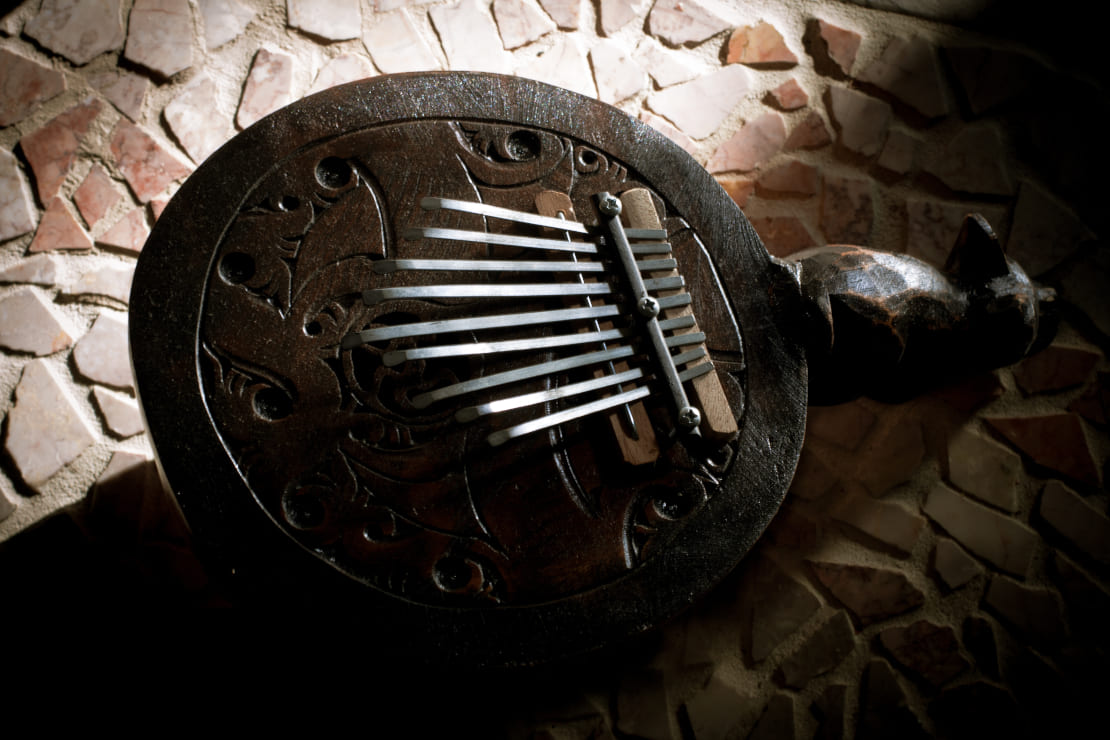
Father João dos Santos described a particular musical instrument he called “ambira”, consisting of nine metal strips mounted on a wooden support. According to the explorer, the instrument produced “soft and pure” sounds, and the player needed to have fairly long fingernails in order to play it properly. He also notes that this percussion instrument does not produce a loud sound and is therefore best suited to intimate settings. Several other explorers would later describe thumb pianos in their writings.
Who created the modern kalimba?
The modern kalimba was invented by ethnomusicologist Hugh Tracey in the 1950s. In 1921, Hugh Tracey left his native England for the former Southern Rhodesia, a British colony that is now Zimbabwe, to work on his brother’s tobacco farm.
During this time, he developed a passion for African music and its unusual instruments. Hugh Tracey then focused his attention on the thumb piano and spent several years designing a Westernized version of the instrument, which he named the kalimba, borrowing one of the names traditionally given to it by African peoples.
The biggest change in the model proposed by the ethnomusicologist was that the instrument was now tuned according to the diatonic scale. In other words, the notes available on the kalimba now follow the familiar Western scale—C, D, E, F, G, A, and B—much like an electric guitar, ukulele, other stringed instruments, or keyboard instruments such as the piano. Before that, thumb pianos weren’t really standardized, and the tines could be tuned in a more irregular way from one instrument to the next. Musicians would simply tune the instrument to their own preference. Hugh Tracey’s kalimba now has 15 tines and is tuned to G major, allowing it to play very melodic pieces.

He also changed the support on which the steel keys were mounted. Instead of a simple wooden board or a calabash, the new support is hollow like a box with a hole in the middle. This design creates a resonance box within the solid wood body, boosting the overall volume of this African percussion instrument. With this acoustic setup, you can also create expressive sound effects on this West African instrument.
Once his kalimba was finalized, Hugh Tracey founded the company AMI, which stands for “African Musical Instruments,” with the aim of marketing his kalimba worldwide. It was also sold at a fairly high price as an educational toy for children by the company Creative Playthings in the United States, alongside other instruments such as guitars, keyboards, string instruments, and flutes. The idea was to connect the kalimba with the music-education approaches used in schools at the time.
The evolution of the thumb piano to the present day
Since the 1950s, Hugh Tracey’s likembe or kalimba model first became popular and then evolved again.
Its popularity grew mainly thanks to the ethnomusicologist’s sons, who played the kalimba in several American music magazines in the 1960s. Then the instrument truly gained mainstream attention when the famous band Earth, Wind and Fire found success with their song “A Kalimba Story” released in 1974, where you can hear the kalimba’s full musical potential alongside the voice of Maurice White. You can discover (or rediscover) this track right below:
Since then, the number of kalimba makers and craftsmen has multiplied, and so have the ways this instrument is designed. Very quickly, models with far fewer tines appeared, often seen as toys, while others boasted many more. While the basic model had 15 tines and was tuned to G major, it now appears that most kalimbas have 17 notes tuned to C major.
The kalimba’s frame has also changed significantly. Until a few years ago, only wood was used to make this type of musical instrument. But now, thumb pianos can also be made from acrylic glass, a transparent plastic polymer that offers a one-of-a-kind look and strong resistance to the elements. The shapes have also become more playful. As a result, Hugh Tracey’s classic box-shaped design now has competition, since you can find kalimbas shaped like cats, foxes, or simply round models at low prices. The types of wood used are also evolving, as the mbira can now be made from mahogany, acacia, or walnut. In short, there’s now something for everyone.
The increase in the number of tines has also led to the emergence of chromatic kalimbas that include all 12 semitones. A major step forward for this small percussion instrument, which becomes more advanced and gains musical range with a wider set of notes and more flexible tuning options. That also makes it possible to learn more complex pieces. The trade-off is that the price is generally higher than for a more traditional model. Finally, other manufacturers such as Hokema, Gecko, and Hluru have emerged to compete with Hugh Tracey’s brand by offering new features such as accessories to protect the player’s fingers or thumbs and sheet music booklets. In addition, the vibrations produced by the tines have been improved.

The mbira’s inscription on UNESCO’s Intangible Cultural Heritage list in 2020
At the fifteenth session of the Intergovernmental Committee for the Safeguarding of the Intangible Cultural Heritage in December 2020, the art of making and playing the mbira was inscribed on UNESCO’s Intangible Cultural Heritage of Humanity list for the prominent role it plays in Malawi and Zimbabwe. On this occasion, the thumb piano was described as producing “a fluid and percussive sound, considered mystical, peaceful, and enchanting.”
In my opinion, this recognition is a well-deserved tribute to an instrument that’s still considered unusual, yet is growing in popularity year after year across the West—and in France—much to the delight of players and musicians who love its gentle tone. What’s more, on some high-quality African models, you can find resonators made from bottle caps, which add a unique charm to the kalimba.
Embark on a unique musical journey by purchasing a kalimba
Unlike the drum or drum kit, the kalimba, or sanza, is an instrument steeped in history, and some of its secrets are still unknown. Dating back more than 3,000 years, its origins are often unknown even to many musicians who play it. But now you know the full story of the thumb piano—where it comes from and how it evolved—so you can share its fascinating history with anyone who’s willing to listen.
However, the kalimba’s popularity can make it harder to find a truly high-quality instrument. With so many thumb piano makers out there, it’s easy to feel lost—especially as a beginner. To help you make the right choice, the Instruments du Monde store offers a finely crafted, acacia-wood kalimba with a resonance box, priced attractively and supplied with all the essential accessories.
Discover the fabulous sounds of Africa with this acacia kalimba by clicking on the image below:

Now you know all there is to know about the origins of the kalimba. However, if you’re thinking about buying one, do you know how to choose the right instrument? Find out by consulting our guide on which brand of kalimba to choose to get the best deal. You can then be sure you’re making a smart investment in your thumb piano. In addition, reading our guide to the kalimba is also a real asset.


