



Written by Ambre Montespan - Updated on Aug 11, 2026

Table of contents:
Whether browsing the internet, spending time with friends, or attending a music festival, have you ever spotted a curious musical instrument shaped like a flying saucer or a turtle shell? Did you notice that this unusual object produced sounds that could be described as celestial? Yet you have absolutely no idea what it could be?
As someone who’s been passionate about musical instruments from around the world for over 20 years, I can accurately answer all your questions about UFO-like instruments.
Currently, two percussion instruments are shaped like metal flying saucers. The first is the handpan, also known as the Hang or Spacedrum. The second is the tongue drum, also called the hank drum, tank drum, or steel tongue drum.
After reading this article, you’ll finally know:
- Which musical instruments look like a spaceship?
- What are the differences between these unusual instruments?
- Where can you find these instruments with exotic sounds?
Instruments that look like flying saucers will no longer hold any secrets for you! You’ll be able to get one of your own and discover a wonderful new world of music.
Without further ado, let’s explore all these questions.
The handpan, an instrument that resembles a flying saucer or a turtle shell
As the musical instrument that most closely resembles a UFO or a turtle shell, the handpan will no longer hold any secrets for you after these next few paragraphs.

What is a handpan?
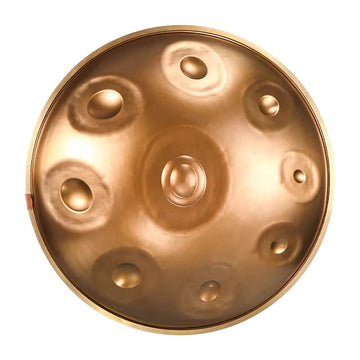
The handpan is an idiophone percussion instrument made primarily of metal, measuring about 55 cm (22 in) in diameter and 25 cm (10 in) tall. It consists of two convex shells, shaped like soup plates or woks, that are hammered and welded together around the edges to give it the shape of a flying saucer.
On the handpan’s upper shell, you’ll see circular or elliptical areas. These are the “tone fields” you strike to produce sounds. Each tone field corresponds to a musical note. The note at the very centre of the handpan is called the “ding”, while the opening in the lower shell is called the “gu”. This opening allows the instrument’s entire body to act as a resonating chamber. On some handpans with many notes, tone fields may also be found on the lower shell.
One of the major advantages of this instrument is that it’s impossible to play a wrong note on it. During production, each tone field is precisely tuned through a lengthy hammering process and corresponds to a specific note. As a result, this instrument is ideal for people who have never studied music theory.

How do you play this unusual instrument?
The handpan is a percussion instrument, so you strike its tone fields with your hands or with sticks called mallets. Handpan music is highly intuitive, and there isn’t much sheet music available. Most players compose their own melodies and let themselves be carried away by the instrument’s enchanting sounds.
The handpan can rest directly between your legs or be placed on a stand.
This very simple playing technique, combined with the fact that no special musical knowledge is required to learn, makes the handpan highly accessible to beginners.
Below is a video by Sam Maher, an excellent handpan musician, showing you how to play this UFO-shaped instrument:
The origins of the Hang
The handpan, handpan drum, or Hang was created in Switzerland by Sabina Schärer and Felix Rohner in 2000. To create this instrument, which resembles an unidentified flying object, they drew heavily on the steel drum and the ghatam, two other musical instruments originating from Trinidad and Tobago and India, respectively.
The handpan was so successful that its creators’ production capacity couldn’t keep up with demand. Since no patent was immediately filed, several other companies began manufacturing handpans, further boosting the instrument’s popularity in the music world. Today, the handpan continues to captivate more and more people with its magical sounds.
Is it a UFO? No, it’s a tongue drum!
In addition to the handpan, another musical instrument also looks like a spacecraft. It’s the tongue drum, which we’ll explore now.
What is a tongue drum?
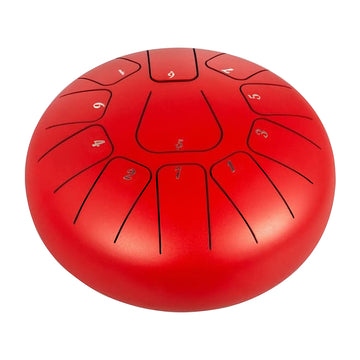
Like the Hang, the tongue drum is a percussion instrument in the idiophone family. It’s made from two steel shells welded together to create its UFO-like appearance. Its dimensions vary widely. You can find very small models measuring about 15 cm (6 in) in diameter and much larger ones that are three times that size.
Tongue-shaped cut-outs are made in the upper shell using a tool such as a grinder or laser. This distinctive cut-out pattern gave the instrument its name: the “tongue drum”. Some tongue drums have an opening in the lower shell that allows the instrument’s entire body to act as a resonating chamber.

Just like the handpan, it’s impossible to play a wrong note on the tongue drum. Each tongue is precisely cut and tuned, making the instrument particularly popular with beginners.
How do you play this exotic musical instrument?
To play the tongue drum, you strike the instrument’s tongues to create vibrations that resonate through its steel body. You can play it directly with your hands, using finger guards, or with drumsticks or mallets, which are widely used with this musical instrument.
The tongue drum can be placed directly on the floor or a table when it has non-slip rubber feet on its lower shell. Otherwise, it can be played between your legs or on a stand.
You can find plenty of tongue drum sheet music online for playing melodies such as “Pirates of the Caribbean”, “Bella Ciao”, and “The Sound of Silence”.
Below is an example of Ed Sheeran’s song “Perfect”, which you can play on this musical instrument:
The origins of the steel tongue drum
The tongue drum, or steel tongue drum, is actually a cousin of the handpan discussed earlier. Its creator, American Dennis Havlena, developed it in 2007. Drawing on the handpan’s design but using the rounded section of a used 13 kg (28 lb 10.6 oz) gas cylinder, he came up with the idea of cutting tongue shapes into the cylinder’s metal to produce sounds. To tune the tongue drum more precisely, neodymium magnets of different sizes and weights are placed on the tongues inside the instrument, slightly altering their vibrations to produce the desired note.
Here is Dennis Havlena’s video presenting the tongue drum prototype:
Since then, the instrument has been refined and professionalised. The cut-outs are now made more precisely, and the tongue drum’s appearance has evolved from that of a gas cylinder to that of a flying saucer, making it more portable and visually appealing.
The tongue drum is also called a “steel tongue drum”, “tank drum”—a reference to the gas cylinder used to create the original instrument—or “hank drum”, a blend of “tank” from “tank drum” and “Hang”, another name for its cousin, the handpan.
What are the differences between a handpan and a tongue drum?
Although these two musical instruments look similar and are even cousins, there are several important differences to explore.

A fundamental design difference between these two instruments
Once you look beyond the very similar shapes of these two instruments, you can see a difference in how the handpan and tongue drum are made.
The handpan’s upper shell has no cut-outs; its metal is hammered into the desired shape. In contrast, the tongue drum’s shell is directly machined and cut. At a glance, an experienced musician can therefore distinguish between a handpan and a tongue drum.
This design difference directly affects the sounds produced by these two musical instruments. The handpan tends to resonate much more and is more sensitive than a tongue drum.

The price difference between a handpan and a tongue drum
The different manufacturing techniques described above obviously affect the prices of these two instruments—and in this case, the impact is significant.
It’s important to understand that while a tongue drum requires only a “simple” cutting process using a grinder—or a laser for higher-quality models—a handpan requires many hours of work by experienced craftspeople, who hammer the shell’s metal with highly specialised tools to give it the proper shape.
For example, while you can find entry-level 8- to 10-note tongue drums for around £60, a 9-note handpan will cost about £850. This significant price difference is justified by the immense amount of craftsmanship required to create a high-quality handpan.
Where can you buy an instrument like a handpan or a tongue drum?
Since handpans and tongue drums are still relatively rare and exotic instruments, it can be difficult to find a wide selection that meets everyone’s needs. Nevertheless, let’s explore the available options.

Online
The internet currently offers the best selection. You can find handpans and tongue drums in different sizes, with varying numbers of notes, and in the tunings of your choice.
At the Instruments du Monde shop, you’ll find a collection of over 50 tongue drums as well as a collection of over 100 handpans.
In a physical shop
You also have the option of visiting a physical shop, where you can test the instrument to determine whether it’s right for you. However, the selection will be very limited—if these instruments are available at all—and prices will also be higher.
Second-hand market
At certain events, you may come across second-hand musical instruments. Again, the selection is likely to be very limited, and the quality may not meet your expectations, but this option remains appealing in terms of price.
However, if this is your first purchase or you’re unfamiliar with these instruments, we recommend avoiding this option so you don’t get scammed into buying a broken instrument.

Travel through space with an exotic beginner-friendly instrument!
As you’ve gathered, two musical instruments resemble alien spacecraft: the handpan and the tongue drum. It’s important to distinguish between them because both their construction and prices vary greatly depending on the instrument. After reading this article, however, you’ve become a true expert on the subject. You’ll be able to distinguish between these two musical instruments at a glance and tell your friends and family about the origins and construction of these curious instruments that resemble flying saucers or turtle shells.
Perhaps one of these two instruments has charmed you so much that you’re planning to learn how to play it?
That’s perfect because neither the handpan nor the tongue drum requires any previous musical knowledge, including music theory. As the more affordable option, Instruments du Monde offers dozens of tongue drums so everyone can find the right instrument.
Enjoy the relaxing benefits of this musical instrument by clicking the image below:
Have you heard of the percussion instrument that looks like a kalimba embedded in a frame drum? It’s called a sansula, and we invite you to learn all about it in our article. Read our article about the sansula to deepen your knowledge of exotic musical instruments even further.


