



Written by Ambre Montespan - Updated on Sep 25, 2026

Table of contents:
Do you own a Tibetan singing bowl and want to learn how to use this Asian instrument for meditation? Want to deepen your contemplative state with a Tibetan bowl, like Buddhist monks do? Curious about all the benefits that deep meditation with this musical instrument can bring?
I’ve been a committed meditation practitioner for over two decades, and five years ago I started adding a singing bowl to my sessions to take them further. I noticed a real difference—and only positive results. In this guide, I’ll show you how you can use the unique qualities of this instrument to reach a meditative state, too.
To meditate effectively with a Tibetan bowl, find a quiet, comfortable space, sit with good posture, hold the bowl correctly, and focus on its tones while letting your thoughts pass.
Once you’ve read this article in full, you’ll learn about:
- The benefits of meditation using a Tibetan singing bowl
- The best methods for entering a meditative state with this musical instrument
- How often you should practice in order to achieve good results
This will enable you to significantly improve the effectiveness of your meditation sessions. You’ll experience real benefits, both physically and mentally, to support your day-to-day well-being.
Get ready to slip into deep contemplation as we explore, together, the secrets of meditating with a singing bowl.
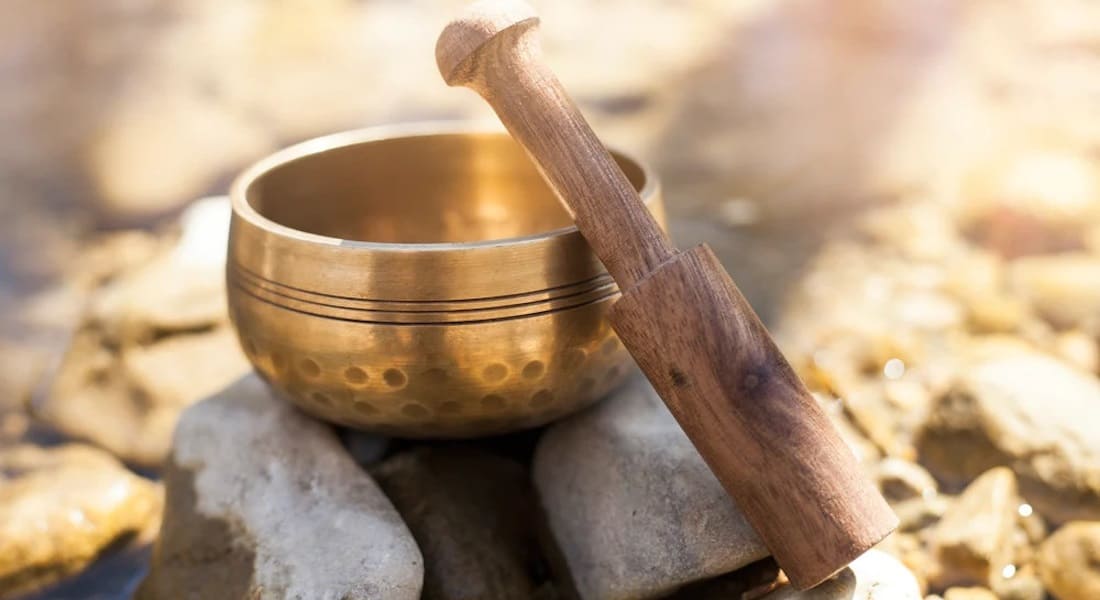
Why practice mindfulness meditation with a Tibetan bowl?
When I tell beginners that I regularly meditate using one of my Tibetan singing bowls, the first question I’m usually asked is: "But why meditate with this musical instrument?" The answer is simple. On the one hand, scientific research has confirmed what Buddhist, Taoist, and Hindu monks intuitively understood hundreds of years ago: meditation has a very beneficial impact on the human body and mind. It’s a mental relaxation technique that, among other things, can strengthen the immune system, reduce stress and anxiety, and improve concentration.
On the other hand, using a Tibetan singing bowl can strengthen mantra meditation. Well known to yoga practitioners, mantra meditation involves repeating a short sound at a steady rhythm, usually made with the voice, so you can focus on it and quiet the mind. Some meditation experts see the mantra as a sacred hymn built on the power of sound. In our case, the tones of the Tibetan bowl can replace the mantra during your session. Personally, I find it easier to clear my mind with this instrument, and the effects feel even stronger when I use it.

A study dated September 30, 2016, conducted by professors and doctors at the University of San Diego in the United States, highlighted the benefits of using singing bowls in this context. Entitled "Effects of Singing Bowl Sound Meditation on Mood, Tension, and Well-Being," this study noted a decrease in stress, depression, pain levels, and blood pressure in a panel of 62 people. Other research has also shown that it’s easier to enter a deep meditative state with the help of an instrument’s sound. For more details, take a look at this article on the benefits and virtues of Tibetan singing bowls. All the advantages of this instrument will then be revealed to you.
So if you want to deepen your meditative state, or if you struggle to quiet your thoughts, adding a Tibetan singing bowl to your practice is an excellent idea. Let’s look at how to do it.
How can you enter a state of contemplation with a singing bowl?
Using a Tibetan bowl for meditation isn’t something you can improvise. First, you’ll want to go through a short preparation phase before you can clear your mind with the help of this Asian instrument.
Prepare your instrument and focus in silence
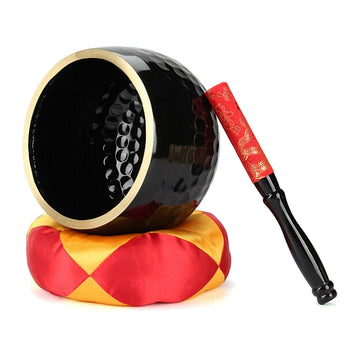
If you own more than one, the first step is to select your singing bowl. Depending on the note your bowl produces, it can be associated with a different chakra. For guidance, check out this guide explaining which note to choose for your Tibetan bowl. This will help you target the specific energetic benefits you’re looking for.
Once you’ve chosen your bowl, it’s essential to find a quiet place with as little background noise as possible and spend a moment in silence to relax—an ideal introduction to meditation. Sit in the position that feels best to you and try to enjoy this release by focusing on your breathing. Inhale through your nose and exhale through your mouth, expanding your belly rather than your chest.
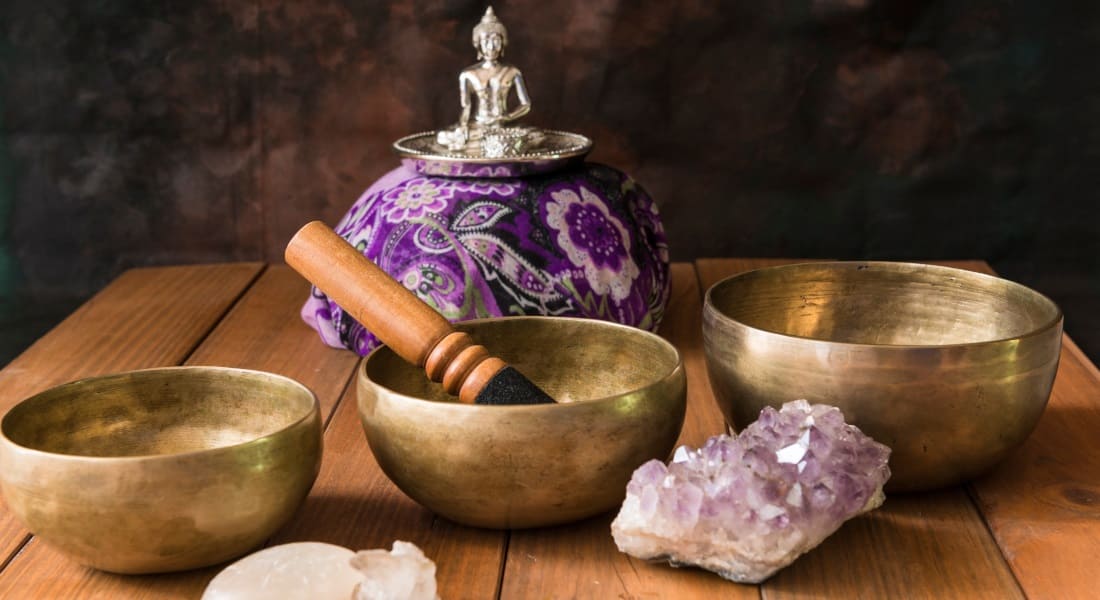
The length of this silent time should match the time you have for your session. For example, in a 20-minute session, try relaxing for one to two minutes. Don’t use a stopwatch or alarm to mark the end of that time. If it lasts a little longer or shorter than expected, it truly doesn’t matter. You can, of course, prepare any accessories you usually use to help you meditate, such as incense or crystals if you’re into crystal therapy.
Find the right posture for contemplation with the singing bowl
The next step is to position yourself correctly. Find a comfortable posture you can maintain for a while without discomfort that could keep you from reaching a contemplative state. One of the best options is the lotus position, half-lotus, or simply sitting cross-legged if you’re not flexible enough. When seated, your legs should be crossed, your back straight without over-arching your lower back, and your head aligned with your spine. Sit on a comfortable support such as a cushion or your bed mattress.
Hold your Tibetan bowl correctly to relax properly
Holding the singing bowl correctly is one of the most important steps you need to master. If you hold your musical instrument incorrectly, you’ll quickly feel pain in your forearm, which can prevent you from fully enjoying this spiritual exercise of meditation. Follow these guidelines to make sure you’re in the best possible conditions for relaxation.
- If you're using a small Tibetan bowl, hold it in your hand with your palm flat and your fingers slightly open so the vibrations can resonate freely.
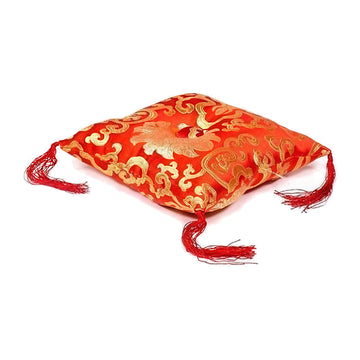
- If you have a large singing bowl, rest it on a cushion made for this instrument, placing the cushion on a hard surface close to you.
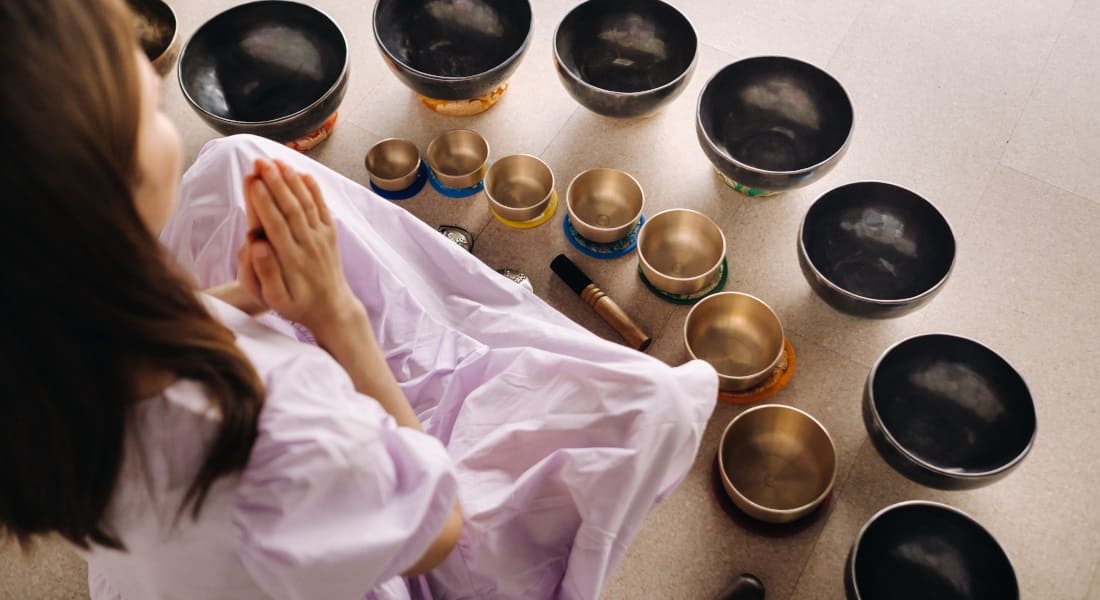
These rules are essential because of the instrument’s weight. You’ll need to stay in the position described above for a while before entering a deep meditative state. However, some singing bowls can weigh several pounds (a few kilograms), and holding one for several minutes can tense your muscles, making meditation impossible. So it’s up to you to choose between the two approaches above based on your body type and comfort level—either holding the Tibetan singing bowl or resting it on a cushion.
If you choose to hold it, you can rest your forearm on your leg or knee to relieve strain, while making sure the instrument isn’t touching any other part of your body besides your hand, which should remain open and flat. If possible, remove rings and other jewelry from the fingers holding the bowl to avoid distracting metallic rattling. If you prefer to rest the singing bowl, don’t skip the cushion: placed directly on a hard surface, it can create unpleasant sounds and shift slightly due to the vibrations. As for cushions, I personally prefer donut-shaped ones, which guarantee good acoustics.
Let the instrument’s sound carry you away
Now that you know how to prepare properly, let’s move on to the core of the practice. You have two techniques for clearing your mind that are well known to Tibetan singing bowl enthusiasts. One is the "striking" technique, and the other is called the "rubbing" technique.
The striking technique is the simplest. All you need to do is take your stick, mallet, or striker and gently tap the outer wall of the instrument. Because every singing bowl is unique, there’s usually a sweet spot that produces a longer, more pleasant tone. It’s up to you to find it with a few tries. Over time, you can strike a little more firmly to find the right balance between volume, which shouldn’t be too loud, and sustain, which ideally should last as long as possible.
The rubbing technique makes the Tibetan bowl sing. Start by striking the bowl once as described above to create what’s sometimes called an "impulse." Then move your mallet in circles, rubbing the outside wall of the singing bowl in a steady motion without going too fast. This way, the bowl will keep producing sound as long as you continue the circular movement. However, the rubbing method can be harder to use during meditation because it requires more effort and precision, which can pull you out of a deep reflective state. It takes more practice to become effective and feel automatic.
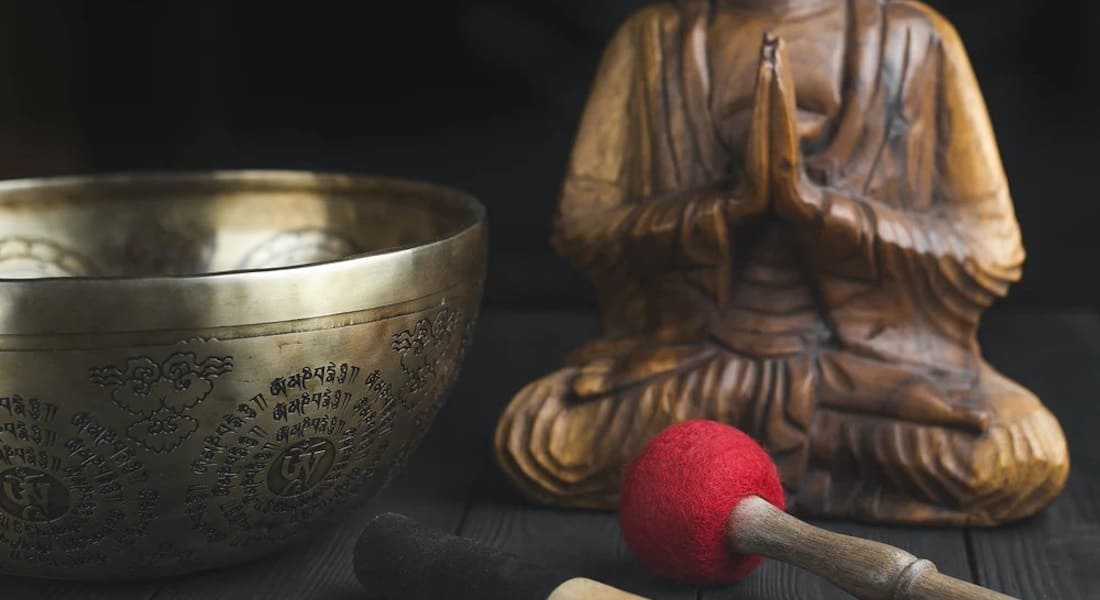
Once you’ve mastered one or both techniques, use them to create sound with the singing bowl. The pure, crystalline tones you generate should help you enter a meditative state. Focus only on these sounds, especially the sustain—the bowl’s ability to hold a note after being struck or rubbed. Feel the vibrations and imagine them spreading through your body and the space around you. You can also work on your abdominal breathing as described earlier.
At this point, you have two options. You can keep playing the singing bowl if you feel it helps, or you can stop. If you enter a contemplative state, you’re not required to keep using the instrument. Some practitioners prefer to, others don’t. Trust your instinct to create the most Zen, relaxing session possible. To guide you and help you confirm that you’ve absorbed everything we’ve covered, watch this short video showing an example of a meditation session using a Tibetan bowl.
Using alternative techniques with the bowl to enhance the meditative state
There are several highly effective variations of meditation with a Tibetan bowl. These include using this musical instrument with water, guided meditation, and the use of singing bowls made of quartz crystal.
1 – Relax with a quartz crystal singing bowl
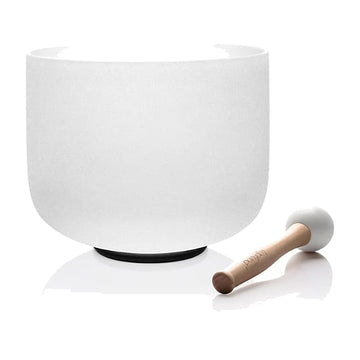
Singing bowls aren’t only made from metal alloys. In recent years, another type of instrument has become popular: bowls made from quartz crystal. Highly appreciated by practitioners of crystal therapy, who enjoy combining this approach with what a Tibetan bowl can offer, crystal bowls produce a different sound from metal ones.
So it can be really interesting to try meditating with this kind of singing bowl for a new, different, even complementary experience. Some people love them so much that they only do their meditation ritual with this type of instrument. Others don’t feel anything special. Personally, I can only recommend giving it a try, because I truly enjoy the rich, complex sound of quartz.
2 – Be Zen by using a Tibetan bowl filled with water
Several decades ago, Tibetan bowl musicians discovered that by putting a liquid inside the bowl while making it sing, the water begins to vibrate in a way that can look like it’s levitating or boiling. Some people also believe this practice “charges” the water with positive energy.
In meditation, though, that visual effect matters less. The real goal is to enjoy the gentle crackling sounds of the water—which I personally find very soothing—to slip into a state of mindfulness more easily. This technique won’t work for everyone, because not everyone responds to it the same way, but it’s absolutely worth trying. To learn how to do it, check out our free guide on how to make water vibrate with a Tibetan bowl. You’ll see it’s simple and accessible to everyone, even if you’ll want to follow a few small recommendations. You can also watch the video below to see the result:
3 – Enjoy a guided meditation session
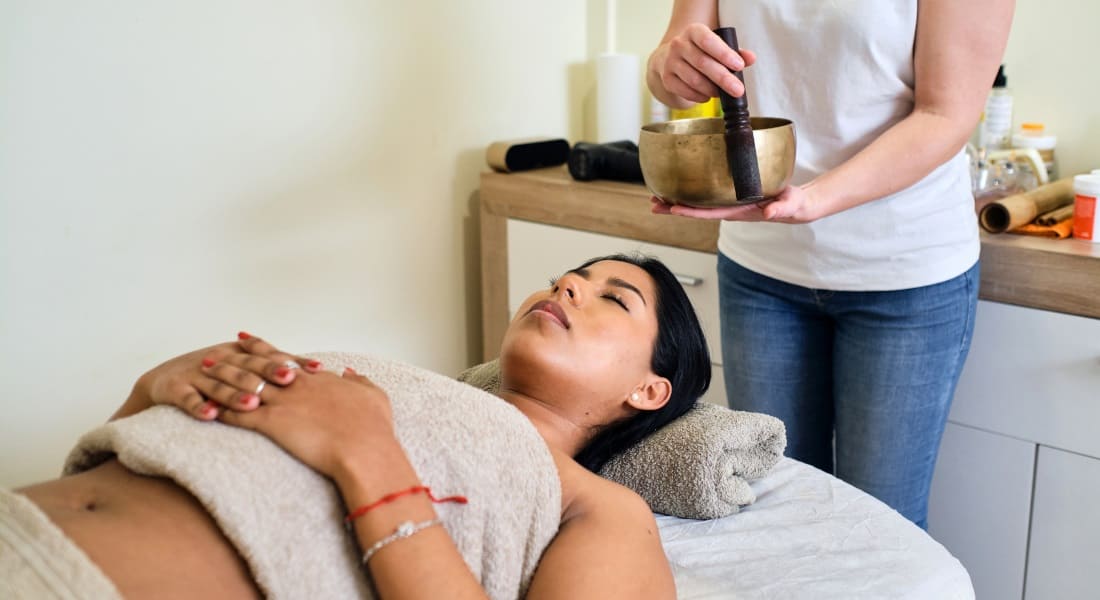
Guided meditation is, as its name suggests, a session led by a "guide," meaning an experienced practitioner who can help a person—or a whole group—enter a meditative state more easily. This approach has a major advantage: it allows participants to fully rest. They can stay in the position they prefer, often lying on their backs with their eyes covered, and simply focus on the sounds without needing to move to play the Tibetan bowl.
On the other hand, the guide will rarely be able to meditate at the same time, because they’ll be speaking regularly to help others create mental images that will promote meditation. In addition, these sessions are usually paid, unless you’re close to the practitioner supporting you on your meditative journey.
How often should you meditate with your musical instrument?
As with many practices, when it comes to meditation, regularity is more important than quantity. It’s better to do five 10-minute sessions per week than one hour-long session in the same week.
That said, meditation should never become a constraint—something you force yourself to do just to get it over with. If your days are packed and you don’t have the time or desire to do a session, don’t push yourself to do it every day. Instead, meditation should become a pleasure you give yourself regularly, at a rhythm that fits your life. Think of it like a little pocket of serenity in your day, week, or month. For some, it’s 10 minutes in the morning before the rest of the family is up. For others, it’s 20 minutes at night before sleep. Stay flexible so meditation remains a true moment of deep relaxation.
What is the best Tibetan singing bowl for meditation?
Meditation using a Tibetan singing bowl is a discipline that can’t be improvised. You need to adopt good posture—both in how you sit and how you hold the instrument—to reach a contemplative state. Intense focus on the sounds and vibrations created by the different techniques is also essential. But thanks to the advice you’ve just learned, you’ll be able to refine your meditation sessions with this Asian instrument and improve your daily well-being.
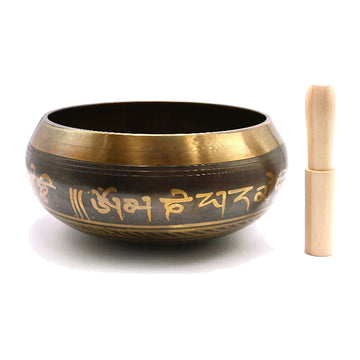
That said, not all singing bowls are equally suited to this spiritual development practice. Some produce a sound that’s too loud or harsh, while others generate strong vibrations intended more for sound massage. That’s why Instruments du Monde strongly recommends a seven-metal Tibetan bowl with gentle tones, designed for meditation and available in a range of eight different diameters to suit every deep-relaxation enthusiast.
Get the singing bowl that will help you enjoy a better meditation experience by clicking on the image below:
As you can see, meditating with a Tibetan bowl brings many benefits to the body and mind. But that’s not the only benefit of this musical instrument. In fact, it appears that singing bowls may also support people living with cancer. Learn more by reading our article, which will give you all the details about the links between Tibetan singing bowls and this disease.


