



Written by Ambre Montespan - Updated on Sep 25, 2026

Table of contents:
Are you interested in trying meditation or relaxation with a handpan? Not sure whether it’s possible or within your reach? Do you need to know how to play this percussion instrument to truly enjoy all its benefits? Which instrument should you choose to feel calmer in just a few notes?
I’ve been playing the handpan for more than 10 years and have a strong interest in music therapy, so I sometimes take a few minutes to meditate with this flying-saucer-shaped sound object. That means I can share all my tips so you can enjoy it, too.
Even if you’ve never touched a handpan and you aren’t a musician, it’s perfectly possible to meditate with a handpan or simply use it to relax and unwind. The method is very simple.
In this guide, you’ll discover:
- Why a handpan can help you feel calmer than a more traditional instrument
- What scientific studies have shown about rest and relaxation
- The right way to meditate with a handpan
- Which instrument model will be most effective for guiding you through this practice
That way, you’re sure to have all the information you need to learn how to meditate and relax with the right instrument. You’ll then be able to significantly improve your daily quality of life and well-being.
Now, let’s look together at why the handpan is so well suited to producing a relaxing effect.
Why do the sounds of the handpan have a relaxing effect?
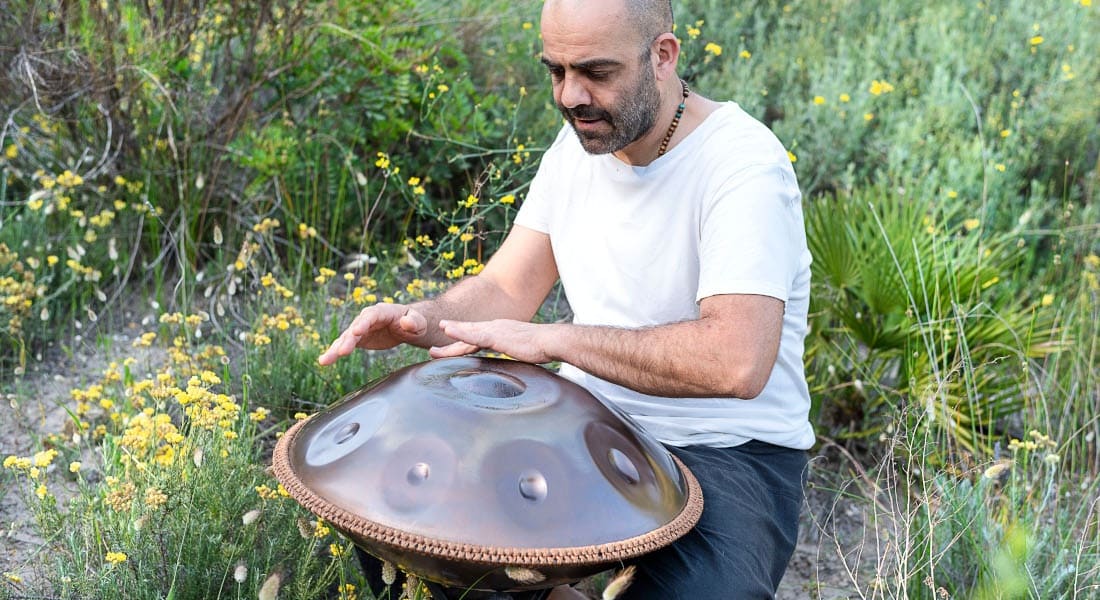
The handpan is no ordinary metal drum. Each note on this percussion instrument has been hammered and tuned by hand to produce vibrations with simple but effective frequency relationships: the fundamental, its octave, and its twelfth (also called the duodecim). So when you strike a note on the handpan, three very specific frequencies that are connected to one another actually vibrate, creating a sound that is especially melodic to our ears.
And this isn’t just a marketing claim. In 2009, musical acoustics physicists Thomas Rossing and Andrew Morrison measured these frequencies using holographic interferometry and published their results in Physics Today. They were also working directly with Felix Rohner and Sabina Schärer, founders of PANArt, the company that created the Hang drum and later the handpan. In fact, it’s the only solid scientific literature that exists on this instrument. The result of this blend of frequencies is simple: the sound is perceived as consonant and pleasant. There is almost no roughness, making it an ideal instrument for unwinding, relaxing, or meditating.
Alongside these frequencies, another reason the handpan creates a sense of calm is its especially deep, long-lasting sound. Made from two lenticular shells, the handpan has a large resonating body with a single outlet hole underneath, known as the Gü. This cavity produces a low resonance that supports all the other musical notes. It is also what explains the handpan’s exceptionally long sustain.
Finally, it’s also worth mentioning that the handpan produces no wrong notes. Since it is tuned during manufacturing, the player cannot, unlike with a violin for example, make a mistake that could ruin their concentration or their moment of relaxation. With the handpan, everything is fluid and harmonious, which plays a major role in putting it among the best instruments for relaxation.

Does science validate the handpan for sound or music therapy?
Let’s say it right away: no scientific study focuses specifically on the handpan in a meditative context. Absolutely none. It would be interesting to fill that gap if any scientists are reading this article. What does exist concerns related instruments, mainly singing bowls, and relaxing music in general.
As for what is based on real evidence, two studies are worth mentioning. The first, published in 2017 in the Journal of Evidence-Based Complementary & Alternative Medicine by Tamara Goldsby and her team, followed 62 participants before and after a singing bowl sound meditation. Decreases were observed in blood pressure, anger, fatigue, and depressed mood. The second, conducted in 2023 by a Chilean team, was published in the European Journal of Investigation in Health, Psychology and Education. It was a randomized controlled trial involving 50 people with anxiety, divided into three groups: Tibetan singing bowls, Jacobson’s progressive muscle relaxation, and a waiting list. The group selected for the Tibetan singing bowl sessions showed a greater reduction in anxiety than the others.
As for the handpan, its long sustain, harmonicity, and consonance, in my opinion, make it easier to slow the breath and anchor attention. And that remains perfectly consistent with what has been proven about the benefits of relaxing music. I say “in my opinion” because a scientific study is still missing to prove it.
However, the handpan has limitations that should be made clear. I often hear or read three claims that are partially or completely false:
- “The handpan heals”: No, the handpan does not heal. It is a musical instrument used for well-being, not medical care. At most, it can accompany care, but it’s best to speak with a medical professional beforehand.
- “89% of participants in a University of Paris study,” “−30% cortisol,” or “INSERM confirms”: These are claims or statistics with no source whatsoever. There is a very strong chance that all of it is invented. As I just explained, the only solid study on the handpan is the one published in 2009 in Physics Today, and it does not address well-being.
- “The handpan synchronizes alpha and theta brain waves”: The hypothesis of brainwave entrainment through sound has been studied for decades, mainly through binaural beats. A systematic review published in PLOS One in 2023 compiled the available research: the majority reported negative results. Five studies support the hypothesis, while eight find nothing. It can be discussed as a possible avenue. Not as a fact.
How do you meditate with a handpan?
There are two ways to meditate with a handpan. One is active meditation, which means playing your instrument with the goal of relaxing. The other is passive meditation, where the person benefiting from the session simply listens to the instrument’s sounds. It’s useful to look at these two methods one after the other.
For active meditation with a handpan, you’ll be the one playing the notes on your instrument. First, find a quiet place and set aside a moment just for yourself by turning off anything that could interfere with it, such as your smartphone, tablet, or other devices. Get into the position that feels best and that you can hold comfortably for a few minutes. You can absolutely use accessories such as a chair, cushions, or even a mat. Most people sit with the handpan resting on their thighs and their elbows free.
Finally, the most important point: don’t try to compose a melody. You’re not here to recite a score or a combination of notes you saw on YouTube. Let your instinct guide you. Choose three or four anchor notes, no more, and strike them lightly with your fingertips. The motion should bounce, not crash into the steel. Then align the rhythm with your breath rather than the other way around. One strike on the exhale, silence on the inhale. Let the resonance fade completely before the next note. That silence between two strikes is the most important part of the exercise: it’s where your attention settles. After a few minutes, let go of the instruction and let your hands move without deciding in advance. If a pattern forms, keep it and circle around it. If it falls apart, that’s fine. This way, you don’t need to know how to play your instrument, or even how to read music.
Consistency is more important than duration in meditation. So I recommend doing short ten- to twenty-minute sessions three times a week rather than a single one-hour session over the same period. You can absolutely play outside if the weather allows.
When it comes to passive meditation, it can also be called guided meditation since the person simply listens without playing the handpan. That means you need a recording or, even better, someone available who knows how to play the handpan. There are also group sessions known as “sound baths.” These sessions usually last between 30 and 90 minutes. However, even though I tend to prefer passive meditation with a real musician playing next to me, no study proves that a recording, such as a YouTube video, would be less effective. Personally, though, I prefer the acoustics of a real handpan placed just a few inches from me. During a passive meditation session, all you have to do is focus on the sounds you hear and let your mind go wherever it wants to go. You can also clear your mind, stop thinking about anything, and live in the present moment. Here’s an example you can listen to:
Is there an instrument model that’s better suited to calm or relaxation?
Yes, some handpans are more interesting than others if your only goal is relaxation or meditation. There are three criteria you should pay special attention to: the scale, the frequency, and the material.
- The scale : Since a handpan’s tuning is fixed, the scale cannot be changed later, and it determines which notes will be placed on your future instrument. For meditation and relaxation, I primarily recommend a D Kurd model, which is the benchmark and by far the best seller. It offers enough notes to tell a story, which makes it inexhaustible over the long term. If you’re unsure or don’t have a specific idea in mind, this is the one to choose. I’ve written a dedicated article on handpan scales if you want to learn more. Take a look.
- The frequency : You’ll have the choice between 440 and 432 hertz. A at 440 Hz is the international standard (ISO 16), set in London in 1939 and then standardized in 1955. Almost all musical instruments are tuned to this frequency. 432 hertz is said to be closer to nature and soothing, but no scientific study has actually validated that. Read my article dedicated to 440- and 432-hertz handpans to get a better idea.
- The material : There are 3 materials used to make handpans: nitrided steel, stainless steel, and ember steel. The latter two have greater sustain and are therefore recommended over nitrided steel, which is better suited to percussive and energetic playing. Read my article comparing nitrided steel, stainless steel, and ember steel handpans for a clearer picture.
Calm yourself now with a handpan made for this purpose
Ironically, the handpan was never invented for well-being or relaxation. It was simply a sound sculpture. Twenty-five years later, it has become a pillar of meditation thanks to its long sustain, aligned harmonics, and the fact that wrong notes are impossible. You’ve now learned all of that through this informative article.
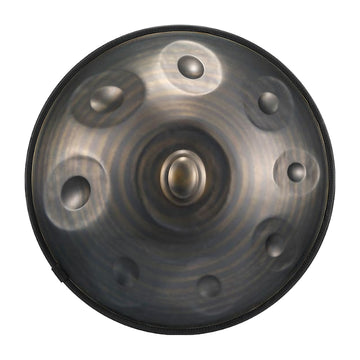
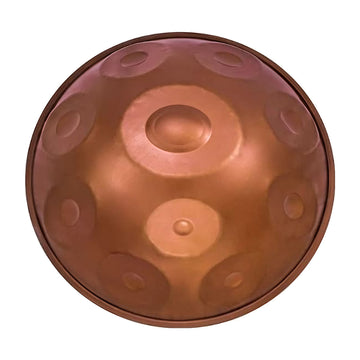
Still, even though the handpan has developed especially well over the years, finding a high-quality model dedicated to relaxation or meditation can sometimes be complicated. That’s why Instruments du Monde, a shop specializing in exotic instruments such as the handpan, offers a 10-note model designed for meditation, made of stainless steel and tuned to D Kurd. It will be ideal for helping you unwind during a well-deserved break.
Get this handpan now by clicking the image below:
On a related note, did you know the handpan can be used for yoga, zen practice and even chakra work? That's what I cover in this other article, which pairs perfectly with the one you're reading.


